Foundations of Topology
Compactness and Connectedness
Compactness
In everyday language, 'compact' means small and efficiently arranged. In topology, the meaning is similar but more precise. A topological space is compact if it isn't too large or spread out. It captures the idea of being 'contained' in a way that goes beyond just being bounded.
The formal definition: A topological space is compact if every open cover of the space has a finite subcover.
Let's break that down. An 'open cover' is a collection of open sets that, when combined, completely contain the entire space. Imagine trying to cover a line segment with a collection of smaller, overlapping open intervals. You've created an open cover.
A 'finite subcover' means you can throw away all but a finite number of those open intervals and still completely cover the original line segment. If you can always find such a finite collection, no matter how the initial open cover is chosen, the space is compact.
For example, the closed interval on the real number line is compact. Any collection of open intervals that covers it has a finite subcollection that also covers it. However, the open interval is not compact. It's missing its endpoints, and you can create an open cover where you need infinitely many sets to get closer and closer to 0 and 1 without ever reaching them. The entire real line is also not compact; it's unbounded, so you can't cover it with a finite number of finite-length intervals.
Heine-Borel Theorem
The abstract definition of compactness can be tricky to work with. Thankfully, for the familiar Euclidean spaces like the number line (), the plane (), or 3D space (), there's a much simpler rule called the Heine-Borel Theorem.
A subset of Euclidean space () is compact if and only if it is closed and bounded.
This is incredibly useful. Let's define those two terms:
- Closed: A set is closed if it includes its boundary. The interval is closed because it contains its endpoints, 0 and 1. The interval is open because it excludes them.
- Bounded: A set is bounded if you can draw a circle (or a sphere in higher dimensions) of a finite radius that completely contains it. The interval is bounded, but the entire real line is not.
So, a solid disk in the plane (including its circular edge) is compact. An open disk (without its edge) is not compact because it's not closed. A single quadrant of the plane, extending infinitely, is not compact because it's not bounded.
Connectedness
Connectedness is a more intuitive concept. A space is connected if it's all in one piece. You can't separate it into two or more distinct, non-touching parts.
Formally, a space is connected if it cannot be written as the union of two disjoint non-empty open sets.
Think of it this way: if a space is disconnected, you can find two open sets that don't overlap, whose union is the entire space, and neither of which is empty. The entire real line is connected. You can't split it into two disjoint open parts. However, the set consisting of the union of two separate intervals, like , is not connected. You can easily find two disjoint open sets, for example and , whose intersections with the set are the two original intervals.
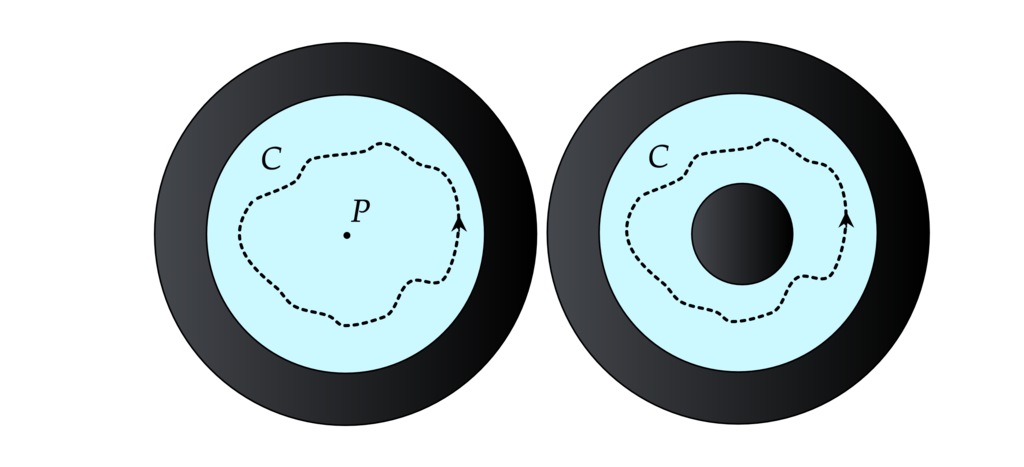
A circle is connected. So is a figure-eight, even though it intersects itself. As long as you can move from any point in the space to any other point without leaving the space, it's path-connected, which is a strong form of connectedness.
An Important Consequence
These properties aren't just abstract classifications. They have powerful implications, especially in analysis. One of the most famous results from calculus is actually a direct consequence of connectedness: the Intermediate Value Theorem.
If is a continuous function on a connected set, then its image is also connected.
When the output of the function is the real numbers, this means the function must take on every value between any two points in its range. A continuous function whose domain is 'in one piece' cannot have a range that 'jumps' over values. If you draw a curve from point A to point B without lifting your pen, you must pass through every height between A and B.
This is the essence of the Intermediate Value Theorem. The topological concept of connectedness provides the deep reason why this familiar theorem from calculus is true.
What is the formal definition of a compact topological space?
The open interval is not compact because it is not closed.
Compactness and connectedness are fundamental properties that help us understand the structure of spaces. They tell us whether a space is 'contained' or 'all in one piece', providing the foundation for many important theorems in mathematics.