Foundations of Statistical Physics
Microstates and Macrostates
The View from the Inside
Imagine a room full of air. From the outside, you can describe it with a few simple measurements: temperature, pressure, and volume. This overall description is a macrostate. It gives you the big picture without any of the messy details. Now, imagine you could see every single air molecule in that room—its exact position, its speed, and its direction. That incredibly detailed, particle-by-particle snapshot is a microstate.
A macrostate is what we measure (temperature, pressure). A microstate is the specific arrangement of all the particles that produces that measurement.
For any given macrostate, there can be a staggering number of different microstates. The air in the room has a certain temperature because of the average kinetic energy of its molecules. Countless different arrangements and speeds of those individual molecules could produce the exact same average, and thus the same temperature. Statistical physics is all about connecting the microscopic details to the macroscopic properties we observe.
Counting the Possibilities
The number of microstates corresponding to a given macrostate is called its multiplicity, often represented by the symbol . Let's consider a simple system: four coins. The macrostate could be the number of heads we get. The microstate is the specific outcome of each coin (Heads or Tails).
| Macrostate | Possible Microstates (H=Heads, T=Tails) | Multiplicity (Ω) |
|---|---|---|
| 4 Heads | HHHH | 1 |
| 3 Heads | HHHT, HHTH, HTHH, THHH | 4 |
| 2 Heads | HHTT, HTHT, HTTH, THHT, THTH, TTHH | 6 |
| 1 Head | HTTT, THTT, TTHT, TTTH | 4 |
| 0 Heads | TTTT | 1 |
Notice that the macrostate "2 Heads" is the most likely. It has the highest multiplicity; there are more ways to arrange the coins to get two heads than any other outcome. For systems with a small number of particles, we can list all the possibilities. For systems with billions of particles, we need a more general formula. The number of ways to choose items from a set of is given by the binomial coefficient.
Entropy Is Just Counting
This idea of multiplicity is directly linked to one of the most fundamental concepts in physics: entropy. In the late 19th century, Ludwig Boltzmann proposed a revolutionary idea that connected the macroscopic property of entropy () to the microscopic world of states. His insight is immortalized in a simple, profound equation.
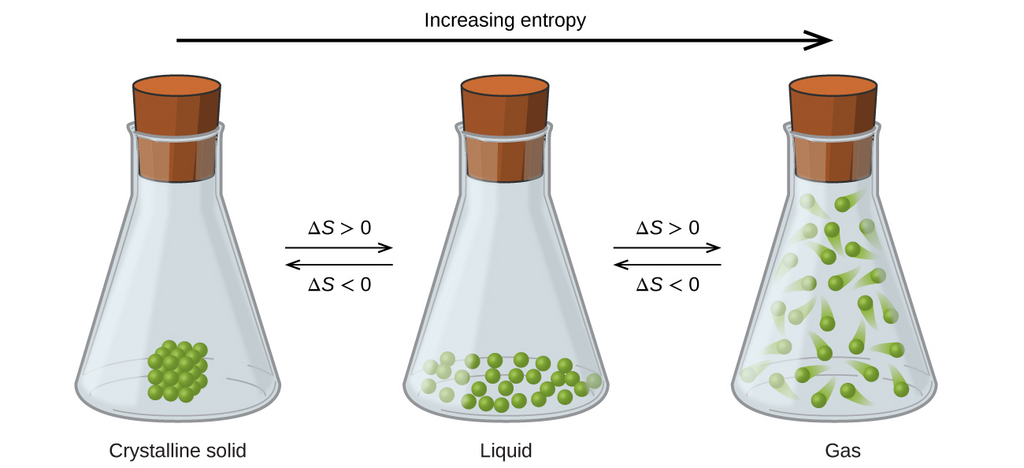
This equation is a cornerstone of statistical mechanics. It defines entropy in a new way. Entropy is a measure of the number of ways a system can be arranged. A macrostate with a high multiplicity has high entropy. A state with low multiplicity has low entropy. The logarithm is used to make the numbers manageable; multiplicity can be astronomically large, and the logarithm scales it down to a more practical value.
The Overwhelming Likelihood of Disorder
The second law of thermodynamics states that the entropy of an isolated system tends to increase over time. Boltzmann's definition gives us a powerful new way to understand why. It's not that a decrease in entropy is forbidden, it's just overwhelmingly improbable.
A system naturally evolves towards the macrostate with the highest multiplicity because that state has the most microscopic configurations. Think of the coins again. If you shake the four coins and toss them, you are most likely to get 2 heads. It's not impossible to get 4 heads, but it's six times less likely.
Now imagine instead of 4 coins, you have $10^{23}$ gas particles in a box. The state where all the particles are crammed into one corner has an incredibly low multiplicity. The state where they are spread out evenly has an unimaginably high multiplicity. The system will naturally move towards the spread-out state simply because there are vastly more ways to be in that state. This is the statistical basis for the arrow of time and why processes like a broken egg reassembling itself don't happen in nature.
An object’s entropy is described by microstates: the number of ways atoms can be rearranged to achieve the same macroscale object.
Understanding the link between microstates, multiplicity, and entropy is the first step in seeing how the predictable laws of thermodynamics emerge from the chaotic, random behavior of individual particles.
Which of the following best describes the relationship between a macrostate and a microstate?
In the context of statistical mechanics, what is 'multiplicity' (Ω)?