Foundations of Solid State Physics
Crystal Structures
The Orderly World of Crystals
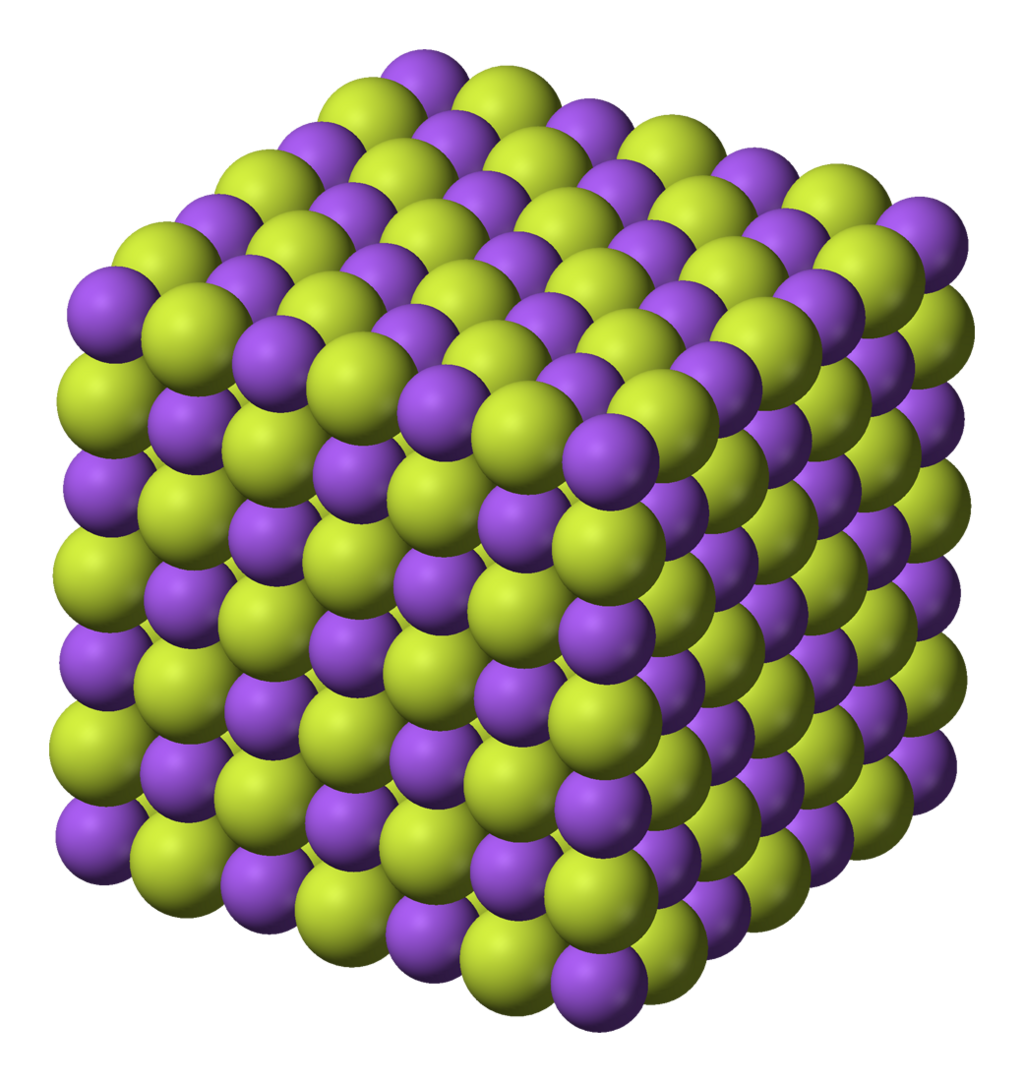
Most solids aren't just a jumble of atoms. In many materials, especially metals and minerals, atoms arrange themselves in a highly ordered, repeating pattern. This three-dimensional arrangement is called a crystal structure.
Think of it like perfectly repeating wallpaper. Once you identify the core pattern, you know how it will look everywhere else. In a crystal, this core pattern is made of atoms, and it extends in all three dimensions. The underlying framework for this pattern is a set of imaginary points in space called a lattice. Each point in the lattice has identical surroundings to every other point.
The Unit Cell
To describe a crystal structure, we don't need to specify the position of every single atom. We just need to find the smallest repeating block that can be used to build the entire crystal. This fundamental building block is called the unit cell.
Imagine a tiled floor. The unit cell is a single tile. By repeatedly placing this one tile next to itself, you can create the entire floor pattern.
A unit cell is defined by three vectors, , , and , which originate from one corner. The lengths of these vectors () and the angles between them () are known as the lattice parameters. These six parameters define the shape and size of the unit cell.
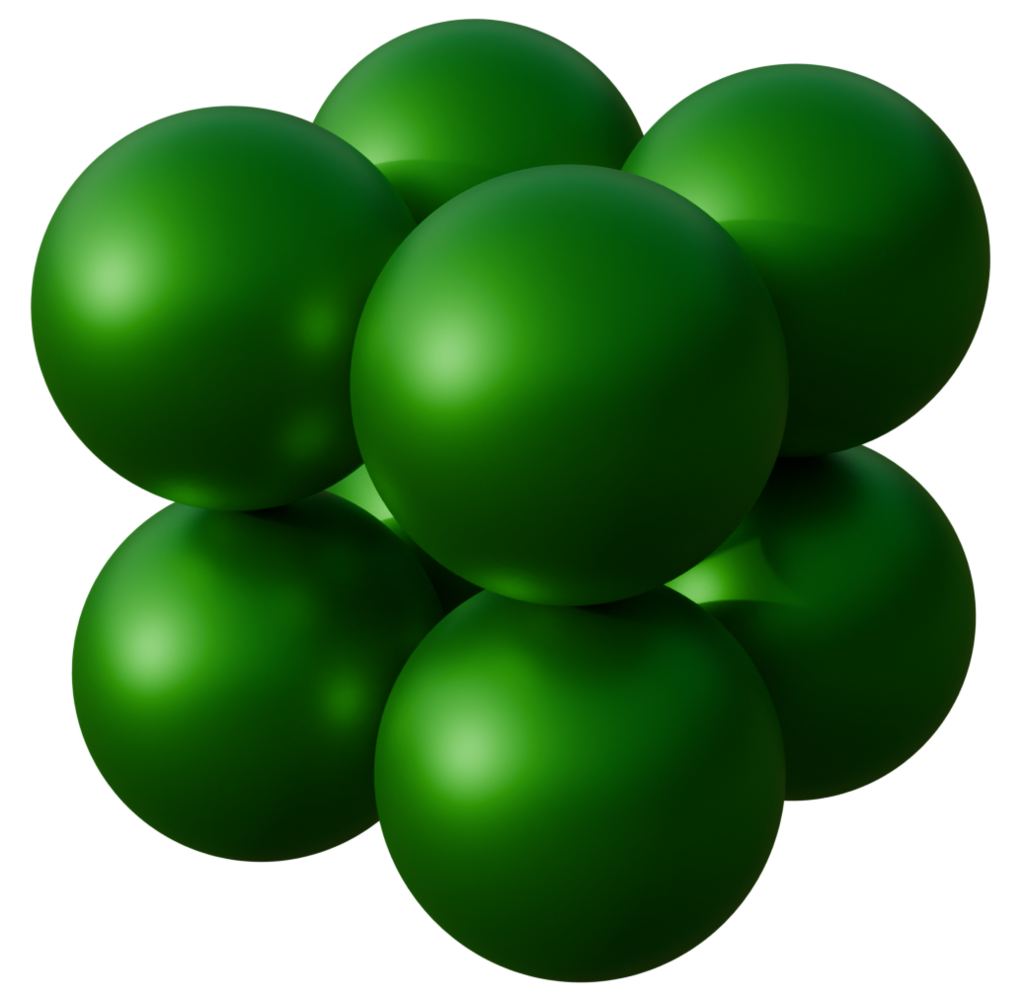
In three dimensions, the unit cell is a parallelepiped. One of the simplest 3D unit cells is the simple cubic (SC) structure. It has atoms only at the corners of a cube. This means its lattice parameters are and .
Bravais Lattices
It turns out there are only 14 unique ways to arrange points in a 3D lattice so that each point has an identical environment. These 14 arrangements are called the Bravais lattices. They are grouped into seven crystal systems based on the symmetry of their unit cells.
| Crystal System | Unit Cell Shape Conditions |
|---|---|
| Cubic | , |
| Tetragonal | , |
| Orthorhombic | , |
| Hexagonal | , |
| Trigonal | , |
| Monoclinic | , |
| Triclinic | , |
Within these systems, we can have different lattice types. Besides simple (or primitive) lattices with points only at the corners, we can have:
- Body-Centered (I): An extra point at the very center of the unit cell.
- Face-Centered (F): Extra points at the center of each of the six faces.
- Base-Centered (A, B, or C): Extra points at the center of two opposite faces.
Not all combinations are unique. For example, a face-centered tetragonal lattice is just a different way of looking at a body-centered tetragonal unit cell. When you eliminate all the duplicates, you are left with the 14 Bravais lattices.
Describing Planes and Directions
To talk about specific directions and planes of atoms within a crystal, physicists and materials scientists use a notation called Miller indices. This system provides a unique label for every possible plane and direction.
Miller indices are important because the properties of a material can change depending on the direction. For example, a crystal might be easier to scratch along one plane than another.
For a plane, the Miller indices are found by:
- Finding where the plane intercepts the crystal axes , , and .
- Taking the reciprocal of these intercepts.
- Multiplying by a common factor to get the smallest set of whole numbers.
For a direction, the indices are simpler. They are the vector components of the direction, reduced to the smallest integers.
Symmetry Operations
The defining feature of a crystal is its symmetry. A symmetry operation is an action, like a rotation or reflection, that leaves the crystal looking unchanged. These operations are fundamental to classifying crystals.
There are four main types of symmetry operations in crystals:
- Translation: Shifting the entire lattice by a vector that connects two lattice points. This is the most basic symmetry.
- Rotation: Rotating the lattice around an axis. In crystals, only 2, 3, 4, and 6-fold rotations are possible. A 5-fold rotation, for instance, cannot tile space without leaving gaps.
- Reflection: Reflecting the lattice across a mirror plane.
- Inversion: Projecting every point through a central point of inversion to an equal distance on the other side.
Combining these basic operations can create more complex ones, like glide planes (reflection followed by translation) and screw axes (rotation followed by translation). The complete set of symmetry operations for a particular crystal structure is known as its space group. There are 230 possible space groups, and they describe every possible crystal symmetry.
Let's test your understanding of these building blocks of solids.
What is the smallest repeating block of atoms that can be used to build an entire crystal structure?
Which of the following rotational symmetries is impossible for a crystal lattice because it cannot tile 3D space without leaving gaps?
Understanding these fundamental concepts of crystal structure is the first step toward analyzing the electronic, thermal, and mechanical properties of solid materials.