Foundations of Sociology for Class 11 India
Introduction to Sociology
What is Sociology?
Have you ever wondered why people in a lift stare at the floor, or why fashion trends change so quickly? Sociology is the study of these kinds of questions. It looks at human social life, groups, and societies. Instead of focusing on what makes individuals unique, it examines the patterns in how people behave together.
Think of it like looking at a forest. You could study a single tree, its leaves and bark. That’s like psychology, which focuses on the individual's mind. A sociologist, however, steps back to see the entire forest. They study how the trees interact, how they compete for sunlight, and how the whole ecosystem functions. Sociology does the same for human society.
Sociology is the systematic study of society and social behavior.
The scope of sociology is vast. It can analyse a brief encounter between two people on the street, or investigate global social processes like the rise of the internet. It examines everything from family dynamics and crime to social class and religion. The core idea is to understand the link between what society makes of us and what we make of ourselves.
The Birth of a Science
Sociology is a relatively new science. It emerged in the 19th century, a time of massive upheaval in Europe. The Industrial Revolution was pulling people from farms into cities, creating new social problems like overcrowding, poverty, and crime. At the same time, the French Revolution had overturned traditional forms of authority like the monarchy and the church.
People's lives were changing dramatically, and old explanations no longer seemed to fit. Thinkers at the time realised they needed a new way to understand this rapidly changing world. They wanted to study society scientifically, just as physicists study the natural world.
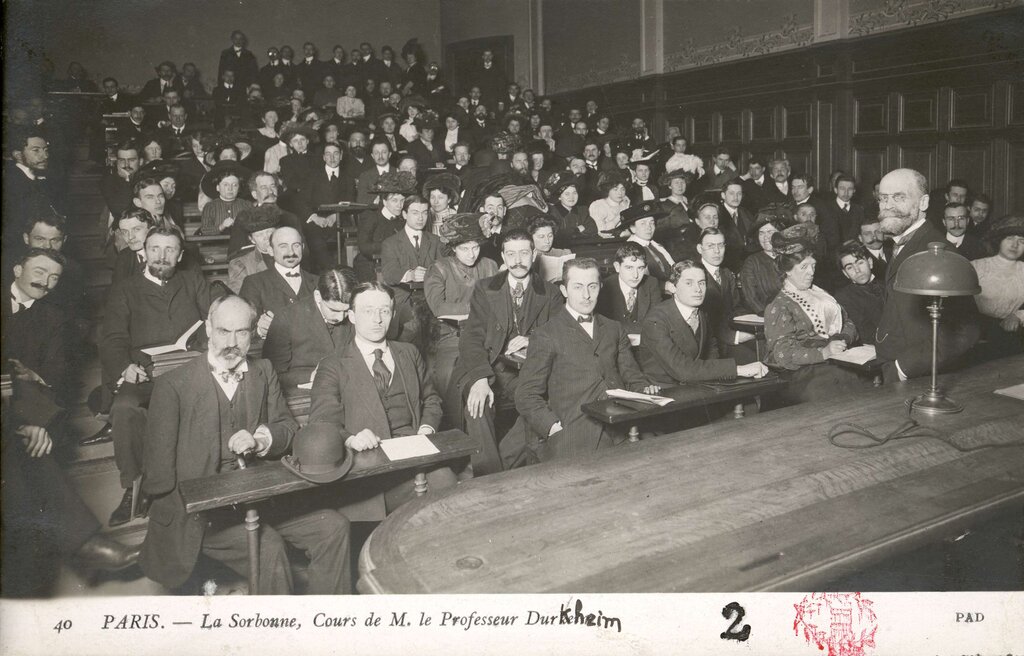
The French philosopher Auguste Comte first used the term "sociology" in 1838. He believed that this new discipline could discover the laws of the social world and help solve its problems. This marked the beginning of a systematic effort to analyse society not through superstition or common sense, but through careful observation and analysis.
Sociology and Its Neighbours
Sociology is part of the family of social sciences, which also includes psychology, economics, history, and political science. While they all study human society, they each look at it through a different lens.
| Discipline | Primary Focus |
|---|---|
| Sociology | Social structures, groups, and society as a whole. |
| Psychology | The individual's mind, emotions, and behaviour. |
| Economics | Production, distribution, and consumption of goods and services. |
| History | Past events and how they shape the present. |
| Political Science | Systems of government, power, and political activity. |
While these disciplines have distinct focuses, the lines often blur. A sociologist studying unemployment might use economic data to understand market trends, historical context to see how work has changed, and psychological insights into the effects of job loss on individuals. What makes the sociological perspective unique is its insistence on connecting individual experiences to broader social forces.
Society as a Complex System
Sociology encourages us to see society not as a random collection of individuals, but as a complex system. This system is made up of interconnected parts, like the economy, the political system, the family, and education. Each part influences the others.
For example, a change in the economy, such as a recession, can have ripple effects across the system. It can increase unemployment, strain family budgets, and influence political elections. Sociologists study these connections to understand how the system works and how it changes over time.
Thinking like a sociologist means making the familiar strange. It’s about questioning things we take for granted and looking for the social patterns that shape our lives.
By understanding society as a system, we can better grasp the social forces that influence our choices, beliefs, and opportunities. This is the foundational perspective that sociology offers.
According to the text, what is the primary focus of sociology?
In the "forest and trees" analogy, what does studying the entire forest represent?