Foundations of Scientific Literacy
Scientific Method
A Method for Asking Questions
Science is a way of understanding the world by asking questions and looking for evidence-based answers. The scientific method is the toolkit for this process. It isn't a rigid checklist, but a flexible framework that guides inquiry, helping us move from a simple observation to a well-supported conclusion in a structured way.
At its essence, the scientific method is a systematic procedure that researchers use to explore observations, answer questions, and test hypotheses.
Think of it as a cycle. An observation sparks a question, which leads to a potential answer, which is then tested. The results of that test feed back into our understanding, often leading to new observations and new questions. This continuous loop is how scientific knowledge is built, piece by piece.
The Steps in Action
Let's walk through the steps with a common scenario: you have a houseplant, and its leaves are turning yellow.
-
Observation: You notice the yellow leaves. You also know that plants generally need sunlight and water to be healthy. You see that this particular plant is in a dark corner of your room.
-
Hypothesis: This is your educated guess. It must be a specific, testable statement. A good hypothesis might be: "If the plant receives more sunlight, then its new leaves will grow in green." This is much better than simply guessing "the plant needs more sun."
hypothesis
noun
A proposed explanation for a phenomenon, made as a starting point for further investigation.
-
Experiment: Now you test your hypothesis. You could move the plant to a sunny windowsill. To make your experiment stronger, you might get a second, similar plant and leave it in the dark corner as a control. You'd give both plants the same amount of water.
-
Data Analysis: Over the next few weeks, you record your observations. The plant in the sun starts growing new, green leaves. The control plant in the corner does not. This is your data.
-
Conclusion: Your data supports your hypothesis. You can conclude that the lack of sunlight was likely the cause of the yellow leaves. If the plant hadn't improved, you would have rejected your hypothesis and formed a new one, perhaps about watering or soil nutrients.
The Rules of the Road
The scientific method has a few core principles that make it a reliable way to build knowledge. Two of the most important are falsifiability and reproducibility.
Falsifiability means that a hypothesis must be testable in a way that it could be proven wrong. The statement "All swans are white" is falsifiable because we can test it by looking for a non-white swan. If we find one, the hypothesis is false. A statement like "This plant is yellow because of invisible, undetectable energy" is not falsifiable, because there's no experiment we could design to prove it wrong. It's not a scientific hypothesis.
Reproducibility is the idea that if someone else follows your experimental procedure, they should get the same results. If an experiment can't be reproduced by other researchers, its conclusions are considered unreliable. This is a crucial quality-control check. It ensures that results aren't just a fluke or due to a mistake in one specific lab.
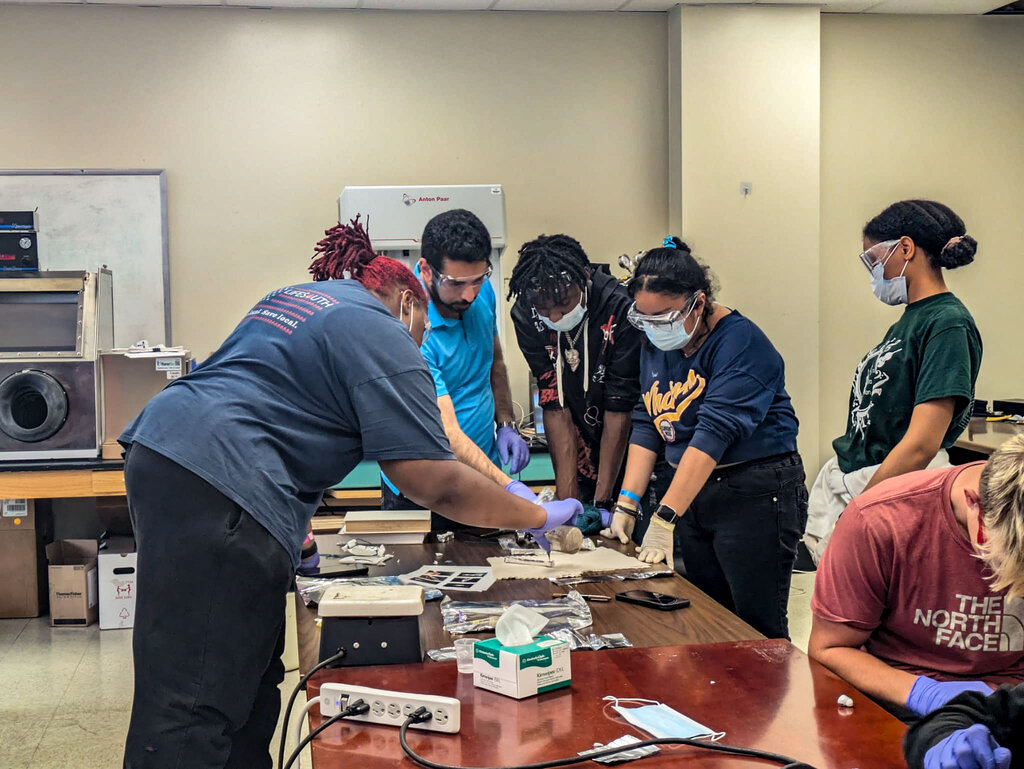
Finally, science is a community effort. Before a study's conclusions are widely accepted, the research is usually submitted to a journal for peer review. This means other independent experts in the same field scrutinize the study's methods, data, and conclusions. They look for flaws in the experiment, mistakes in the analysis, or unsupported claims.
Peer review acts as a filter, helping to ensure that scientific literature is based on solid, well-conducted research. It doesn't guarantee a study is perfect, but it makes the scientific process more rigorous and self-correcting.
What is the primary role of the scientific method?
A scientist observes that fish in a particular pond are smaller than fish in a nearby lake. Which of the following is the BEST example of a testable hypothesis?
This structured approach of observing, guessing, testing, and sharing is what allows us to confidently build a shared understanding of the world around us.