Foundations of Quantum Mechanics
Wave-Particle Duality
The Dual Nature of Reality
In the world we see around us, things are either particles or waves. A thrown baseball is a particle; it has a definite position and follows a clear path. The ripples on a pond are waves; they are spread out and can interfere with each other.
Quantum mechanics reveals that this neat division breaks down at the subatomic level. Fundamental entities like electrons and photons don't stick to one identity. Instead, they exhibit wave-particle duality, behaving like a particle in some situations and a wave in others. Which behaviour we see depends entirely on how we choose to measure it.
Wave-particle duality is one of the most fundamental principles of quantum mechanics, encapsulating the complex nature of light and matter.
The most famous demonstration of this concept is the double-slit experiment. It’s a simple setup with profound consequences.
The Double-Slit Experiment
Imagine a barrier with two thin, parallel slits in it. On one side, we have a source that can fire things, and on the other side, a detector screen that records where they land.
If we fire solid objects like tiny paintballs through the slits, the result is predictable. They pass through one slit or the other and hit the screen directly behind, forming two distinct bands. This is classic particle behaviour.
If we send waves, like water waves, through the slits, something different happens. As the waves pass through, they spread out and interfere with each other. Where two wave crests meet, they create a bigger wave (constructive interference). Where a crest meets a trough, they cancel out (destructive interference). The result on the screen is an interference pattern: a series of bright and dark bands, not just two.
Now for the quantum surprise. What happens if we fire electrons, which we typically think of as particles, one at a time? Since they are sent individually, they can't interfere with each other. Common sense suggests they should act like the paintballs and create two bands.
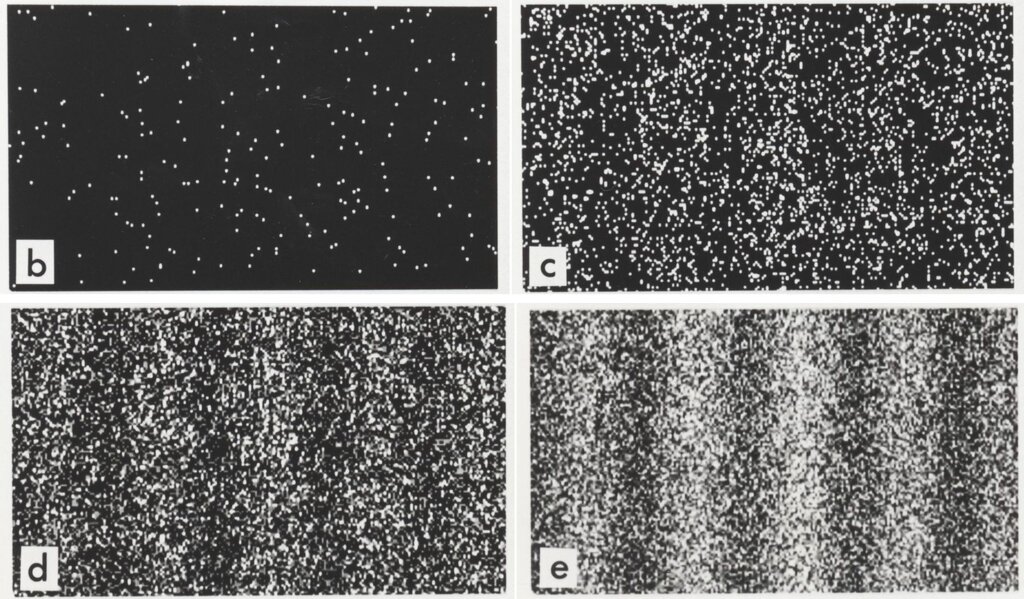
Instead, they create an interference pattern, just like the waves. Each individual electron hits the screen at a single point, like a particle. But over time, the collection of these hits builds up into the characteristic wave pattern. It's as if each electron, travelling alone, somehow passes through both slits simultaneously as a wave and interferes with itself.
The story gets stranger. If we place a detector at the slits to see which one each electron goes through, the interference pattern vanishes. The very act of observing which path the electron takes forces it to behave like a particle, and we go back to seeing just two bands on the screen. The wave behaviour disappears simply because we looked.
The De Broglie Wavelength
In 1924, physicist Louis de Broglie proposed a radical idea: if waves like light can behave like particles (photons), then perhaps particles like electrons could behave like waves. He suggested that all matter has a wavelength associated with it.
This wasn't just a philosophical idea; he provided a mathematical relationship for it.
The equation shows an inverse relationship between wavelength and momentum. The larger an object's momentum, the smaller its wavelength.
This is why we don't observe wave-like properties in everyday objects. A moving car has enormous momentum compared to an electron, so its de Broglie wavelength is astronomically small, far too tiny to ever be detected. For subatomic particles, however, the momentum is small enough that their wavelength becomes significant and observable, as seen in the double-slit experiment.
De Broglie's hypothesis was confirmed experimentally just a few years later, demonstrating that electrons could be diffracted by a crystal lattice, just like X-rays. This proved that matter truly does have a wave-like nature.
Wave-particle duality isn't a statement that an electron is both a wave and a particle at the same time. Rather, it has the potential to be either. The specific experimental setup we use determines which of these complementary properties becomes manifest.
Ready to test your understanding of this strange quantum behaviour?
In the classic double-slit experiment, what pattern emerges on the screen when electrons are fired one at a time without any observation at the slits?
What happens in the double-slit experiment if a detector is placed at the slits to determine which one each electron passes through?
This dual nature is a fundamental aspect of the quantum world, setting the stage for even more counter-intuitive phenomena.