Foundations of Probability
Sample Spaces and Events
The World of Possibilities
Every time we're faced with uncertainty, whether it's flipping a coin or forecasting tomorrow's weather, there's a set of all possible things that could happen. In probability, we call this set the sample space. It's a complete list of every single potential outcome of an experiment.
The sample space is the foundation. Before we can talk about the chance of something happening, we need to know everything that could happen.
Think about a simple coin flip. What are the possible outcomes? The coin can land on heads, or it can land on tails. That's it. So, the sample space, which we often denote with , is just {Heads, Tails}.
Let's take it up a small step: rolling a standard six-sided die. The possible outcomes are rolling a 1, 2, 3, 4, 5, or 6.
Focusing on an Event
A sample space lists all possibilities. But usually, we're interested in a specific outcome or a group of outcomes. We call this an event. An event is simply a subset of the sample space. It's the specific thing we're watching for.
Let's stick with our die-rolling example. The sample space is . Maybe we want to know the chances of rolling an even number. This is an event. Let's call it event . Which outcomes from our sample space satisfy this event? The numbers 2, 4, and 6.
An event can be as simple as one outcome (like rolling a 5, where the event is just {5}) or it can include multiple outcomes.
Visualizing the Possibilities
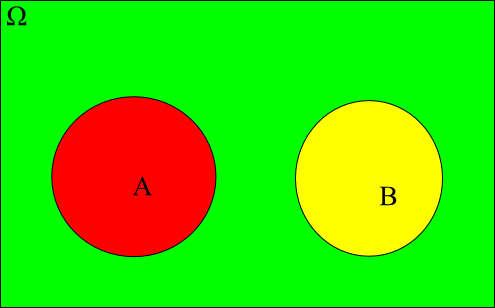
It can be helpful to visualize these concepts. We can think of the entire sample space as a large area. Within that area, any specific event is a smaller, defined region. This helps show that an event is always a part of the larger sample space.
In this diagram, the sample space contains all possible outcomes from rolling a die. Event (rolling an odd number) and Event (rolling a number greater than 3) are subsets within . Notice that the number 5 fits the criteria for both events, so it sits in their overlapping section.
| Experiment | Sample Space (S) | Example Event (E) | Outcomes in E |
|---|---|---|---|
| Flip a coin | {H, T} | Getting heads | {H} |
| Roll a die | {1, 2, 3, 4, 5, 6} | Rolling a number less than 3 | {1, 2} |
| Draw a card | {52 cards} | Drawing a King | {K♠, K♥, K♣, K♦} |
Understanding the distinction between the set of all possibilities and the specific outcomes you're interested in is the first and most crucial step in mastering probability.