Foundations of Practical Python Programming
Python Scripting Fundamentals
Setting Up Your Workspace
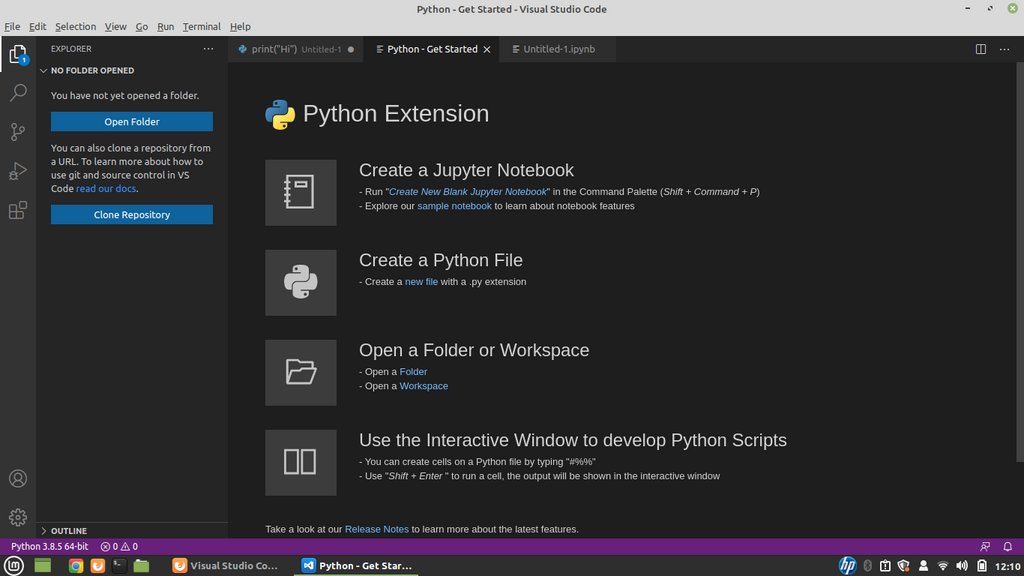
The first step in writing scripts isn't writing code, it's creating an environment where you can write code effectively. While you can write Python in a simple text editor, using an Integrated Development Environment (IDE) makes life much easier. An IDE is a software application that provides comprehensive facilities to programmers for software development. Think of it as a workbench with all the tools you need within reach: a text editor, a file explorer, a debugger, and a terminal, all in one window.
A popular choice is Visual Studio Code (VS Code), a free IDE from Microsoft. It's lightweight but powerful, and highly customizable with extensions. For Python, you'll want to install the official Python extension, which provides features like code completion (IntelliSense), linting (checking for errors), and debugging support. Setting this up properly helps you catch errors before you run your script and makes navigating your code much simpler.
The Pythonic Way
Python has a guiding philosophy that emphasizes code readability and simplicity. This philosophy is often referred to as "The Zen of Python." It's a collection of 19 aphorisms that you can actually see by typing import this into a Python interpreter. These principles aren't strict rules, but they guide the design of the language and how experienced developers write code.
Beautiful is better than ugly. Explicit is better than implicit. Simple is better than complex. Readability counts.
To help developers write code that aligns with this philosophy, the Python community created PEP 8, the official style guide for Python code. It provides conventions for everything from how to name variables to how many spaces to use for indentation (it's four). Following PEP 8 makes your code more consistent and easier for other Python programmers to read. Most IDEs, including VS Code, have tools that can automatically check your code for PEP 8 compliance and even reformat it for you.
Writing and Running Your Script
A Python script is just a text file with a .py extension. You write your code, save the file, and then run it from your terminal using the command python your_script_name.py. But how does Python know where to start? For a simple script, it just starts at the top and executes line by line. However, as scripts become more complex, it's crucial to structure them properly. A common and important pattern is to use a special conditional block: if __name__ == "__main__":. This is the script's entry point.
The name variable is a special built-in variable that Python sets for your script. When you run your file directly, Python sets __name__ to the string "__main__". If the file is imported by another script, __name__ is set to the module's name instead. This check allows you to write code that will only execute when the file is run as the main program, not when it's imported. It's the standard way to make your scripts reusable and organized.
def main():
    # This is where the main logic of your script goes.
    print("Script is running!")

# This conditional block is the entry point of the script.
if __name__ == "__main__":
    main()
Automating File Operations
One of the most common tasks for a script is interacting with files. Python makes this incredibly straightforward. To work with a file, you first need to open it. The best practice for this is using the with statement, which ensures the file is automatically closed when you're done, even if errors occur.
# Open a file for reading and a file for writing
with open('input.txt', 'r') as infile:
    with open('output.txt', 'w') as outfile:
        # Read each line from the input file
        for line in infile:
            # Write a modified version to the output file
            outfile.write(line.upper())

print("File has been processed.")
Let's build on this with a more useful example: batch renaming files. Imagine you have a folder of text files with a .txt extension, and you want to change them all to Markdown files with a .md extension. This kind of repetitive task is perfect for a script. To interact with the operating system, like getting a list of files in a directory, we can use Python's built-in os module.
import os

def batch_rename(directory, old_ext, new_ext):
    # Get a list of all files and directories
    for filename in os.listdir(directory):
        # Check if the file has the old extension
        if filename.endswith(old_ext):
            old_path = os.path.join(directory, filename)
            # Create the new filename by replacing the extension
            new_filename = filename.replace(old_ext, new_ext)
            new_path = os.path.join(directory, new_filename)

            # Rename the file
            os.rename(old_path, new_path)
            print(f"Renamed: {filename} -> {new_filename}")

if __name__ == "__main__":
    # Specify the target directory and extensions
    target_dir = "."
    batch_rename(target_dir, ".txt", ".md")
Handling the Unexpected
What happens if our script tries to open a file that doesn't exist? It will crash. A robust script should anticipate potential problems and handle them gracefully. This is done using try...except blocks. You place the code that might fail inside the try block. If an error occurs, the code in the except block is executed, and the program doesn't crash.
try:
    with open('non_existent_file.txt', 'r') as f:
        print(f.read())
except FileNotFoundError:
    print("Error: The file was not found.")
except Exception as e:
    # A general catch-all for other potential errors
    print(f"An unexpected error occurred: {e}")
In the example above, we specifically catch a FileNotFoundError. It's good practice to catch specific exceptions whenever possible, so you know exactly what went wrong. You can also have a more general except block to handle any other unexpected issues. This makes your automation scripts more reliable and trustworthy.
What is the primary purpose of an Integrated Development Environment (IDE) like Visual Studio Code?
What is the official style guide for Python code that dictates conventions like using four spaces for indentation?