Foundations of Piano and Music Theory
Introduction to Musical Notes
The Musical Alphabet
Music is built on a simple foundation: just seven notes. These notes are named after the first seven letters of the alphabet: A, B, C, D, E, F, and G. That's it. This sequence of seven notes is the core of all melodies you hear.
Think of them as the primary colors of sound. From just these seven notes, we can mix and create every song imaginable.
On a piano, these seven notes correspond to the white keys. After you get to G, the pattern starts over again on the next white key, which will be another A.
Higher and Lower
When the pattern of notes repeats, we are moving into a different octave. The word octave comes from the Latin word for eight. If you play a C, and then play the eighth white key up from it, you will land on the next C. It's the same note, but it has a higher, brighter sound, or pitch.
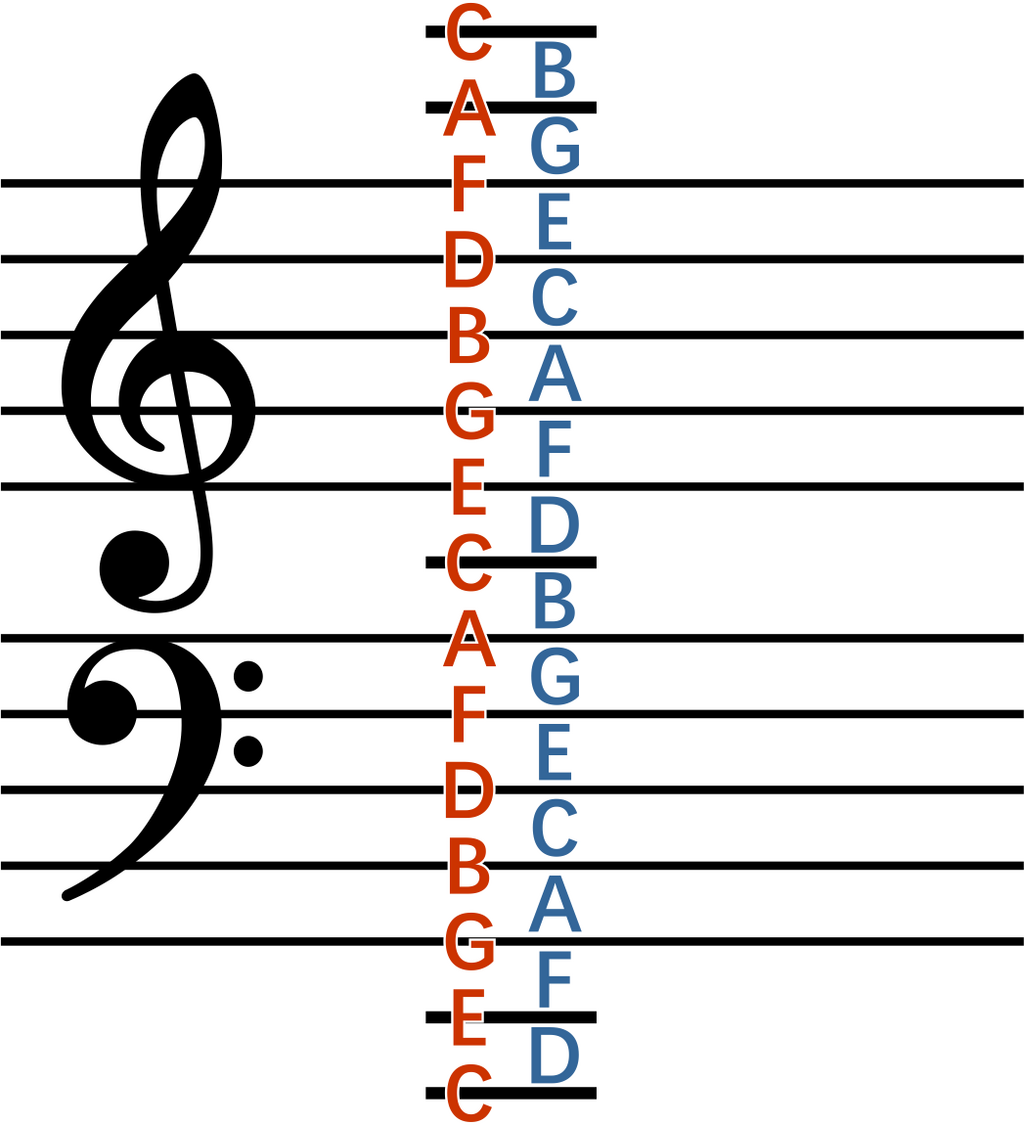
This works in both directions. You can go up to a higher octave or down to a lower one. Imagine a ladder where each rung is a note. As you climb up, the pitch gets higher. As you go down, it gets lower. The pattern of A, B, C, D, E, F, G repeats on every section of the ladder.
The In-Between Notes
You've probably noticed the black keys on a piano. These keys represent notes that fall in between the main seven notes. We identify them using two special symbols: the sharp (♯) and the flat (♭).
A sharp raises a note's pitch by a small step, called a half step. For example, the black key just to the right of C is called C-sharp (C♯).
A flat lowers a note's pitch by a half step. The black key to the left of D is called D-flat (D♭). Interestingly, C♯ and D♭ are the exact same key on the piano, just with different names depending on the musical context.
Sharp
noun
A symbol (♯) that indicates a note should be played a half step higher in pitch.
Here is the flat, its counterpart.
Flat
noun
A symbol (♭) that indicates a note should be played a half step lower in pitch.
Together, the seven core notes and their sharp and flat versions give us a total of 12 unique notes. These 12 notes are the complete set of building blocks for Western music.
Let's review these foundational concepts.