Foundations of Physics
Introduction to Mechanics
The Rules of Motion
Mechanics is the part of physics that explains why things move and why they stay still. It all starts with a simple idea: a force is just a push or a pull. If you want to move something, you have to apply a force to it. If you want to stop something that's already moving, you also need a force.
This leads to a fundamental rule, known as Newton's First Law of Motion. It says that an object will keep doing whatever it's doing unless a force makes it change. A soccer ball sitting on the grass won't roll away by itself. If it's already rolling, it will keep rolling in a straight line until friction from the grass and air slows it down. This tendency to resist changes in motion is called inertia.
An object at rest stays at rest, and an object in motion stays in motion with the same speed and in the same direction unless acted upon by an unbalanced force.
Force, Mass, and Acceleration
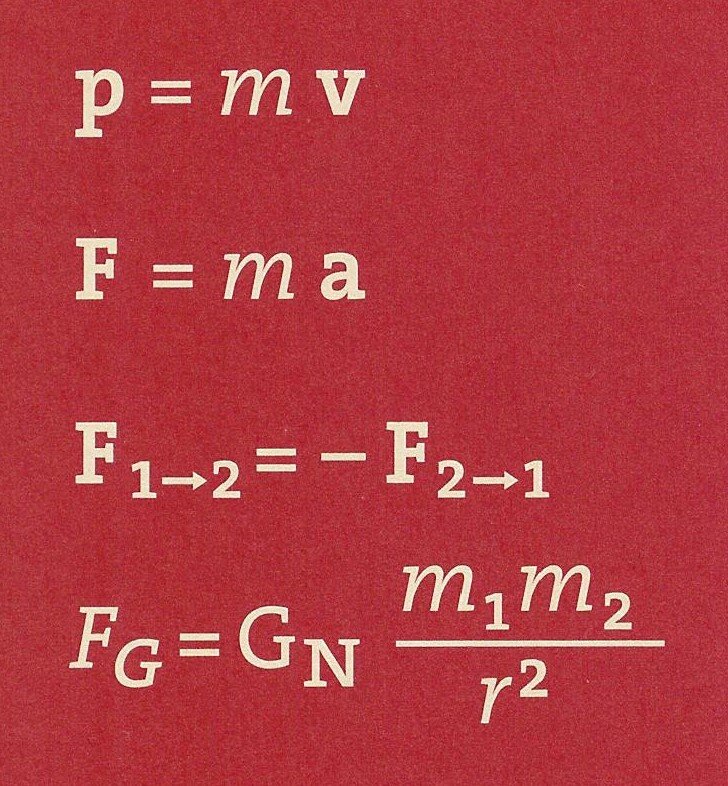
So, a force causes a change in motion. But how much change? That depends on two things: the mass of the object and the size of the force. This relationship is described by Newton's Second Law, which is one of the most important equations in all of physics.
Let's break that down:
- F is force: The push or pull you apply.
- m is mass: A measure of how much stuff, or matter, is in an object. A bowling ball has more mass than a tennis ball.
- a is acceleration: The rate at which the object's velocity changes. This means speeding up, slowing down, or changing direction.
Think about pushing a shopping cart. If the cart is empty (low mass), a small push makes it accelerate quickly. But if the cart is full of heavy groceries (high mass), you need to push much harder to get it moving at the same rate. The force you need is directly proportional to the mass and the acceleration you want to achieve.
This law also explains why it's harder to stop a heavy, moving object. A moving truck has a lot of mass, so a large force is needed to give it a negative acceleration (to slow it down).
Action and Reaction
Newton's Third Law might be the most famous: For every action, there is an equal and opposite reaction. This means forces always come in pairs. When you push on something, it pushes back on you with the exact same amount of force.
It sounds strange at first. If you push on a wall and it pushes back with equal force, why don't the forces cancel out? The key is that the forces are acting on different objects. Your push acts on the wall. The wall's push acts on you.
A rocket launch is a perfect example. The rocket pushes hot gas downwards (the action). In return, the gas pushes the rocket upwards with an equal and opposite force (the reaction), lifting it into the sky. A swimmer pushes the water backward with their hands, and the water pushes them forward.
Energy, Work, and Momentum
Forces do more than just cause acceleration. When a force makes an object move a certain distance, it does work. In physics, work isn't just about effort. If you push on a brick wall for an hour, you'll get tired, but if the wall doesn't move, you haven't done any work on it. Work requires both force and movement.
Doing work requires energy, which is the capacity to do work. Energy comes in many forms. A moving object has kinetic energy (the energy of motion), while an object held up high has potential energy (stored energy due to its position). These concepts are crucial in engineering, from designing efficient engines to building roller coasters that convert potential energy at the top of a hill into thrilling kinetic energy on the way down.
Finally, there's momentum. Momentum is a measure of an object's motion, combining its mass and velocity. Think of it as "mass in motion."
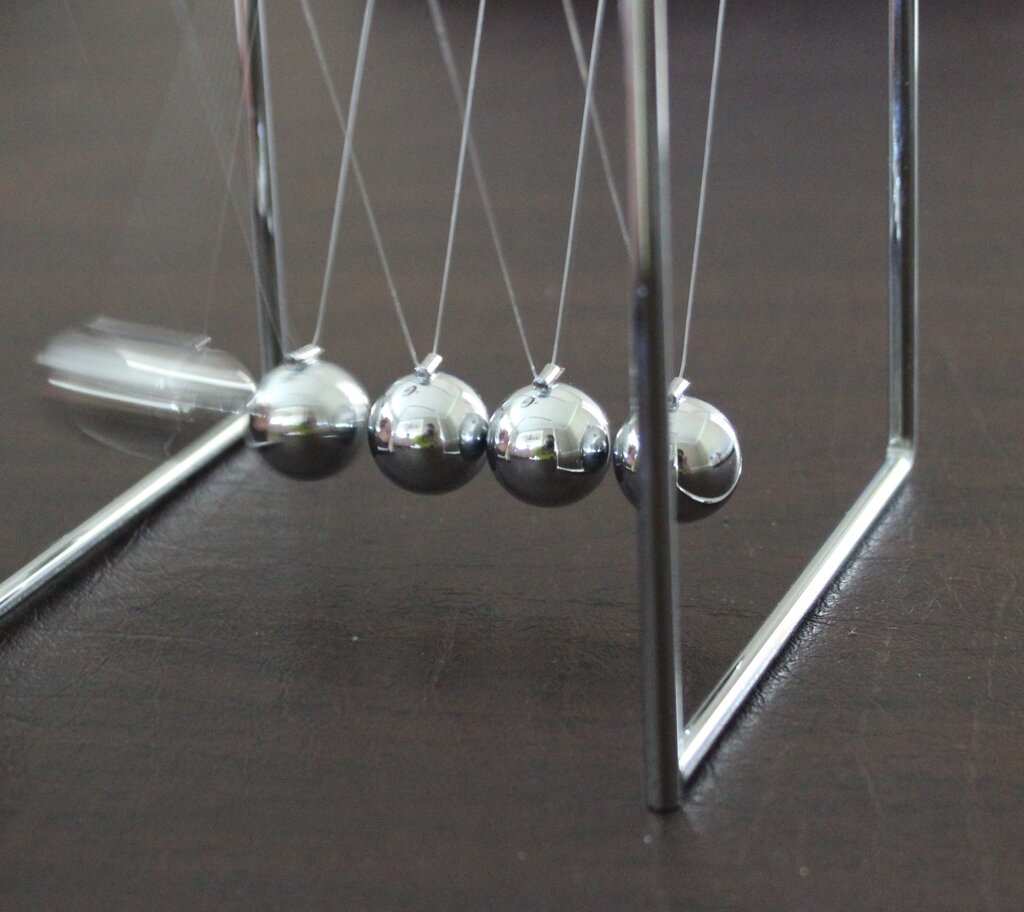
A key principle is the conservation of momentum. In any collision, the total momentum of the objects before they hit is equal to their total momentum after. This is why in a game of pool, the cue ball slows down or stops after hitting another ball, transferring its momentum to make the other ball move.
These principles of mechanics aren't just for physics classrooms. They're at the heart of how engineers design safer cars that crumple to absorb momentum during a crash. They're how sports scientists analyze a baseball pitch or a golf swing to maximize force and energy transfer. Understanding these fundamental rules helps us predict and control the motion of everything around us.
According to the principle of inertia, an object in motion will...
If you apply the same amount of force to two objects, one with a large mass and one with a small mass, the object with the small mass will experience a greater __________.