Foundations of Physics
Classical Mechanics
The Rules of Motion
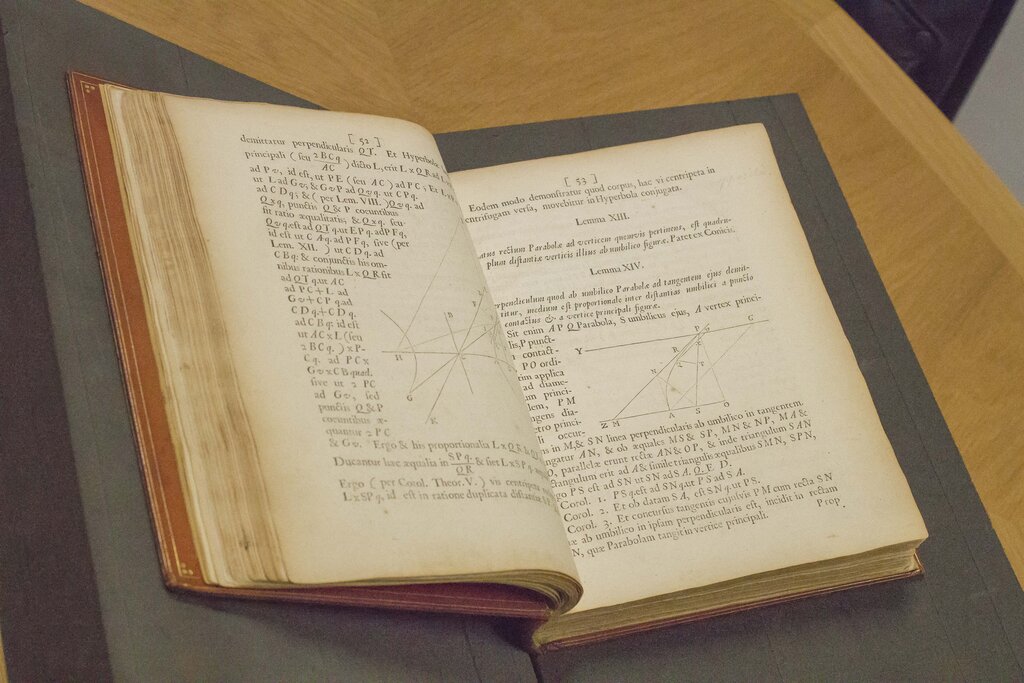
Everything in our everyday world, from a thrown baseball to a planet orbiting the sun, follows a predictable set of rules. These rules form the bedrock of classical mechanics, the physics of the macroscopic world. The first person to lay them out clearly was Isaac Newton.
His first law, the law of inertia, is simple: an object in motion stays in motion, and an object at rest stays at rest, unless acted upon by an outside force. A hockey puck gliding across an endless sheet of frictionless ice would just keep going forever. It's only the force of friction that stops it in the real world.
Newton's second law is the heart of the matter. It connects force, mass, and acceleration into one elegant equation. It tells us that the more force you apply to an object, the more it accelerates. It also says that for the same amount of force, a heavier object will accelerate less than a lighter one.
The third law is probably the most famous: for every action, there is an equal and opposite reaction. When you push on a wall, the wall pushes back on you with the same force. A rocket pushes hot gas out its nozzle (the action), and the gas pushes the rocket forward (the reaction). This law reveals that forces always come in pairs.
The Universe's Accounting System
Newton's laws tell us how forces change motion. But some things in the universe are conserved, meaning their total amount never changes. Two of the most important conserved quantities are momentum and energy.
Momentum is essentially "mass in motion." A heavy truck moving slowly can have the same momentum as a light baseball moving very fast. In any collision or interaction where no external forces are involved, the total momentum of the system before the event is the same as the total momentum after.
Think of a game of pool. When the cue ball hits a stationary ball, momentum is transferred. The total momentum of all the balls right after the break is the same as the momentum of the cue ball just before it hit.
Energy is a bit more abstract. It's the capacity to do work. Like momentum, the total energy of an isolated system is always conserved. It can change forms, say from the potential energy of a rollercoaster at the top of a hill to the kinetic energy of its motion on the way down, but the total amount remains constant. This principle of energy conservation is one of the most fundamental ideas in all of physics.
A New Perspective
Newton's laws are powerful, but for complex systems with many moving parts or constraints, like a double pendulum, using forces can become incredibly messy. Two other formulations of classical mechanics, Lagrangian and Hamiltonian mechanics, offer a more elegant approach by focusing on energy instead of forces.
Lagrangian mechanics uses a quantity called the Lagrangian, which is simply the kinetic energy minus the potential energy.
A powerful idea called the principle of least action states that an object will always follow the path that minimizes a certain quantity (the action) over time. By applying this principle to the Lagrangian, we can derive the equations of motion without ever thinking directly about forces or vectors. It simplifies complex problems by boiling them down to a single scalar quantity: energy.
Hamiltonian mechanics takes this a step further. It rephrases the problem in terms of an object's position and momentum. The Hamiltonian, which often represents the total energy of the system (), provides a set of first-order differential equations that are often easier to solve than the second-order equations from Newton's or Lagrange's methods. This formulation is so fundamental that it forms the bridge to quantum mechanics.
Think of it this way: Newton asks "What forces are acting now?", Lagrange asks "What path minimizes the action over time?", and Hamilton asks "What is the state of position and momentum right now?" All three give the same answers, but from different and powerful perspectives.
One area where these methods shine is in analyzing small oscillations. Almost any system in a stable equilibrium, from a pendulum to atoms in a crystal, will oscillate when disturbed. The motion of these systems can be broken down into a set of simple, independent motions called normal modes. Each normal mode has its own characteristic frequency. Understanding these modes is crucial in fields ranging from music to structural engineering.
An ice hockey puck is sliding on a perfectly frictionless, infinitely large sheet of ice. According to Newton's First Law, what will happen to the puck?
You push a bowling ball and a basketball with the exact same amount of force. According to Newton's Second Law (), which one will experience greater acceleration?
Classical mechanics provides the essential toolkit for understanding the world we see and interact with every day. While newer theories have expanded our understanding of the very fast and the very small, Newton's foundational principles remain as relevant as ever.