Foundations of Physics Explained
Kinematics
The Language of Motion
Kinematics is the part of physics that describes how things move. It doesn't worry about what causes the motion, just the motion itself. To talk about motion clearly, we need some specific terms. Let's start with two that seem similar but are critically different: distance and displacement.
Distance
noun
The total length of the path traveled by an object.
Distance is a straightforward measure of how much ground you've covered. If you walk 3 blocks to a store and 3 blocks back, you've walked a distance of 6 blocks. It’s a scalar quantity, which means it only has a size (or magnitude).
Displacement
noun
The change in an object's position from its starting point to its ending point, including direction.
Displacement is about where you end up relative to where you started. In that round trip to the store, your displacement is zero because you ended up exactly where you began. Displacement is a vector quantity; it has both a size and a direction.
Speed vs. Velocity
Just as distance and displacement are different, so are speed and velocity. Speed is how fast you're going, while velocity is how fast you're going in a specific direction.
A car going around a circular track might have a constant speed, but its velocity is always changing because its direction is constantly changing.
Speed, like distance, is a scalar. It's calculated by dividing the total distance traveled by the time it took. Velocity is a vector, like displacement. Average velocity is found by dividing the displacement by time.
The distinction is crucial. If a satellite orbits Earth at a constant speed of 17,000 mph, its velocity is continuously changing. This change in velocity leads us to our next concept.
Getting Up to Speed
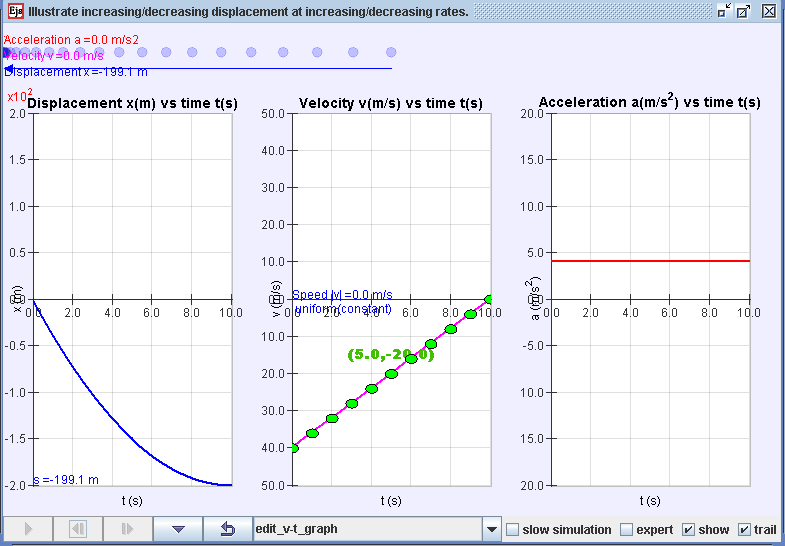
Acceleration describes how an object's velocity changes over time. You experience acceleration every day. When your car speeds up from a stoplight, that's acceleration. When you hit the brakes, that's also acceleration, often called deceleration. Even turning a corner at a constant speed is a form of acceleration because your direction, and therefore your velocity, is changing.
A constant acceleration means an object's velocity is changing by the same amount each second. The pull of gravity near Earth's surface causes a nearly constant acceleration for falling objects, which we'll see is very useful.
The Kinematic Equations
When an object moves with constant acceleration, we can use a set of powerful equations to predict its motion. These are often called the equations of motion or the kinematic equations. They link displacement, velocity, acceleration, and time.
This first equation is just a rearrangement of the definition of acceleration. The next one helps us find the displacement.
What if you don't know the time? The third equation is useful in that case.
Flying Through the Air
Projectile motion is a perfect real-world application of kinematics. A projectile is any object that is thrown or launched into the air and then moves only under the influence of gravity (ignoring air resistance). Think of a kicked soccer ball, a launched rocket after its engine cuts out, or a diver jumping off a platform.
The key to analyzing projectile motion is to split the problem into two parts: horizontal motion and vertical motion.
| Horizontal Motion (x-axis) | Vertical Motion (y-axis) |
|---|---|
| Velocity is constant. | Velocity changes due to gravity. |
| Acceleration is zero (). | Acceleration is constant and downward (). |
By treating the horizontal and vertical components of motion independently, we can use the kinematic equations to solve for things like how high the object will go, how far it will travel, and how long it will be in the air. The one thing that connects the two components is time; the object is moving horizontally and vertically for the same amount of time.
With these concepts, you can describe and predict the motion of almost anything in your daily life, from a falling apple to a speeding car. You now have the basic toolkit for analyzing motion.
A runner completes exactly one lap of a 400-meter circular track. What are their distance traveled and their displacement?
A race car is driving at a constant speed of 150 km/h around a circular track. Which of the following statements is true?