Foundations of Physics Explained
Introduction to Classical Mechanics
The Rules of Motion
Classical mechanics is the study of how objects move and the forces that cause that motion. It's the physics of the everyday world, from a thrown baseball to the orbit of a planet. At its core are three fundamental rules developed by Isaac Newton in the 17th century. These laws provide the instruction manual for motion.
An Object's Stubbornness
Newton's First Law deals with inertia. In simple terms, objects like to keep doing whatever they're already doing. If an object is sitting still, it will stay still. If it's moving, it will keep moving at the same speed and in the same direction.
An object at rest stays at rest and an object in motion stays in motion with the same speed and in the same direction unless acted upon by an unbalanced force.
Think about a hockey puck gliding across the ice. It travels in a straight line at a steady speed until it hits the wall or friction slows it down. The wall and friction are unbalanced forces. Without them, the puck would glide forever. This tendency to resist changes in motion is called inertia.
inertia
noun
The property of matter by which it continues in its existing state of rest or uniform motion in a straight line, unless that state is changed by an external force.
Force, Mass, and Acceleration
Newton's Second Law gives us a way to measure how forces change motion. It connects three key concepts: force, mass, and acceleration. A force is a push or a pull. Mass is a measure of how much matter is in an object (and also a measure of its inertia). Acceleration is any change in an object's velocity, meaning a change in its speed or direction.
The relationship is surprisingly simple: the more force you apply, the more the object accelerates. The more massive an object is, the harder it is to accelerate.
Imagine pushing a small cardboard box and a heavy refrigerator. To get the refrigerator moving at the same rate as the box, you need to apply a much greater force. This is the second law in action.
Every Action Has a Reaction
Newton's Third Law describes a fundamental symmetry in nature. It states that forces always occur in pairs. If one object exerts a force on a second object, the second object exerts an equal and opposite force back on the first.
For every action, there is an equal and opposite reaction.
When you jump, your feet push down on the Earth. That's the "action." In return, the Earth pushes up on you with an equal force. That's the "reaction," and it's what launches you into the air. A rocket pushes hot gas downward (action), and the gas pushes the rocket upward (reaction).
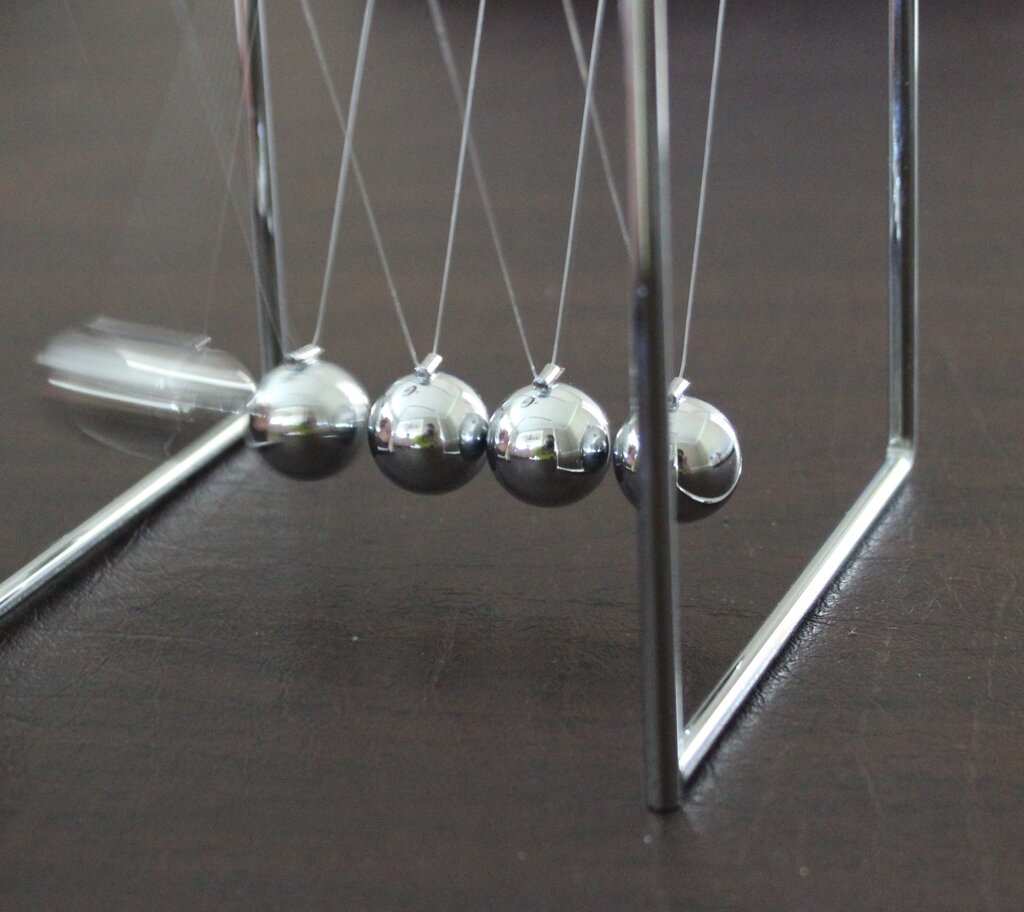
It's important to remember that these two forces act on different objects. The action (your feet on the Earth) and the reaction (the Earth on your feet) don't cancel each other out because they aren't acting on the same thing.
Work, Energy, and Momentum
Beyond Newton's laws, classical mechanics uses other powerful concepts to describe motion. Work is done when a force causes an object to move a certain distance. It's a transfer of energy, which is the capacity to do work. A moving car has kinetic energy (the energy of motion), and a book held above the ground has potential energy (stored energy due to its position).
Energy cannot be created or destroyed, only transferred from one form to another. This is the law of conservation of energy.
Another crucial concept is momentum. It's a measure of an object's motion, combining its mass and velocity. Think of it as "mass in motion."
Like energy, momentum is conserved in a closed system. When two billiard balls collide, the total momentum of both balls before the collision is the same as the total momentum after. This principle of conservation of momentum is essential for analyzing collisions and explosions.
A hockey puck slides across a perfectly frictionless ice rink. After the initial push, no horizontal forces are acting on it. What does Newton's First Law of Motion say the puck will do?
According to Newton's Second Law, if you apply the same net force to two objects, the object with the smaller mass will experience...