Foundations of Physics
Introduction to Physics
The Rules of the Universe
Physics is the search for the fundamental rules that govern everything around us. From the way a ball falls to the ground to the way stars shine, physics aims to explain how and why things work the way they do. It’s about asking questions and seeking precise, testable answers. At its core, physics is a way of thinking, a method for making sense of the physical world.
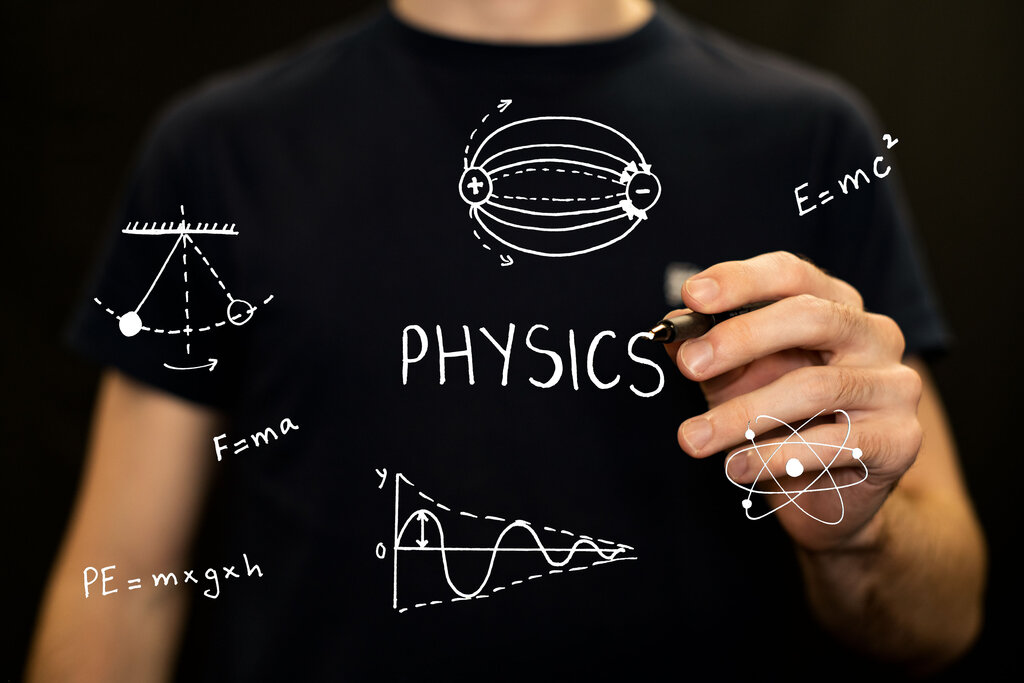
This process isn't random; it follows a structured approach that allows scientists to build knowledge reliably. This structured approach is known as the scientific method.
It begins with an observation of the world, which leads to a question. A scientist then proposes a testable explanation, or a hypothesis. Based on that hypothesis, they make a specific prediction. An experiment is then designed to test this prediction. The results are analyzed, and a conclusion is drawn about whether the data supports or refutes the hypothesis. This cycle of testing and refining ideas is how our understanding of the universe grows.
A Common Language
To test ideas and share results, scientists need a common language of measurement. Imagine trying to build something with a team where everyone's ruler was a different length. It would be chaos. That's why scientists use the International System of Units (SI).
| Quantity | SI Base Unit | Symbol |
|---|---|---|
| Length | meter | m |
| Mass | kilogram | kg |
| Time | second | s |
| Electric Current | ampere | A |
| Temperature | kelvin | K |
| Amount of Substance | mole | mol |
| Luminous Intensity | candela | cd |
These seven base units form the foundation for all other measurements in physics. For example, speed is measured in meters per second (m/s), and force is measured in newtons, which are defined as kg⋅m/s².
Beyond units, mathematics is the language used to express physical laws. It provides a precise way to describe relationships and make predictions. You don't need advanced calculus to start, just a solid grasp of a few key tools.
Algebra helps us rearrange equations to solve for an unknown quantity. Trigonometry allows us to work with angles and triangles, which is essential for describing motion and forces. Scientific notation makes it easier to handle very large or very small numbers, like the mass of the Earth or an electron.
How to Solve Problems
Physics isn't just about knowing facts; it's about using those facts to solve problems. Developing a systematic approach is key. It turns complex challenges into manageable steps.
First, read the problem carefully and visualize the situation. Drawing a simple sketch is often the most important step. Next, identify what you know (knowns) and what you need to find (unknowns). Then, determine which physical principles or equations connect your knowns and unknowns.
Once you have a plan, execute the math to solve for your target variable. Finally, check your answer. Does it make sense? Is the unit correct? This final step helps catch mistakes and deepens your understanding.
This structured process is valuable not just in physics, but in many areas of life. It teaches you to think critically, break down challenges, and approach solutions logically.
The principles of physics are at work all around you. The GPS in your phone relies on the theory of relativity. The technology in your screen is a product of quantum mechanics. Understanding basic physics helps you appreciate the hidden workings of the modern world. Now, let's test your understanding of these foundational ideas.
What is the primary goal of physics?
In the scientific method, what is a hypothesis?