Foundations of Physics
Introduction to Classical Mechanics
The Rules of Motion
Classical mechanics is the study of how things move. It’s the physics of the world we can see and touch, from a thrown baseball to the orbit of a planet. At its core are three simple, powerful rules discovered by Isaac Newton over 300 years ago.
Think of Newton's laws of motion as the instruction manual for the universe.
Newton's first law is about inertia. It states that an object will keep doing what it's doing unless a force acts on it. If it's at rest, it stays at rest. If it's moving, it keeps moving in a straight line at a constant speed.
Think about a hockey puck gliding across a perfectly smooth sheet of ice. If you push it, it will slide on and on, seemingly forever. It only stops because of the small amount of friction from the ice and the air. In a perfect, frictionless world, it would never stop.
Inertia
noun
The property of an object to resist changes in its state of motion.
The second law connects three key ideas: force, mass, and acceleration. It tells us that the acceleration of an object is directly proportional to the net force applied to it and inversely proportional to its mass.
In simpler terms, pushing harder makes something speed up faster. And for the same push, a lighter object will speed up more than a heavier one. This relationship is summed up in one of the most famous equations in physics.
Here, is the net force, is the mass, and is the acceleration. This simple formula is the engine of classical mechanics.
Newton's third law is probably the most quoted: for every action, there is an equal and opposite reaction. This means forces always come in pairs. When you push on a wall, the wall pushes back on you with the same force. A rocket pushes hot gas down, and the gas pushes the rocket up.
Energy and Momentum
Beyond the three laws, classical mechanics is built on two powerful conservation principles. These are fundamental rules about what stays the same in a system.
The first is the conservation of energy. Energy can't be created or destroyed, only changed from one form to another. A ball held high in the air has potential energy because of its position. As it falls, that potential energy is converted into kinetic energy, the energy of motion. The total amount of energy remains constant throughout the fall (ignoring air resistance).
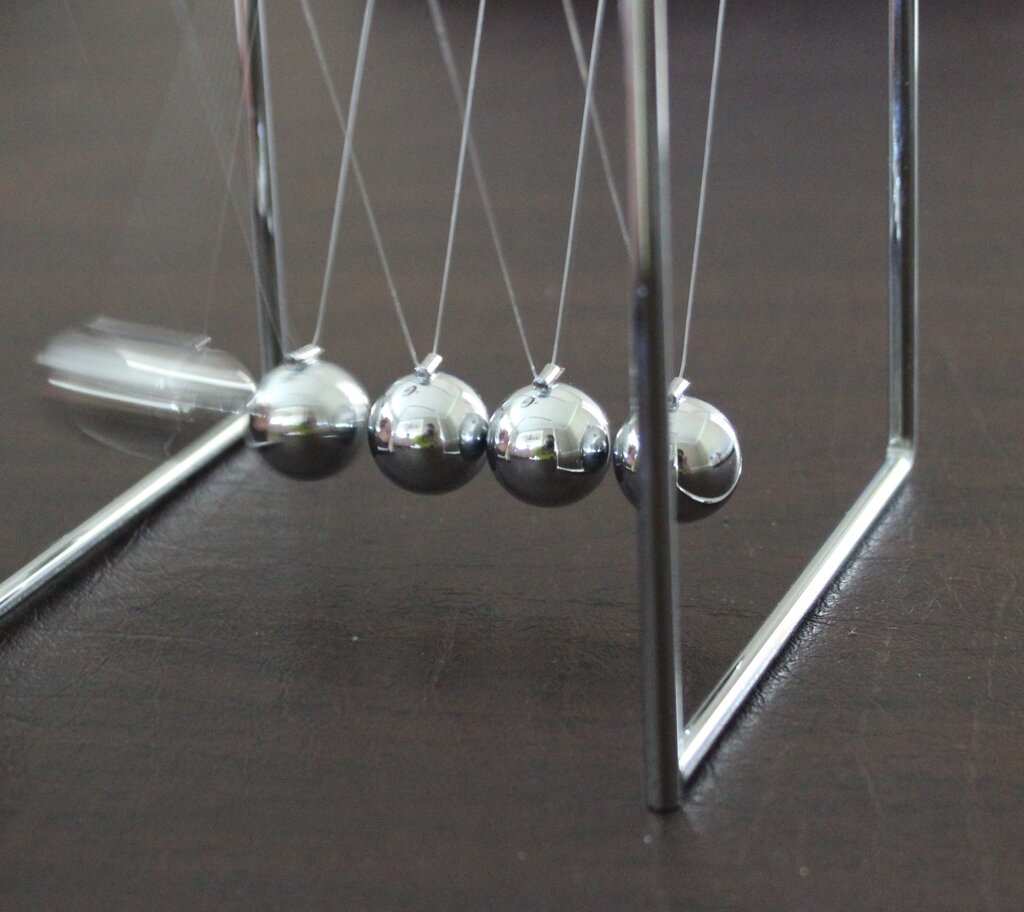
The second principle is the conservation of momentum. Momentum is a measure of an object's motion, combining its mass and velocity. It's often described as "mass in motion."
Here, is momentum, is mass, and is velocity. The law of conservation of momentum says that the total momentum of a closed system (one with no external forces) remains constant. When a cannon fires a cannonball, the cannon recoils backward. The cannonball moves forward with a large velocity, and the much heavier cannon moves backward with a small velocity. The total momentum of the system, however, remains zero, just as it was before firing.
Let's check your understanding of these foundational concepts.
A hockey puck slides across a perfectly frictionless ice rink. According to Newton's First Law of Motion (the law of inertia), what will happen to the puck if no other forces act on it?
If you apply the same net force to a bowling ball and a tennis ball, which one will have the greater acceleration?
These principles of motion, energy, and momentum form the bedrock of classical mechanics, allowing us to predict the behavior of the world around us with remarkable accuracy.