Foundations of Physics
Classical Mechanics
The Rules of Motion
At its heart, classical mechanics is the study of how things move. From a planet orbiting the sun to a baseball flying through the air, a set of fundamental rules governs their paths. These rules, first laid out by Isaac Newton centuries ago, are the foundation of physics. They describe the relationship between an object and the forces acting upon it.
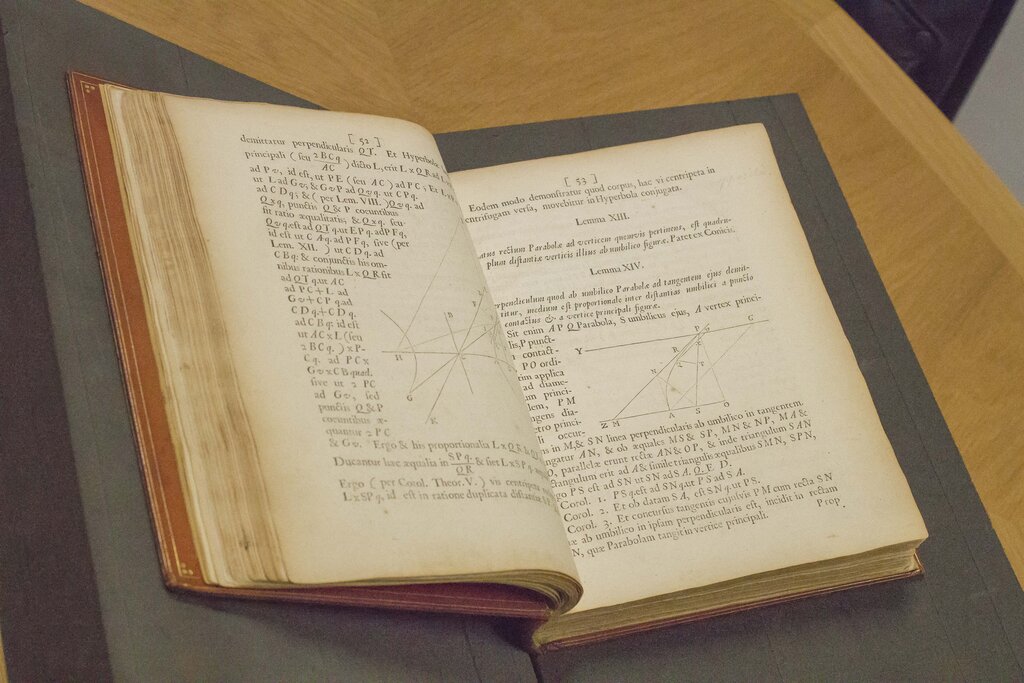
Newton's First Law: The Law of Inertia
Newton's first law of motion is simple but profound: an object will keep doing what it's doing unless an outside force interferes. If it's sitting still, it will stay still. If it's moving, it will continue moving in a straight line at a constant speed.
Think about sliding a hockey puck across ice. It glides for a long distance because the ice is smooth and offers very little friction. If you slid the same puck across a carpeted floor, it would stop almost immediately. The force of friction from the carpet is what changes its motion. Without friction or air resistance, the puck would just keep going.
inertia
noun
The tendency of an object to resist changes in its state of motion.
Inertia is why you feel pushed back into your seat when a car suddenly accelerates, and why you lurch forward when it stops. Your body is just trying to continue in its original state of motion.
Newton's Second Law: Force, Mass, and Acceleration
So, a force can change an object's motion. But by how much? Newton's second law gives us the answer with a precise mathematical relationship. It connects three key ideas: force, mass, and acceleration.
- Force () is a push or a pull.
- Mass () is the amount of "stuff" an object is made of. It’s also a measure of inertia—the more massive an object, the harder it is to change its motion.
- Acceleration () is the rate at which an object's velocity changes.
The law states that the acceleration of an object is directly proportional to the net force applied to it and inversely proportional to its mass. In simpler terms, a bigger push will make something speed up faster. But if that something is very heavy, it will speed up more slowly.
Imagine pushing an empty shopping cart. It's easy to get it moving quickly. Now, imagine pushing a cart that's full of groceries. You have to push much harder to get it to accelerate at the same rate. That's the second law in action. The full cart has more mass, so it requires more force to achieve the same acceleration.
Newton's Third Law: Action and Reaction
The final law is perhaps the most famous: for every action, there is an equal and opposite reaction. This means that forces always come in pairs. When you push on a wall, the wall pushes back on you with the same amount of force. You might not see the wall move, but the force is there.
A rocket launching into space is a powerful example. The rocket pushes hot gas downwards (the action). In response, the gas pushes the rocket upwards (the reaction), lifting it off the ground. One force can't exist without the other.

The Great Conservation Laws
Newton's laws are fantastic for describing forces, but sometimes it's easier to analyze a system by looking at quantities that stay constant. In physics, these are called conservation laws. Two of the most important in mechanics are the conservation of momentum and the conservation of energy.
These laws provide a different, and often more powerful, lens through which to view motion.
First, let's look at momentum. Momentum is often described as "mass in motion." It’s a measure of how hard it is to stop a moving object. A bowling ball and a tennis ball moving at the same speed have very different momentums. The bowling ball, with its greater mass, has much more momentum and is harder to stop.
momentum
noun
The quantity of motion of a moving body, measured as a product of its mass and velocity.
The law of conservation of momentum states that in a closed system (one with no external forces), the total momentum before an event must equal the total momentum after it. Think of a game of pool. When the cue ball hits another ball, momentum is transferred. The total momentum of all the balls right before the collision is the same as the total momentum of all the balls right after. Momentum isn't lost, it just moves around.
Next is energy. The law of conservation of energy is one of the most fundamental principles in all of science. It states that energy cannot be created or destroyed, only changed from one form to another. In mechanics, we often deal with two types of energy: kinetic and potential.
- Kinetic energy is the energy of motion.
- Potential energy is stored energy, often due to an object's position (like a ball held high in the air).
When you drop a ball, its potential energy is converted into kinetic energy as it falls and speeds up. When it hits the ground and bounces, that kinetic energy is briefly converted back into potential energy at the top of its bounce. The total energy of the ball (kinetic + potential) remains constant, ignoring small losses to heat and sound.
Now, let's test your understanding of these foundational principles.