Foundations of Music Theory
Introduction to Pitch
What is Pitch?
Pitch is the quality that makes it possible to judge a sound as “higher” or “lower.” It's one of the basic building blocks of music. Think of the deep, low bark of a large dog versus the high-pitched chirp of a small bird. That difference in sound is pitch.
Pitch is an aspect of a sound that we can hear, reflecting whether one musical sound, note or tone is “higher” or “lower” than another musical sound, note or tone.
Scientifically, pitch is determined by frequency. When something vibrates, it creates sound waves. The faster the vibrations, the higher the frequency, and the higher the pitch we hear. Slower vibrations create a lower frequency and a lower pitch.
The Musical Alphabet
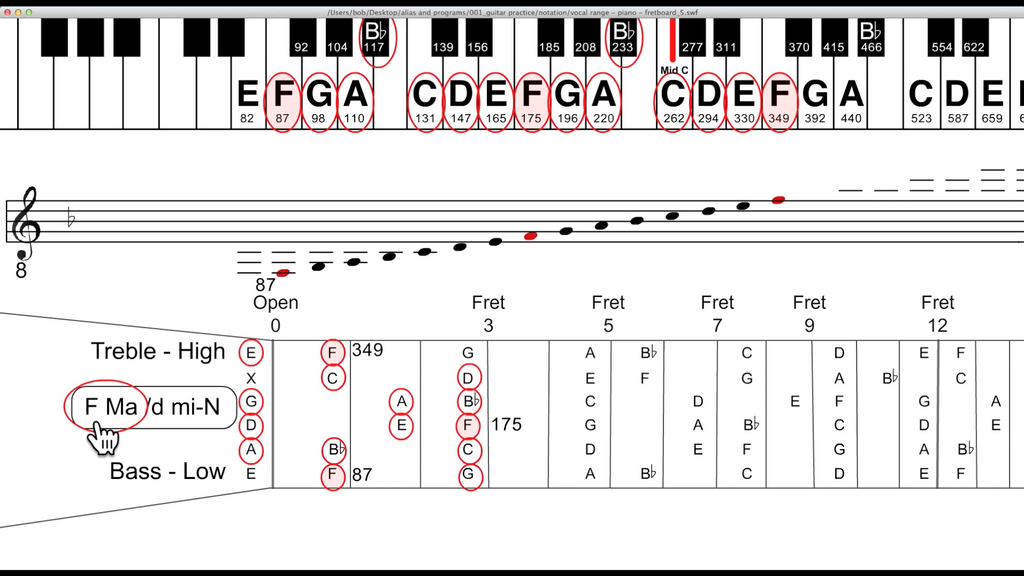
To name and organize pitches, we use a system called the musical alphabet. It's simpler than you might think. It only uses the first seven letters of the regular alphabet: A, B, C, D, E, F, and G.
These letters represent specific pitches. When you play a C on a piano, it has a distinct pitch. A D has a slightly higher pitch, an E is higher still, and so on. After G, the cycle starts over again at A, but at a higher pitch.
Understanding Octaves
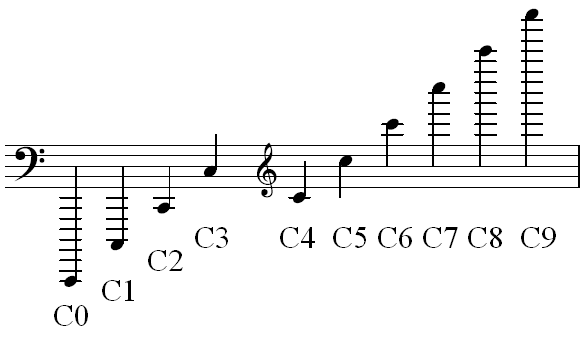
So if the musical alphabet just repeats, how do we tell the difference between a low A, a medium A, and a high A? We use octaves.
An octave is the distance between one note and the next note with the same name. For example, the distance from one C on the piano to the next C up the keyboard is one octave. They sound like the “same” note, but one is clearly higher in pitch than the other.
Octave
noun
The interval between one musical pitch and another with double its frequency.
That's because the frequency of the higher note is exactly double the frequency of the lower one. If a C note has a frequency of 261.6 Hz, the C an octave above it has a frequency of 523.2 Hz. This simple mathematical relationship is why octaves sound so closely related to our ears.
Pitch in Action
Pitch is what allows us to create melodies and harmonies, two of the most important elements of music.
A melody is simply a series of pitches played one after another. It’s the part of a song you hum or sing along to. Think of "Twinkle, Twinkle, Little Star." Each word corresponds to a different note, a different pitch, creating a recognizable tune.
Harmony happens when you play multiple pitches at the same time. When a guitarist strums a chord, they are playing several different notes at once. The combination of these pitches creates harmony, which adds depth and richness to the music.
Understanding pitch is the first step to understanding how music works. By arranging pitches in sequence, we get melody. By combining them, we get harmony. Every song you've ever heard is built on this fundamental concept.
Ready to test your knowledge? Let's see what you've learned about pitch.
What physical property of a sound wave primarily determines its pitch?
Which set of letters represents the complete musical alphabet?
Great job. You now have a solid grasp of pitch, the musical alphabet, and octaves. Next, we'll explore how these pitches are organized into scales.