Foundations of Music Theory
Music Staff Basics
The Foundation of Written Music
Think of written music as a graph where time moves left to right, and sound goes up and down. The framework for this graph is called the staff (or stave). It's a set of five horizontal lines and the four spaces between them.
Each line and space on the staff represents a specific musical pitch. Pitch is simply how high or low a note sounds. A note placed higher on the staff has a higher pitch, and a note placed lower on the staff has a lower pitch. It's an intuitive visual representation of sound.
Pitch
noun
The quality of a sound governed by the rate of vibrations producing it; the degree of highness or lowness of a tone.
Notes in music are named using the first seven letters of the alphabet: A, B, C, D, E, F, and G. After G, the cycle repeats with the next note being A again, just at a higher pitch. This repeating pattern is what creates different octaves, but we'll get to that later. The key is knowing which line or space corresponds to which letter.
Using the Treble Clef
A staff by itself doesn't tell us which specific notes to play. We need a reference point. That's the job of a clef, a symbol placed at the very beginning of the staff. The most common clef is the treble clef, also known as the G-clef.
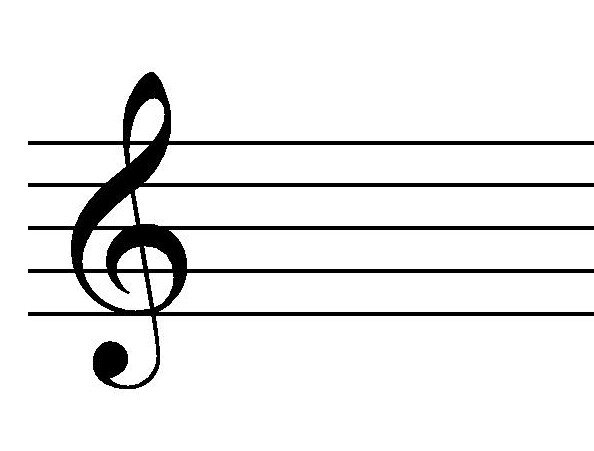
The treble clef is used for higher-pitched instruments and voices, like a flute, a violin, or the right hand on a piano. Its elegant curl wraps around the second line from the bottom, indicating that this specific line is the note G. With that G as our anchor, we can figure out all the other notes.
Think of a clef as the legend on a map. It tells you how to interpret the symbols you're about to see.
To easily remember the notes, musicians use mnemonics. For the four spaces from the bottom up, the notes spell out the word FACE.
For the five lines, a popular mnemonic is "Every Good Boy Does Fine," starting from the bottom line and going up.
Notes Beyond the Staff
What happens when you need a note that's higher or lower than the five lines of the staff? We add small, temporary lines called to extend the staff's range. For example, one of the most important notes in music, Middle C, sits on its own ledger line just below the treble clef staff.
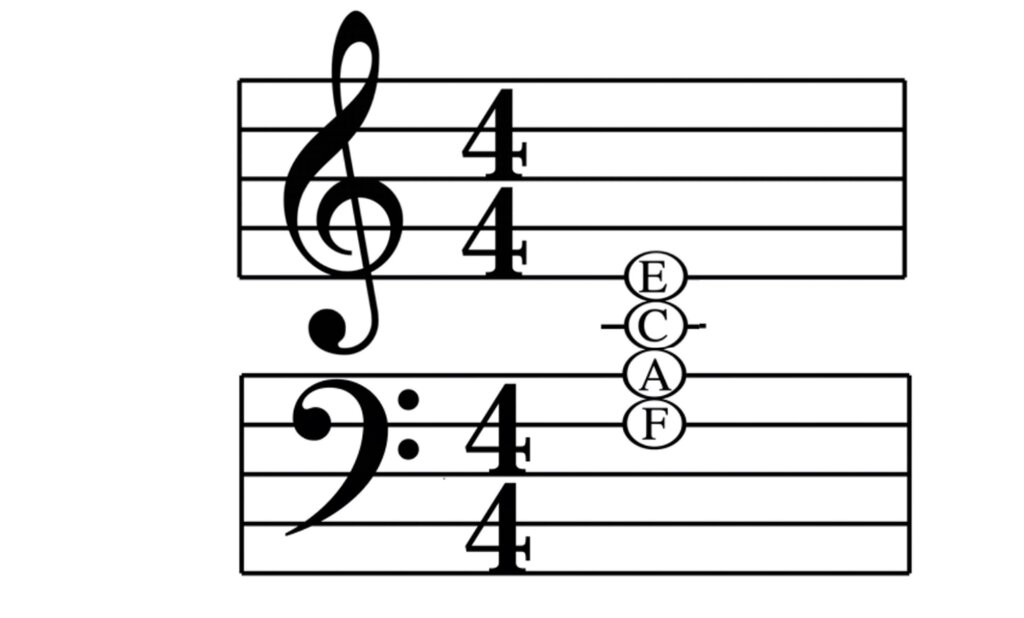
You now have the basic tools to identify any note on the treble clef. By combining the staff, the clef, and these simple mnemonics, you can translate the symbols on the page into the language of music. This is the first and most important step to reading any piece of music.