Foundations of Multivariable Analysis
Vectors and Geometry
Vectors: More Than Just a Number
Some quantities in the world can be described with a single number. Your height, the temperature outside, the price of a coffee, these are all scalars. They just have magnitude.
But what about describing the wind? Saying it's blowing at 15 miles per hour only tells half the story. Is it coming from the north? The southwest? To describe the wind fully, you need both its speed (magnitude) and its direction. This is a vector.
Vectors are mathematical objects that have both magnitude and direction. We represent them as arrows. The arrow's length indicates the magnitude, and the way it points shows the direction. In coordinate systems, we often describe them by their components along the axes.
This vector, , moves 4 units in the positive x-direction and 3 units in the positive y-direction. We write this in component form as . In three dimensions, we simply add a third component for the z-axis, like .
Working with Vectors
We can perform mathematical operations on vectors. The rules are straightforward and have clear geometric meanings.
Adding and Subtracting Vectors To add two vectors, we simply add their corresponding components. Geometrically, this is like placing the tail of the second vector at the head of the first. The new vector, called the resultant, goes from the tail of the first to the head of the second.
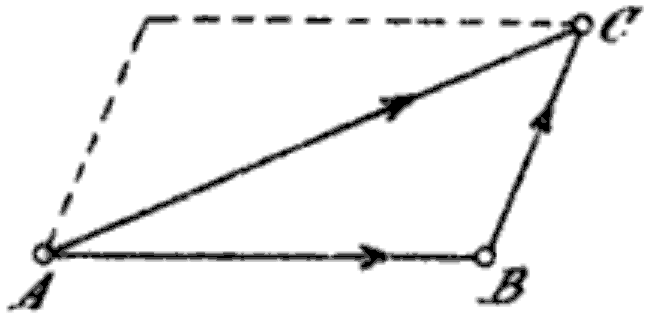
Subtraction works the same way. Subtracting a vector is the same as adding its opposite. The vector has the same length as but points in the exact opposite direction.
Scalar Multiplication What happens if you multiply a vector by a scalar (a plain number)? You scale its magnitude. Multiplying by 2 doubles the vector's length but keeps its direction. Multiplying by -1 reverses its direction but keeps its length. Multiplying by 0.5 halves its length.
Products of Vectors
Multiplying two vectors is more complex than adding them. There are two different kinds of products that are useful in different situations: the dot product and the cross product.
The dot product gives a scalar (a number) as its result, while the cross product gives a new vector.
The Dot Product The dot product tells us something about how much one vector points in the direction of another. It's a measure of alignment. If two vectors are perpendicular (at a 90° angle), their dot product is zero. If they point in similar directions, it's positive. If they point in opposite directions, it's negative.
There are two ways to calculate it.
The Cross Product The cross product is a bit more exotic and only works for vectors in three dimensions. The result of a cross product, , is a new vector that is perpendicular to both and .
This is incredibly useful in physics and engineering. For example, the force on a wire carrying current in a magnetic field is described by a cross product. The direction of the resulting vector is determined by the "right-hand rule." If you point your index finger in the direction of and your middle finger in the direction of , your thumb points in the direction of .
The magnitude of the cross product vector is related to the area of the parallelogram formed by and .
Describing Lines and Planes
With vectors, we can move beyond describing single points and start describing entire geometric objects like lines and planes in space.
Equation of a Line A line in space can be uniquely defined by a point on the line and a vector that points in the direction of the line. Think of it as a starting address and a set of driving directions.
Let be the position vector of a known point on the line, . Let be a vector parallel to the line. Any other point on the line can be reached by starting at and moving some distance along . This distance is represented by a scalar, .
Equation of a Plane What defines a plane? You could use three points, but a more elegant way is with one point on the plane and a vector that is normal (perpendicular) to the plane.
Imagine a flat tabletop. The normal vector would point straight up, perpendicular to the surface. Any vector created by connecting two points on the tabletop will be perpendicular to that normal vector. We know that the dot product of two perpendicular vectors is zero. This gives us the equation of the plane.
Let be the normal vector, and be a point on the plane. For any other point in the plane, the vector from to is . Since this vector is in the plane, it must be perpendicular to .
Expanding this dot product gives us the standard scalar form of the equation for a plane.
Which of the following quantities is best described by a vector?
What is the result of the dot product of two vectors?
Understanding these vector operations and geometric equations is fundamental. They provide the language needed to describe motion, forces, and surfaces in multiple dimensions.