Foundations of Motion and Kinematics
Distance and Displacement
The Long and Short of It
Imagine you walk out your front door, head two blocks east to a coffee shop, and then walk one block west to a friend's house. How far did you walk?
You traveled a total of three blocks. This is the distance you covered. It's the full length of the path you took, every step included.
Distance is a scalar quantity that refers to “how much ground an object has covered” during its motion.
Distance is straightforward. It’s what your car's odometer tracks. It only cares about the total amount, not the direction. In physics, we call any quantity that has a magnitude (a size or amount) but no direction a scalar.
Scalar
noun
A quantity that is fully described by a magnitude (or numerical value) alone.
Now, let’s ask a different question about your walk. How far are you from your starting point?
Even though you walked three blocks, your friend's house is only one block east of your own. This is your displacement. It's the straight-line distance from your start point to your end point, and it includes a direction.
Your displacement is one block to the east.
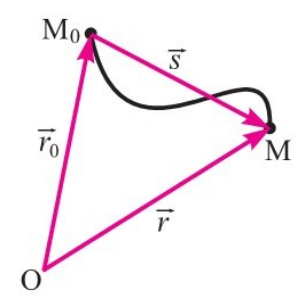
Displacement is a vector quantity. Vectors have both magnitude and direction. Saying "one block" isn't enough; you have to say "one block to the east." Direction is part of the measurement.
Vector
noun
A quantity that has both a magnitude and a direction.
Seeing the Difference
The distinction is clearest when your path isn't a straight line. If you run a full lap around a 400-meter track, your distance traveled is 400 meters. But because you end up exactly where you started, your displacement is zero.
In the diagram above, the winding blue path shows the actual route taken, which is the distance. The straight red arrow from the starting point to the ending point is the displacement.
Displacement is often represented by the symbol or , where (delta) means "change in." The formula is simple:
Key Differences
Let's summarize the main points.
| Feature | Distance | Displacement |
|---|---|---|
| Type | Scalar (magnitude only) | Vector (magnitude and direction) |
| Path | The total length of the path traveled. | The shortest path from start to finish. |
| Value | Can only be positive or zero. | Can be positive, negative, or zero. |
| Example | Running 400m around a track. | Finishing a lap, your displacement is 0m. |
Understanding this distinction is the first step in describing motion. Without it, things can get confusing very quickly.
Time to check your understanding.
A quantity that has both magnitude and direction is called a ________.
You walk 5 blocks north to a park, then walk 5 blocks south back to your starting point. What is your total displacement?
Now that you can distinguish between how far something has moved and where it ended up, you're ready to explore how fast it's moving.