Foundations of Modern Combat Systems
Biomechanical Striking Efficiency
The Body as a Whip
A powerful strike isn’t born in the fist or the foot. It starts from the ground. Think of the human body as a whip. The handle is your connection to the floor, and the tip is the striking limb. To make the whip crack, you don't just flick your wrist; you initiate a wave of energy that travels from your hand, up the leather, accelerating until the tip breaks the sound barrier. This is the principle of the kinetic chain in striking.
Energy is generated by the large, powerful muscles of the legs and hips, then transferred sequentially through the torso, shoulder, and finally into the arm or leg. Each segment builds on the momentum of the last. A boxer’s cross isn't just an arm punch; it’s a whole-body event. The back foot pivots, the hip and torso rotate, and the shoulder follows, slingshotting the fist toward the target. It's a cascading release of force.
By leveraging the kinetic chain, optimizing speed through relaxation, and training with intention, martial artists can develop more powerful and faster strikes.
Rotational Power
The engine of the kinetic chain is rotation. The pivot of the foot, the turn of the hip, and the rotation of the torso create torque, which is the foundation of knockout power. The Muay Thai roundhouse kick is perhaps the purest expression of this principle. Unlike a snap kick that primarily uses knee extension, the Muay Thai kick is a full-body rotation into the target, turning the leg into a baseball bat.
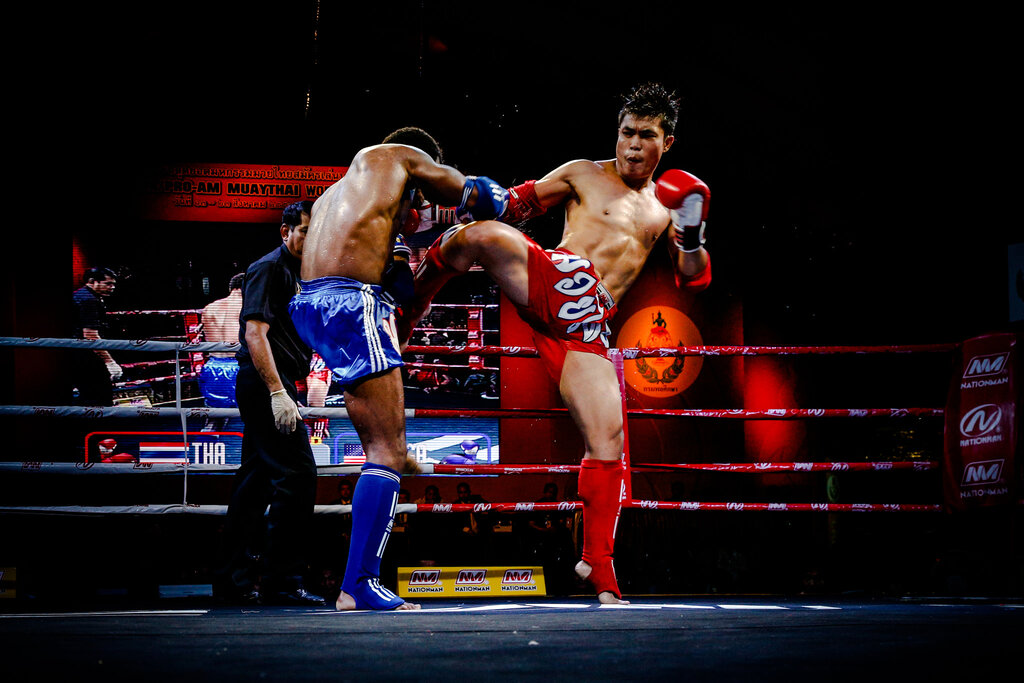
This rotational force is transferred through the body’s —interconnected networks of muscles, fascia, and ligaments that cross the body in diagonal patterns. When a fighter pivots and rotates their hips, these slings load with elastic energy, like a rubber band being stretched. As the strike is thrown, this energy is released, dramatically amplifying the speed and power of the movement. The body itself becomes a coiled spring.
At the moment of impact, another crucial event happens: stiffening. Elite strikers momentarily contract their entire kinetic chain—from their core to their limb—at the precise instant of contact. This action maximizes the transfer of effective mass into the target. Instead of the limb being a light, fast object, the whole coordinated body mass is driven through the point of impact. It’s the difference between being hit by a switch and being hit by a telephone pole.
Stances and Trade-Offs
The way a fighter stands dictates which weapons are easiest to deploy. The choice of stance creates inherent advantages and disadvantages in power generation and defense.
| Stance | Power Generation | Vulnerabilities |
|---|---|---|
| Muay Thai (Square) | Excellent for rotational power. Hips are pre-oriented to throw powerful roundhouse kicks with either leg. | Larger frontal target, making it more susceptible to linear punches like the jab and cross. |
| Boxing (Bladed) | Optimized for linear power. Aligns the rear hand for a straight, powerful cross and facilitates rapid in-and-out movement. | Rotational power is limited, especially with the lead leg. The lead leg is also a prime target for low kicks. |
A Muay Thai fighter’s square stance keeps their hips open, ready to generate torque for a devastating kick from either side. However, this presents a flatter, wider target to an opponent. A boxer’s bladed stance minimizes this target, making them harder to hit with straight punches, and perfectly loads the rear hip to fire a cross. The trade-off is that throwing a powerful kick from this position requires a more significant, and thus slower, setup.
According to the principle of the kinetic chain, where does the power for a powerful strike primarily originate?
What is the primary engine that creates the knockout power described in the text?
Understanding these biomechanical principles is what separates a novice from an expert. It's not just about moving your limbs, but about channeling energy through a precisely coordinated system.