Foundations of Modern Chemistry
Atomic Structure Deep
An Atom's Address System
Electrons don't circle the nucleus like tiny planets. Instead, they exist in fuzzy clouds of probability called orbitals. To describe an electron's state within an atom—its energy, the shape of its orbital, and its orientation—we use a set of four which act like a unique address.
Think of it like finding a specific person in a large apartment building. The principal quantum number () is the building floor, indicating the main energy level. The azimuthal quantum number () is the type of apartment on that floor—a studio, a one-bedroom, etc.—which defines the orbital's shape. The magnetic quantum number () specifies the orientation of that apartment, like which way its windows face. Finally, the spin quantum number () describes the electron itself, which can have one of two intrinsic spins.
| Quantum Number | Symbol | Describes | Possible Values |
|---|---|---|---|
| Principal | Energy Level & Size | ||
| Azimuthal | Orbital Shape | ||
| Magnetic | Orbital Orientation | ||
| Spin | Electron Spin |
The Shape of an Electron's Home
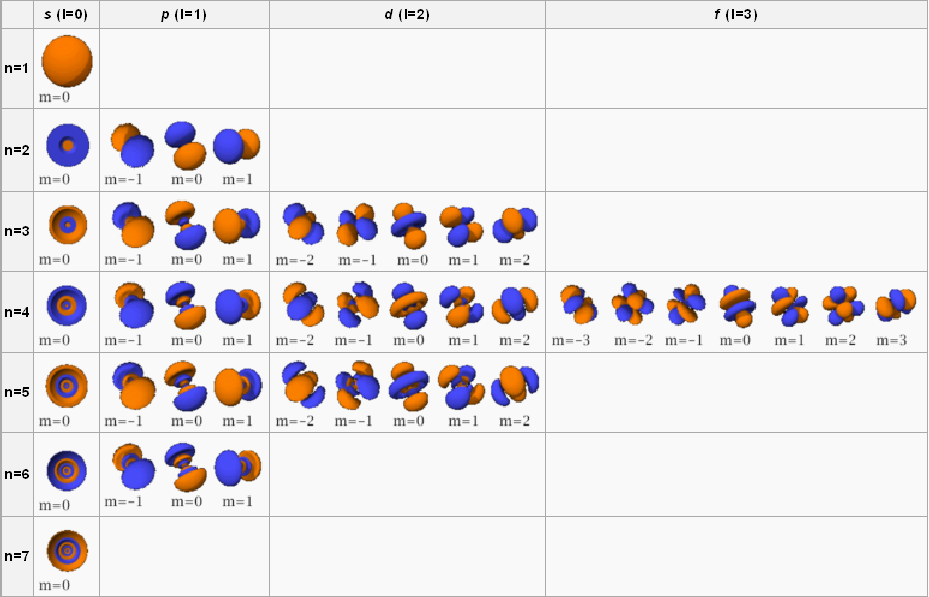
The azimuthal quantum number, , determines the shape of the where an electron is likely to be found. Chemists often use letters as a shorthand for the value of .
| Value of | Orbital Type |
|---|---|
| 0 | s (sharp) |
| 1 | p (principal) |
| 2 | d (diffuse) |
| 3 | f (fundamental) |
An s orbital is spherical. Every energy level () has one. A p orbital is shaped like a dumbbell and exists in three perpendicular orientations along the x, y, and z axes (). These only appear from the second energy level onwards ().
The d and f orbitals, which appear at higher energy levels ( for d, for f), have more complex, multi-lobed shapes.
Filling the Orbitals
An atom's electron configuration is the distribution of its electrons among the various atomic orbitals. This arrangement isn't random; it follows a set of rules that lead to the most stable, lowest-energy state.
Aufbau Principle
noun
States that electrons fill atomic orbitals of the lowest available energy levels before occupying higher levels. The word 'Aufbau' is German for 'building up'.
Two other rules govern how electrons occupy orbitals within a subshell.
Pauli Exclusion Principle: No two electrons in the same atom can have the same set of four quantum numbers. Since they are in the same orbital ( are the same), their spins () must be opposite. This means an orbital can hold a maximum of two electrons, with opposite spins.
Hund's Rule: For orbitals of equal energy (like the three p-orbitals), electrons will fill each orbital singly before any orbital gets a second electron. These unpaired electrons will have the same spin.
Let's see how this works for a nitrogen atom, which has 7 electrons. We can write its electron configuration and draw an orbital diagram.
Electron Configuration: $1s^2 2s^2 2p^3$ This notation shows the principal energy level ($n$), the orbital type ($l$), and a superscript for the number of electrons in that subshell.
Configuration and the Periodic Table
The structure of the periodic table is a direct consequence of electron configuration. Elements are arranged in blocks corresponding to the type of orbital being filled.
- s-block: Groups 1 and 2, where the outermost electrons are in an s-orbital.
- p-block: Groups 13 to 18, filling p-orbitals.
- d-block: Groups 3 to 12 (the transition metals), filling d-orbitals.
- f-block: The lanthanides and actinides, filling f-orbitals.
The chemical properties of an element are largely determined by its valence electrons—the electrons in the outermost energy level. Elements in the same group have similar valence electron configurations, which is why they share similar chemical behaviours. For example, all alkali metals (Group 1) have a single electron in their outermost s-orbital (), making them highly reactive.
This underlying electronic structure explains periodic trends.
| Trend | Definition | How it Changes |
|---|---|---|
| Atomic Radius | Half the distance between the nuclei of two bonded atoms. | Decreases left to right across a period; Increases down a group. |
| Ionization Energy | The energy required to remove an electron from a gaseous atom. | Increases left to right across a period; Decreases down a group. |
| Electronegativity | An atom's ability to attract shared electrons in a chemical bond. | Increases left to right across a period; Decreases down a group. |
Moving across a period, more protons are added to the nucleus, increasing the positive charge. This stronger pulls the electron shells closer, shrinking the atomic radius and making it harder to remove an electron (higher ionization energy). Moving down a group, new electron shells are added, increasing the distance between the valence electrons and the nucleus. This shields them from the nucleus's pull, increasing the radius and making them easier to remove.
Atoms and Light
The quantized nature of electron energy levels has a spectacular consequence: the light emitted by elements.
When an atom is energized—by heat in a flame or electricity in a tube—its electrons can jump to a higher, unoccupied energy level. This excited state is unstable. The electron quickly falls back to a lower energy level, releasing the extra energy as a photon of light. Because the energy difference between any two levels is fixed and unique for each element, the emitted photon has a specific wavelength, and thus a specific colour.
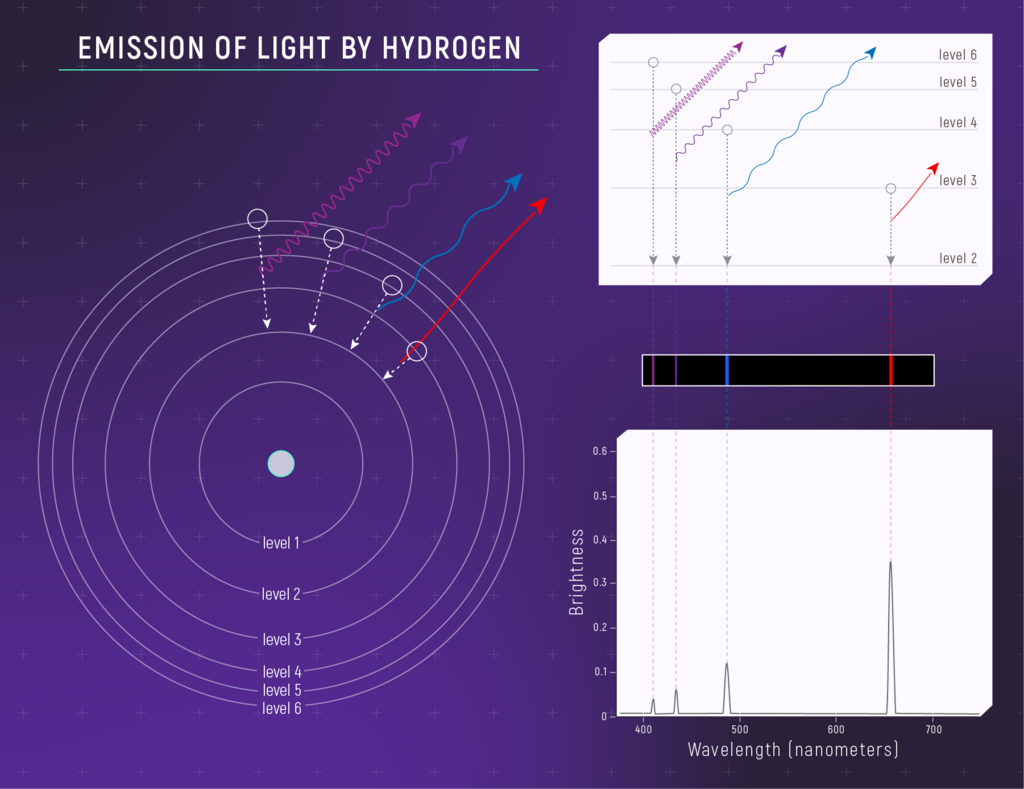
This is why fireworks have different colours. Strontium salts produce brilliant reds, copper creates blues, and barium makes greens. Each colour corresponds to a specific electron transition within that element's atoms. Neon signs work on the same principle; an electric current excites neon gas atoms, which emit their characteristic reddish-orange glow as electrons return to their ground state. This phenomenon, known as atomic emission, is the basis of —a powerful tool used to identify the chemical composition of everything from distant stars to unknown substances in a lab.
Ready to test your knowledge? Let's see how these concepts fit together.
Using the analogy of an electron's address in an atom to a person's address in an apartment building, what does the principal quantum number () represent?
What is the correct electron configuration for a neutral nitrogen atom, which has 7 electrons?
Understanding how electrons arrange themselves in an atom is the key to unlocking why elements behave the way they do. This foundation allows us to predict bonding, reactivity, and the properties of matter.