Foundations of Modern AI
Introduction to Artificial Intelligence
What Is Artificial Intelligence?
Artificial intelligence, or AI, is about creating machines that can think, learn, and solve problems like a human. It's a broad field in computer science focused on simulating intelligent behavior. This doesn't just mean building a robot that can walk and talk, but also creating software that can understand language, recognize images, or make strategic decisions.
At its core, AI is a system's ability to interpret external data correctly, learn from it, and use those learnings to achieve specific goals through flexible adaptation.
Think about how you recommend a movie to a friend. You consider what they've liked before, what genre they enjoy, and maybe even their current mood. AI recommendation systems on streaming services do something similar, just on a much larger scale. They analyze your viewing history to suggest what you might want to watch next.
A Quick Trip Through Time
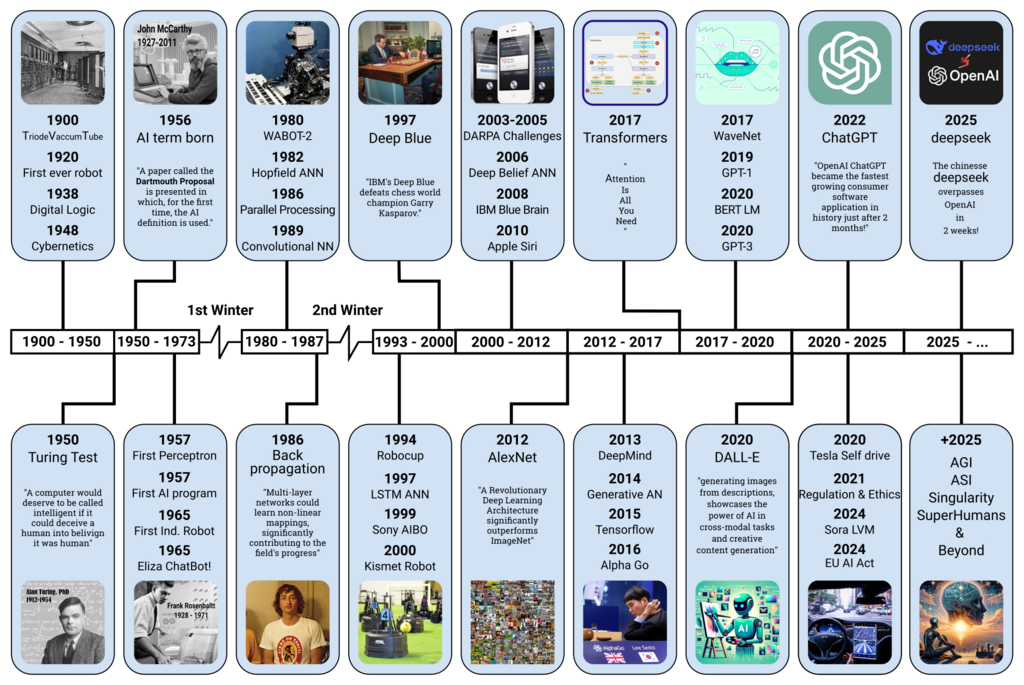
The idea of artificial beings has been around for centuries in myths and stories, but the scientific pursuit of AI began in the mid-20th century. The field was officially born in 1956 at a workshop at Dartmouth College, where the term "artificial intelligence" was coined. Early researchers were incredibly optimistic, believing that a machine with human-like intelligence was just a few decades away.
Progress wasn't always a straight line. The field experienced periods known as "AI winters," when funding and interest dried up due to overly ambitious promises and limited computing power. However, breakthroughs in the last few decades, fueled by more powerful computers and vast amounts of data, have led to the rapid advancements we see today.
From Rules to Learning
Early AI systems operated on a simple principle: rules. Programmers would hand-code a huge set of explicit, if-then instructions. For example, an early chatbot might be programmed with the rule: IF a user says "hello," THEN respond with "Hi, how can I help you?"
This approach is known as rule-based AI or "Good Old-Fashioned AI" (GOFAI). It's great for problems with clear, predictable rules, like playing chess or managing inventory. However, it's brittle. If you encounter a situation that isn't covered by a rule, the system breaks down.
The game-changer was a shift in thinking: What if, instead of programming the rules, we let the machine figure them out on its own? This is the core idea behind machine learning, a major subfield of AI.
With machine learning, developers don't write step-by-step instructions. Instead, they feed the system a large amount of data and let it learn patterns. To build a system that can identify cats in photos, you wouldn't write rules about pointy ears or whiskers. You would show it thousands of pictures labeled "cat" and let the algorithm learn what features cats share.
The Branches of AI
AI isn't just one thing; it's a collection of specialized subfields, each focused on a different aspect of intelligence. Machine learning is the largest branch, but there are others.
| Subfield | What it does | Example |
|---|---|---|
| Machine Learning | Enables systems to learn and improve from experience without being explicitly programmed. | An email service learning to filter out spam. |
| Natural Language Processing (NLP) | Focuses on the interaction between computers and human language. | Voice assistants like Siri or Alexa understanding your commands. |
| Computer Vision | Gives machines the ability to "see" and interpret the visual world. | A phone unlocking by recognizing your face. |
| Robotics | Involves the design, construction, and operation of robots. | Automated machines assembling cars on a factory line. |
These fields often overlap. For example, a self-driving car uses computer vision to see the road, machine learning to make driving decisions, and robotics to control the car's movements. Together, they form the foundation of the AI technology shaping our world.
What is the fundamental goal of artificial intelligence?
What is the key difference between early rule-based AI systems and modern machine learning systems?
From its early days of hand-coded rules to the data-driven learning of today, AI continues to evolve, finding new ways to solve complex problems and augment human capabilities.