Foundations of Mathematics A Complete Journey
Basic Arithmetic
The Building Blocks of Math
Arithmetic is the foundation for all of mathematics. It's built on four basic operations: addition, subtraction, multiplication, and division. Understanding these is like learning the alphabet before you can read. Let's start with the first pair.
Putting Together and Taking Apart
Addition is about combining things. If you have 3 apples and you get 2 more, you add them together to find the total. Subtraction is the opposite; it's about taking things away or finding the difference between two amounts. If you have 5 apples and eat 2, you subtract to see how many are left.
Sum
noun
The result of adding two or more numbers together.
When working with numbers larger than 9, we use place value. Each digit in a number has a value based on its position: the ones place, the tens place, the hundreds place, and so on. To add or subtract multi-digit numbers, you stack them vertically, lining up the place values.
Always line up the ones with the ones, the tens with the tens, and so on. This keeps your calculation organized and accurate.
Let's walk through an example. To add 158 and 265, we start from the right, in the ones column.
Subtraction works similarly, but sometimes you need to "borrow" from the column to the left if the top digit is smaller than the bottom one.
Scaling Up and Splitting Down
Multiplication is a shortcut for repeated addition. Instead of writing , you can simply write . Both equal 12. This is useful when you have multiple groups of the same size. For instance, 3 boxes with 4 apples each gives you 12 apples in total.
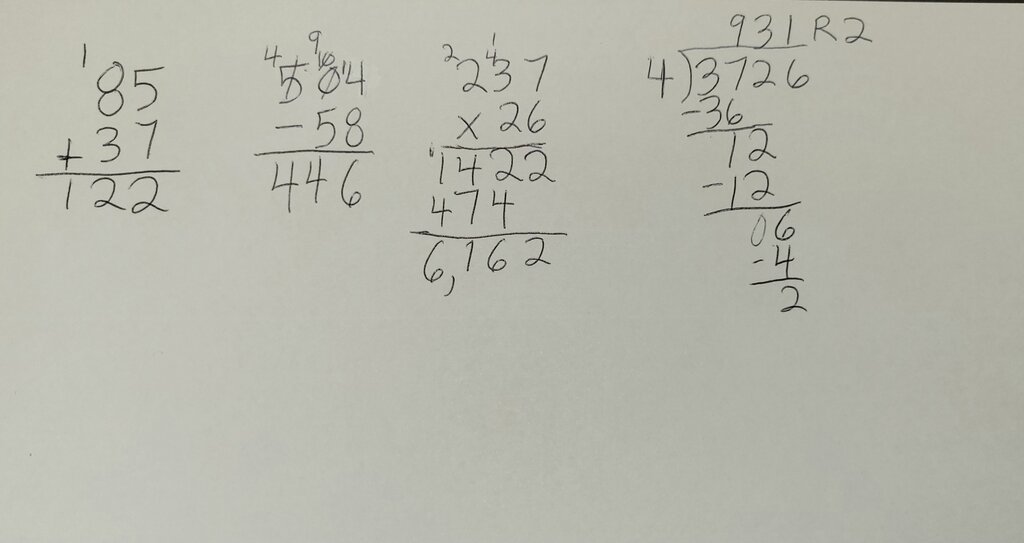
Division is the opposite of multiplication. It's about splitting a quantity into equal groups or finding out how many times one number fits into another. If you have 12 apples and want to split them among 3 friends, you divide. Each friend gets 4 apples.
Product
noun
The result of multiplying two or more numbers.
The Rules of the Road
Arithmetic operations follow certain rules, or properties, that make calculations predictable and consistent. Two of the most important are the commutative and associative properties.
The Commutative Property means you can swap the order of numbers in addition or multiplication and still get the same result. Think of it like commuting to work: the distance is the same whether you go from home to work or from work to home.
The Associative Property means you can change how numbers are grouped in a long addition or multiplication problem without changing the answer. It’s about how numbers associate with each other.
Notice that these properties don't apply to subtraction or division. The order and grouping matter for those operations. $5 - 3$ is not the same as $3 - 5$!
Working with Parts of a Whole
Arithmetic isn't just for whole numbers. It also works with fractions and decimals, which represent parts of a whole.
A fraction like represents one part of something that has been divided into two equal pieces. A decimal like represents the exact same value. They are just different ways of writing the same number.
When adding or subtracting fractions, they must have a common denominator. That means the bottom number of each fraction must be the same. If they aren't, you have to adjust them first.
Multiplying fractions is more direct. You just multiply the numerators together and the denominators together.
Working with decimals is often simpler because it follows the same rules as whole numbers. The key is to keep the decimal points aligned when adding and subtracting.
  12.50
+  3.75
-------
  16.25
This foundation in arithmetic opens the door to solving all kinds of practical problems.
Which of the following operations is the opposite of division?
When adding or subtracting multi-digit numbers like 158 and 265, you should align the numbers based on their:
With these basics, you can begin to see how numbers work in the world around you.