Foundations of Mathematics
Basic Arithmetic
The Building Blocks
Arithmetic is the foundation of math. It's the art of working with numbers. We start with the most basic type: whole numbers. These are the counting numbers you already know (0, 1, 2, 3, ...) without any fractions or decimals.
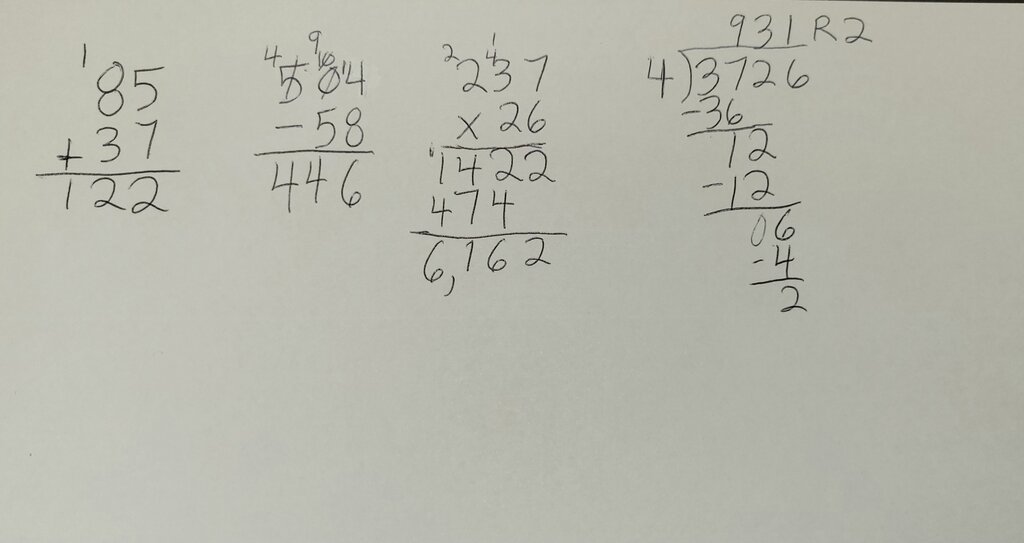
There are four fundamental operations we can perform with these numbers.
| Operation | Symbol | What it does |
|---|---|---|
| Addition | + | Combines values. |
| Subtraction | - | Finds the difference between values. |
| Multiplication | × or * | Adds a number to itself a set number of times. |
| Division | ÷ or / | Splits a number into equal parts. |
Think about it this way: If you have 3 apples and someone gives you 2 more, you add them together to get 5. If you eat 1 of those apples, you subtract to find you have 4 left. It’s that simple.
Rules of the Road
Numbers follow certain rules, or properties, that make calculations predictable and easier. Understanding them helps build your "number sense," which is your intuition for how numbers work.
The Commutative Property: The order doesn't matter for addition and multiplication. For example, is the same as . Similarly, is the same as .
This property does not apply to subtraction or division. You can see right away that $5 - 3$ is very different from $3 - 5$.
The Associative Property: When you're only adding or only multiplying, you can group the numbers in any combination. is the same as . Both equal 9.
These properties are like grammar rules for math. They ensure that everyone gets the same answer to the same problem.
Beyond Whole Numbers
Of course, we don't always deal with whole things. We often need to work with parts of a whole. This is where fractions, decimals, and percentages come in. They are just different ways of expressing the same idea.
Fraction
noun
A number that represents a part of a whole, written as one number over another (the numerator over the denominator).
Imagine a pizza cut into 8 equal slices. If you eat 3 slices, you've eaten $3/8$ of the pizza. Here, 3 is the numerator (how many parts you have) and 8 is the denominator (the total number of parts).
Decimals are another way to write fractions. They are based on the number 10. The fraction is the same as the decimal . The fraction is the same as .
Percentages are fractions out of 100. The word "percent" literally means "per hundred." So, 50% is just another way of saying 50 out of 100, which is the fraction or the decimal .
You can perform all four basic operations on fractions and decimals, too. For instance, adding fractions requires finding a common denominator.
Adding decimals is even simpler. You just line up the decimal points and add as you would with whole numbers.
Knowing how to convert between these forms is a key skill. If a store offers a 25% discount on a $100 item, you can calculate the savings as $25. Or, you could think of it as of $100, which is also $25.
Which of the following are the four fundamental operations of arithmetic?
In the fraction , the number 8 is called the denominator.
Mastering these basics is the first and most important step in your math journey. Every complex problem is built on these simple ideas.