Foundations of Mathematical Sets
Introduction to Sets
Collections and Groups
In mathematics, we often need to group things together. Think about your favorite songs, the planets in our solar system, or the vowels in the alphabet. Each of these is a collection of specific, distinct items. This simple idea of a collection is one of the most fundamental concepts in math.
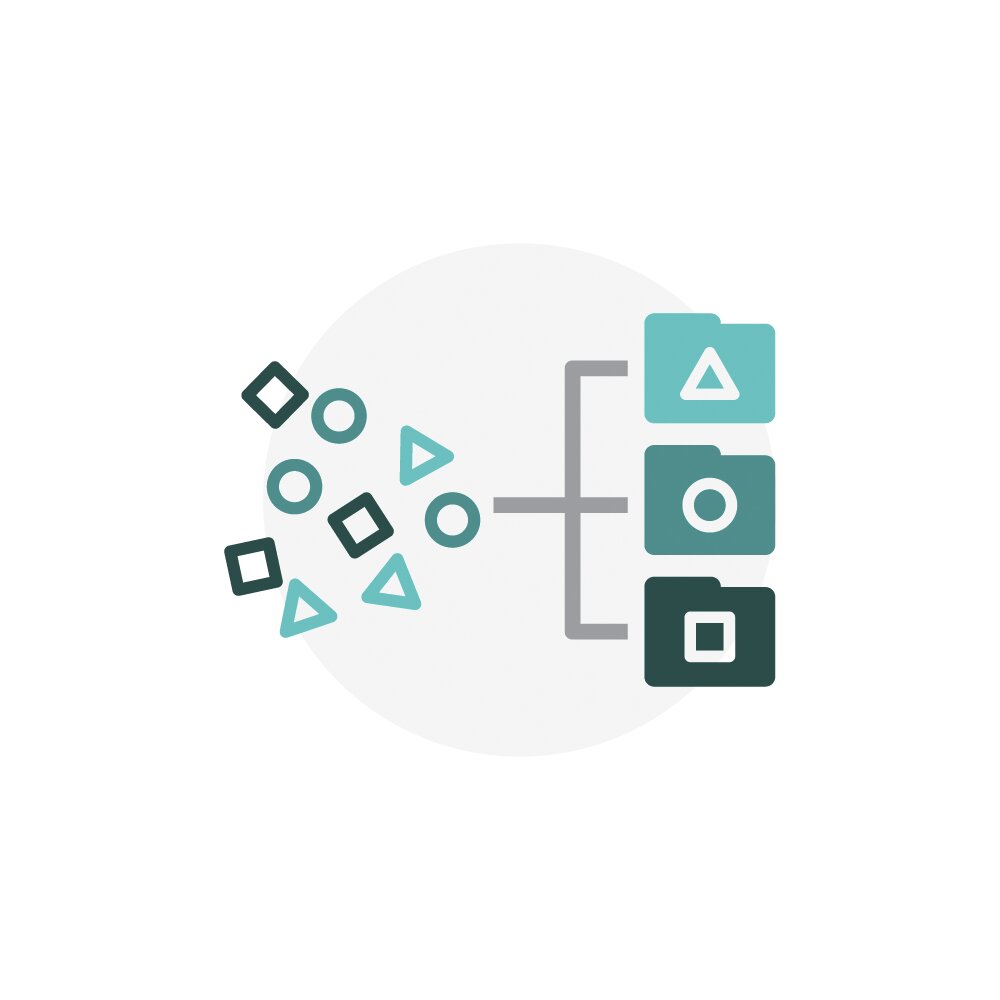
We call these collections sets. A set is a collection of distinct objects, where each object is called an element or a member of the set. Two key ideas here are "well-defined" and "distinct."
- Well-defined means we can tell for certain whether an object belongs in the set or not. The "set of tall people" isn't well-defined because "tall" is subjective. But the "set of people over six feet tall" is well-defined.
- Distinct means that each element in a set is unique. We don't list the same item more than once.
Set
noun
A well-defined collection of distinct objects.
Set Notation
To write a set, we use curly braces {} and list the elements inside, separated by commas. We usually give sets a name using a capital letter.
For example, if we want to define a set V that contains the vowels of the English alphabet, we would write it like this:
Here's another example. Let's create a set N of the first five positive whole numbers:
There are two important rules for writing sets.
First, the order of elements doesn't matter. The set
{1, 2, 3}is exactly the same as{3, 1, 2}.Second, elements are not repeated. The collection
{a, b, a, c}would just be written as the set{a, b, c}.
Membership in a Set
Once we have a set, we often want to talk about whether something is in it. We use special symbols for this.
The symbol means "is an element of." The symbol means "is not an element of."
Let's use our set of vowels, . We can say that 'i' is an element of V and 'b' is not.
Here's how it works with our number set, :
| Statement | Meaning |
|---|---|
| 3 is an element of N. (True) | |
| 7 is not an element of N. (True) | |
| 1 is not an element of N. (False) |
This simple notation helps us be precise about what belongs in our collections.
Ready to check your understanding?
What is a mathematical set?
Which of the following is a well-defined set?
And that's the basic idea of a set. It's a simple but powerful tool for organizing information, and it's the starting point for many other ideas in mathematics.