Foundations of Mathematical Analysis
Real Numbers
Beyond the Rationals
So far, we've dealt with rational numbers, which are any numbers you can write as a fraction, like or . They're incredibly useful, but they don't tell the whole story. There are gaps on the number line that fractions can't fill.
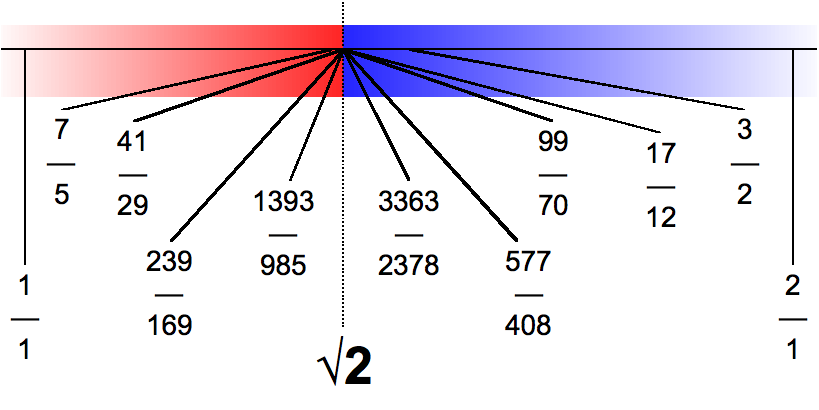
Consider the number . You can get closer and closer to it with fractions (, , , ...), but you can never write it perfectly as one. Numbers like this are called irrational. The real numbers, denoted by the symbol , are the set of all rational and irrational numbers combined. They create a complete, continuous line with no gaps.
The real numbers follow familiar rules for arithmetic. Addition and multiplication are commutative () and associative (), and they work together through the distributive property (). There are also identity elements (0 for addition, 1 for multiplication) and inverses for every number (like and ).
They also have a natural order. For any two real numbers and , one and only one of the following is true: , , or . This allows us to arrange them on the number line.
Filling in the Gaps
What truly separates the real numbers from the rationals is a property called completeness. The Completeness Axiom states that the real number line has no holes. It's a continuous, unbroken line.
To understand this, let's think about sets of numbers. An upper bound of a set is a number that is greater than or equal to every number in the set. A lower bound is a number that is less than or equal to every number in the set.
For example, consider the set . The number 4 is an upper bound, and so are 3, 5, and 100. The number 0 is a lower bound, and so are 1, -5, and -10.
The Completeness Axiom guarantees that for any non-empty set of real numbers that has an upper bound, there must be a least upper bound. The same is true for lower bounds.
This leads us to two important concepts.
supremum
noun
The least upper bound of a set of numbers. It's the smallest number that is greater than or equal to all numbers in the set. It is often denoted as sup(S).
And its counterpart:
infimum
noun
The greatest lower bound of a set of numbers. It's the largest number that is less than or equal to all numbers in the set. It is often denoted as inf(S).
Now, let's look at a more interesting set: all rational numbers whose square is less than 2. This set has plenty of upper bounds (like 2, 1.5, or 1.42). But what is its least upper bound within the rational numbers? There isn't one! You can always find another rational number that's a little smaller but still an upper bound.
This is a 'hole' in the rational numbers. The real numbers fix this. The supremum of this set in the real numbers is exactly . The completeness property ensures that such a number exists to fill the gap.
A Dense Crowd
Even though the real number line is packed with irrational numbers, the rationals are still everywhere. This property is called density.
The Density of Rationals states that between any two different real numbers, you can always find a rational number. No matter how close two real numbers are, there's a fraction sitting between them.
Think about the numbers 3.141592 and 3.141593. They're very close. But we can easily find a rational number between them, like 3.1415925.
This might seem contradictory. How can the line be full of irrationals if there's always a rational next door? It's because there are also irrationals between any two reals. Both sets are infinitely dense, woven together to form the complete number line we use in calculus and beyond.
Time to check your understanding.
Which of the following best describes the set of real numbers, denoted by ?
What fundamental property of real numbers ensures that there are no 'gaps' or 'holes' on the number line?
Understanding these properties of real numbers—their structure, completeness, and the density of rationals within them—is the foundation for exploring the core concepts of mathematical analysis.