Foundations of Machine Learning
Machine Learning Defined
Learning Without Rules
Computers are famous for following instructions. For decades, programming meant giving a computer a very specific, rigid set of rules. Think of it like a recipe: do this, then do that. If you wanted to build an email spam filter this way, you'd have to create a massive list of rules yourself.
You might tell it: "If an email contains the words 'free,' 'money,' and 'guaranteed,' mark it as spam." This works for a while. But spammers adapt. They start using words like 'fr3e' or 'm0ney.' You would have to go back and add new rules for every single variation, forever.
This traditional approach is brittle. It breaks easily and requires constant manual updates.
Machine Learning (ML) flips this idea on its head. Instead of writing the rules, you give the computer a tool to create its own rules by finding patterns in data. For our spam filter, you would feed it millions of emails—some you've labeled as 'spam' and some as 'not spam.'
The computer, using a special recipe called an algorithm, analyzes all of them. It starts to notice patterns that you might miss. Maybe spam emails often come at 3 AM, use lots of exclamation points, or have strange sender addresses. The machine learns these associations on its own. It builds its own internal logic for what spam looks like, without you having to spell it out.
Algorithm
noun
A process or set of rules to be followed in calculations or other problem-solving operations, especially by a computer.
The core idea is that the machine improves through experience, just like a person. The more data it sees, the better its pattern recognition becomes. This is why Netflix can recommend shows you'll probably like. It's not because someone at Netflix wrote a rule that says, "People who like Stranger Things also like The Witcher." It's because their ML system analyzed the viewing habits of millions of people and discovered that pattern automatically.
AI vs. Machine Learning
People often use the terms Artificial Intelligence (AI) and Machine Learning (ML) interchangeably, but they aren't the same. Artificial Intelligence is the broad, overarching goal of creating machines that can simulate human intelligence. This could include reasoning, planning, understanding language, or perceiving the world.
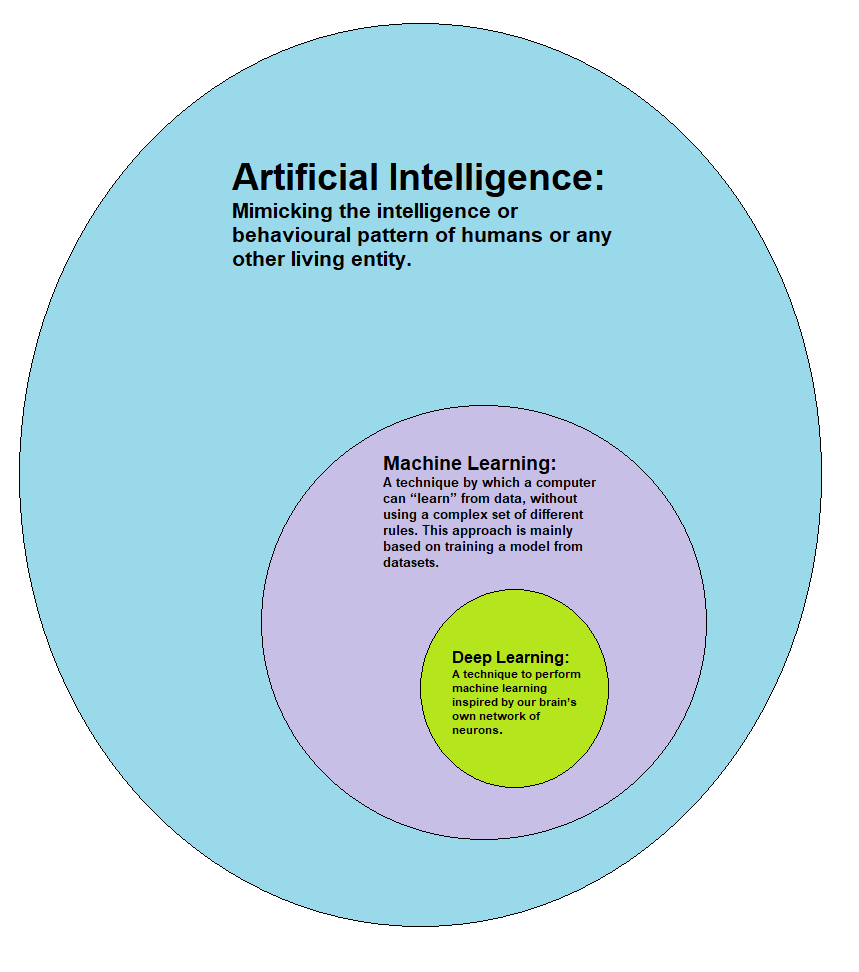
Machine Learning is one of the most powerful and common ways to achieve AI. It's a subset of the field, specifically focused on the part where machines learn from data. Think of AI as the entire field of robotics, and ML as the specific invention of a flexible, learning arm. The arm is a part of the robot, but it isn't the whole robot.
Prediction Machines
At its heart, Machine Learning is about one thing: prediction. Based on past data, it makes an educated guess about new, unseen data.
- Spam Filter: Predicts whether a new email is spam.
- Netflix: Predicts whether you will enjoy a particular movie.
- Weather App: Predicts tomorrow's temperature based on historical weather patterns.
Instead of being programmed with instructions, ML models are trained on examples. They are pattern-recognition engines that turn data into forecasts. This shift from instruction to learning is what makes modern AI so powerful and versatile.
Time to test your understanding.
What is the fundamental difference between traditional programming and Machine Learning (ML)?
According to the text, what is the core function of Machine Learning?