Foundations of Logical Thinking
Introduction to Logical Reasoning
The Structure of an Argument
In logic, an argument isn't about shouting or disagreeing. It's a structured set of statements designed to prove a point. Think of it like building a case. You start with your evidence and build towards a final point. These pieces have specific names: premises and conclusions.
Premise
noun
A statement or piece of evidence offered in support of a conclusion.
Premises are the building blocks of your argument. They are the facts or assumptions you present as true.
For example: Premise 1: All birds have feathers. Premise 2: A robin is a type of bird.
Conclusion
noun
The final statement in an argument that is claimed to follow logically from the premises.
The conclusion is the main point you are trying to make, the logical result of your premises. Using our example, the premises lead to a clear conclusion.
Conclusion: Therefore, a robin has feathers.
Two Paths of Reasoning
So, we have our premises and our conclusion. But how do we get from one to the other? Logic provides two main paths for this journey: deductive reasoning and inductive reasoning. They work in very different ways.
Using logic, a person evaluates arguments and reasoning and strives to distinguish between good and bad reasoning or between truth and falsehood.
Deductive reasoning aims for certainty. In a solid deductive argument, if the premises are true, the conclusion must also be true. There's no other possibility. It's like a mathematical proof where the conclusion is guaranteed by the starting points.
Deduction often moves from a general rule to a specific case.
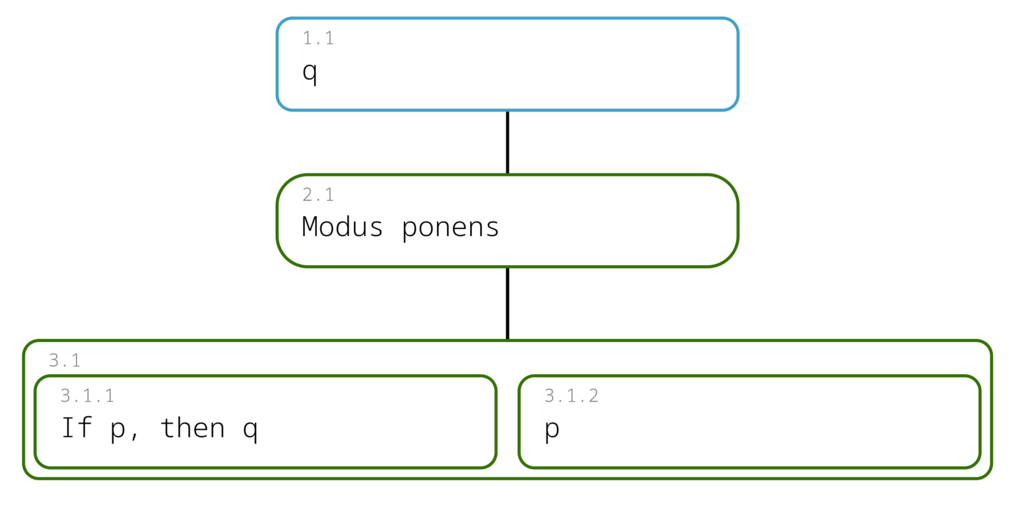
Premise 1: All men are mortal. Premise 2: Socrates is a man. Conclusion: Therefore, Socrates is mortal.
This is a classic example of deduction. Because the first two statements are true, the conclusion about Socrates has to be true. There’s no room for doubt. The conclusion is contained within the premises.
Inductive reasoning, on the other hand, deals in probability, not certainty. It involves looking at specific observations and then making a general conclusion based on them. With induction, even if all your premises are true, the conclusion is only likely to be true, not guaranteed.
Think of it as making an educated guess based on a pattern of evidence.
Premise 1: The sun rose this morning. Premise 2: The sun has risen every morning in recorded history. Conclusion: Therefore, the sun will rise tomorrow.
Based on all available evidence, this conclusion is extremely probable. We'd bet our lives on it. But is it 100% certain? No. It is logically possible, however unlikely, that some cosmic event could prevent the sun from rising. Because the conclusion isn't guaranteed, the reasoning is inductive.
Why Logic Matters
Understanding these basic principles isn't just for philosophers. We use logical reasoning every day, whether we realize it or not.
When you troubleshoot a problem with your Wi-Fi, you might use deduction: 'If the router light is off, it has no power. The light is off. Therefore, it has no power.'
When you decide to bring an umbrella because the sky is dark and cloudy, you're using induction: 'In the past, these clouds have meant rain. Therefore, it will probably rain today.'
Learning to think logically helps you build stronger arguments, spot weaknesses in others' claims, and make better decisions. It's a toolkit for thinking more clearly about the world.
In the context of logic, what is an 'argument'?
Consider the following argument: 'All dogs are mammals. Fido is a dog. Therefore, Fido is a mammal.' Which part is the conclusion?