Foundations of Logic
Introduction to Logic
What Is Logic?
Logic is the study of how we reason. It's not about what we think, but how we think. It provides a framework for building sound arguments and spotting flawed ones. Think of it as the grammar of reasoning. Just as grammar gives rules to language so we can communicate clearly, logic gives rules to thought so we can reason clearly.
Logic
noun
The study of the principles of correct reasoning and valid inference.
At its core, logic deals with arguments. An argument isn't a heated disagreement. In logic, it's a set of statements, called premises, that are offered as reasons for another statement, called the conclusion.
Premises are the evidence. The conclusion is what the evidence is supposed to prove.
For example:
- Premise 1: All humans are mortal.
- Premise 2: Socrates is a human.
- Conclusion: Therefore, Socrates is mortal.
Logic helps us analyze whether the path from the premises to the conclusion is a valid one.
Why Bother With Logic?
Logical thinking is a powerful tool. It helps you clarify your own thoughts, express your ideas coherently, and evaluate the arguments of others. Whether you're deciding on a major purchase, participating in a debate, or just trying to make sense of the news, you're using logic.
Developing this skill allows you to move from simply having an opinion to constructing a well-supported position. It's the difference between a gut feeling and a carefully considered judgment.
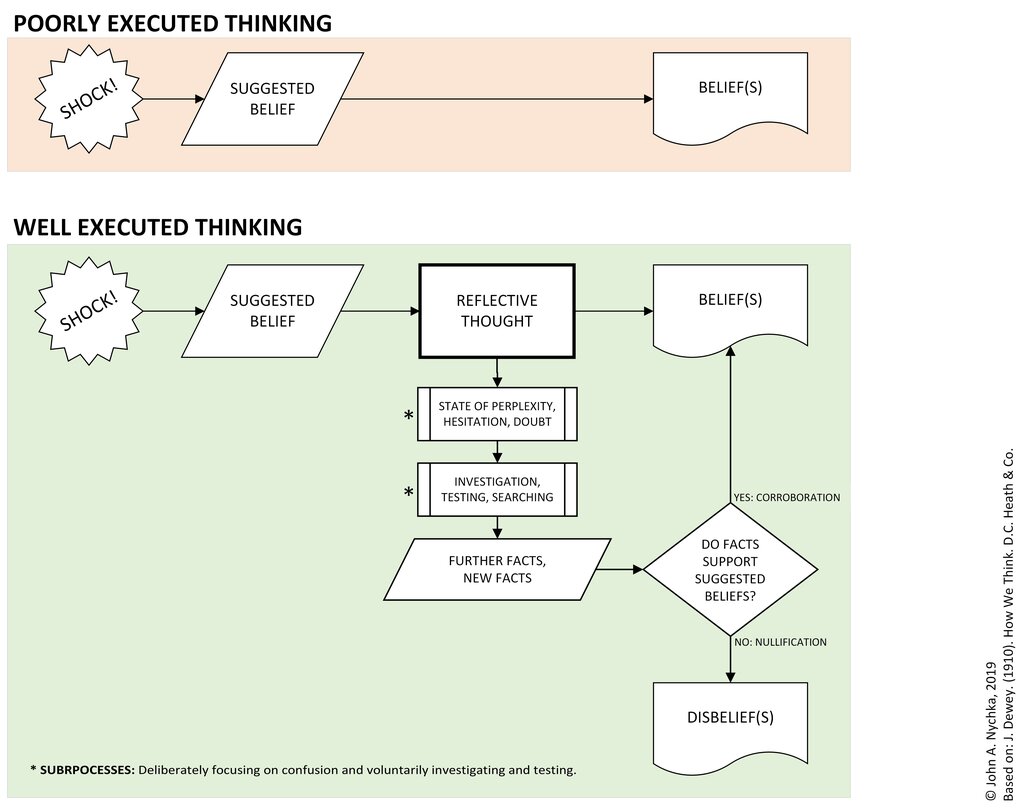
Strong logical reasoning skills are crucial in fields like law, computer science, and engineering, but they're just as valuable in everyday life. They protect you from manipulation and help you make better decisions by filtering out noise and focusing on what's truly relevant.
Two Paths to a Conclusion
Reasoning generally follows two main paths: deductive and inductive. They differ in how they move from premises to conclusions and the certainty they provide.
Deductive reasoning aims for certainty. Inductive reasoning deals with probability.
Deductive Reasoning
Deductive reasoning starts with a general rule (a major premise) and applies it to a specific case (a minor premise) to reach a guaranteed conclusion. If the premises are true, the conclusion must be true. There's no other possibility.
The Socrates example from earlier is a classic case of deductive reasoning. Because the general rule ("All humans are mortal") and the specific fact ("Socrates is a human") are true, the conclusion is undeniable.
Inductive Reasoning
Inductive reasoning works the other way around. It starts with specific observations and uses them to form a general conclusion. It’s about recognizing patterns and making educated guesses.
For instance:
- Observation 1: The sun rose yesterday.
- Observation 2: The sun rose today.
- Conclusion: The sun will probably rise tomorrow.
This conclusion is very likely, but it's not absolutely certain. Inductive reasoning provides strong evidence for a conclusion, but not a guarantee. It's the foundation of the scientific method, where observations lead to hypotheses that are then tested.
| Feature | Deductive Reasoning | Inductive Reasoning |
|---|---|---|
| Direction | General to Specific | Specific to General |
| Starting Point | General principle or theory | Specific observations |
| Conclusion | Guaranteed to be true if premises are true | Likely to be true, but not guaranteed |
| Goal | To prove a conclusion | To predict or generalize |
Both forms of reasoning are essential. Deduction gives us certainty based on what we already know, while induction allows us to expand our knowledge and make predictions about the world.
Time for a quick check. Let's see how well you've grasped these foundational ideas.
What is the primary focus of logic?
In a logical argument, what is the role of a premise?
Understanding these basic building blocks—premises, conclusions, and the different paths of reasoning—sets the stage for exploring the more intricate rules and structures of logic.