Foundations of Linear Algebra
Vectors and Vector Operations
What is a Vector?
Some quantities are simple. If you ask for the temperature, you get a single number: 25°C. If you ask for the price of a coffee, you get another single number: $4. These are called scalars.
But what if you ask for directions? 'Go 3 miles' isn't very helpful. You need more information: 'Go 3 miles north.' That combination of a magnitude (3 miles) and a direction (north) is a vector.
vector
noun
A mathematical object that has both a magnitude (size or length) and a direction.
We often represent vectors as arrows. The arrow's length shows its magnitude, and where it points shows its direction. In a coordinate system, we can describe a 2D vector by its components along the x and y axes. A vector that moves 4 units to the right and 3 units up is written as .
Adding and Subtracting Vectors
Adding vectors isn't like adding regular numbers. You can't just add their lengths. When we add vectors, we add their corresponding components.
For example, let's take two vectors: and . Their sum is a new vector.
Geometrically, this is like following one set of directions and then another. Imagine walking along vector , and then from where you stopped, walking along vector . The vector from your starting point to your final destination is the sum . This is called the 'tip-to-tail' method.
Subtracting vectors works the same way. To find , you just subtract the components.
Geometrically, subtracting is the same as adding a vector that has the same length as but points in the exact opposite direction. This 'opposite' vector is written as . So, is the same as .
Scalar Multiplication
What happens if you multiply a vector by a plain number (a scalar)? This is called scalar multiplication, and it changes the vector's magnitude, or length. It 'scales' the vector up or down.
Take our vector . If we multiply it by the scalar 2, we get a new vector that's twice as long but points in the same direction.
Multiplying by a negative scalar reverses the vector's direction. For instance, multiplying by -1 gives us , a vector of the same length pointing the opposite way.
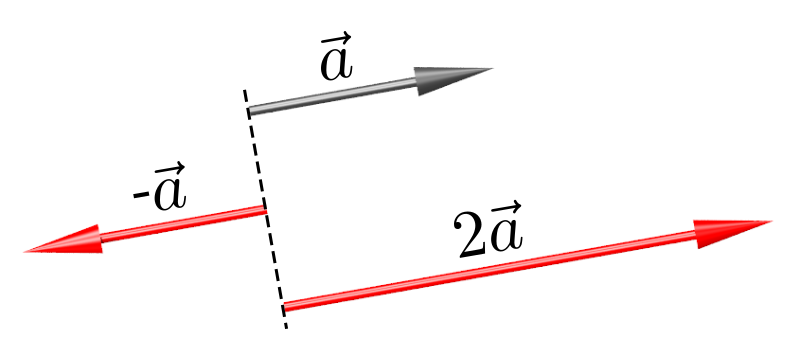
This is incredibly useful. Any time you need to make something stronger, weaker, faster, or slower without changing its direction, you're using scalar multiplication.
Which of the following quantities is a vector?
Given two vectors, and , what is their sum ?