Foundations of Linear Algebra
Vectors as Geometric Objects
Vectors as Arrows in Space
In mathematics and physics, some quantities can be described with a single number. Your height, the temperature outside, the speed of your car — these are all scalars. They have magnitude, but no direction. Vectors are different. They have both magnitude and direction.
A vector is often visualised as an arrow. The length of the arrow represents its magnitude, and the way it points shows its direction. Think of giving someone directions: "Walk 200 metres north." That's a vector. The magnitude is 200 metres, and the direction is north. This dual nature is what makes them so useful for describing forces, velocities, and displacements in space.
Vectors are mathematical objects that possess both magnitude and direction, distinguishing them from scalars, which have only magnitude.
Vector Operations
Because vectors have direction, operating on them isn't as simple as standard arithmetic. The two most fundamental operations are scalar multiplication and vector addition.
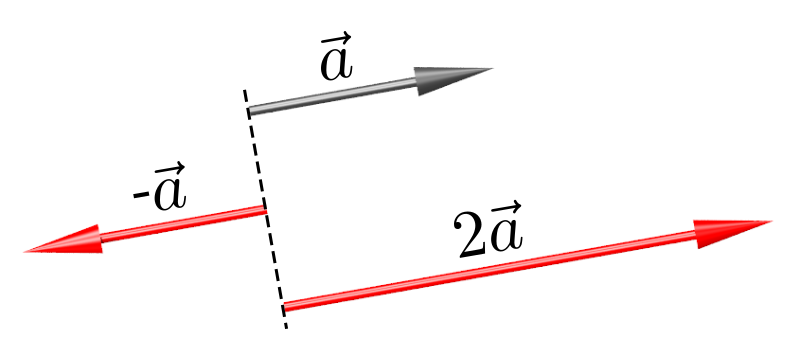
Scalar multiplication is straightforward: multiplying a vector by a scalar changes its magnitude. If you multiply a vector by 2, its arrow becomes twice as long but points in the same direction. Multiply it by -1, and it keeps its length but flips to point in the opposite direction.
Vector addition combines vectors. The most intuitive way to visualise this is the . To add vector to vector , you place the tail of at the head of . The resulting vector, or resultant, is the arrow drawn from the tail of to the head of . This creates a triangle. Vector subtraction, like , is the same as adding a negative vector: .
Products of Vectors
Multiplying two vectors is more complex. There are two main types of vector products: the dot product and the cross product. They serve very different purposes.
The (or scalar product) takes two vectors and returns a single scalar number. Geometrically, it tells you how much one vector points in the direction of another. It's a measure of alignment. If the dot product is positive, the vectors point in generally the same direction. If it's zero, they're perpendicular. If it's negative, they point in generally opposite directions.
The cross product is entirely different. It's defined only for vectors in three-dimensional space and produces a new vector. This new vector has two special properties: its direction is perpendicular to both of the original vectors, and its magnitude is equal to the area of the parallelogram formed by the two original vectors.
The direction of the cross product vector is determined by the . If you curl the fingers of your right hand from the first vector (\{\vec{b}}\{\text{)}}, your thumb will point in the direction of $\{\vec{a}} \times \{\vec{b}}\{\text{)}.
Normalising Vectors
Sometimes, you only care about a vector's direction, not its magnitude. In these cases, it's useful to normalise the vector. This means creating a new vector that points in the same direction but has a magnitude of exactly 1. This new vector is called a unit vector.
Unit Vector
noun
A vector with a magnitude (length) of 1. Unit vectors are used to specify a direction and are often denoted with a circumflex, or 'hat', like .
To normalise any vector, you simply divide it by its own magnitude. This scales the vector down (or up) to a length of 1 without changing its direction.
With these geometric interpretations, vectors move from being abstract lists of numbers to dynamic tools for describing the world around us. Let's test your understanding of these concepts.
What is the fundamental difference between a scalar and a vector?
If you multiply a vector by a scalar value of -3, what happens to the vector?