Foundations of Latin Grammar
Introduction to Latin Nouns
The Building Blocks of Latin
In Latin, just like in English, nouns are the words we use for people, places, things, and ideas. Words like pater (father), Rōma (Rome), stella (star), and pāx (peace) are all nouns. But Latin nouns carry more information than their English counterparts. A Latin noun’s ending tells you about its role in a sentence, whether it's singular or plural, and its gender.
Let's break down these properties.
Gender and Number
Every Latin noun has a gender: masculine, feminine, or neuter. Sometimes the gender is logical, like vir (man), which is masculine. But often, it's just a grammatical feature you have to memorize. For instance, stella (star) is feminine, while bellum (war) is neuter. There's no deep reason for this; it's simply how the language works.
It's best to learn a noun's gender when you first learn the word. Thinking of them as a pair—the word and its gender—will save you a lot of trouble later.
Nouns also have a number, which is more straightforward. They can be singular (one) or plural (more than one). So, stella means "a star," while stellae means "stars."
Introducing Declensions
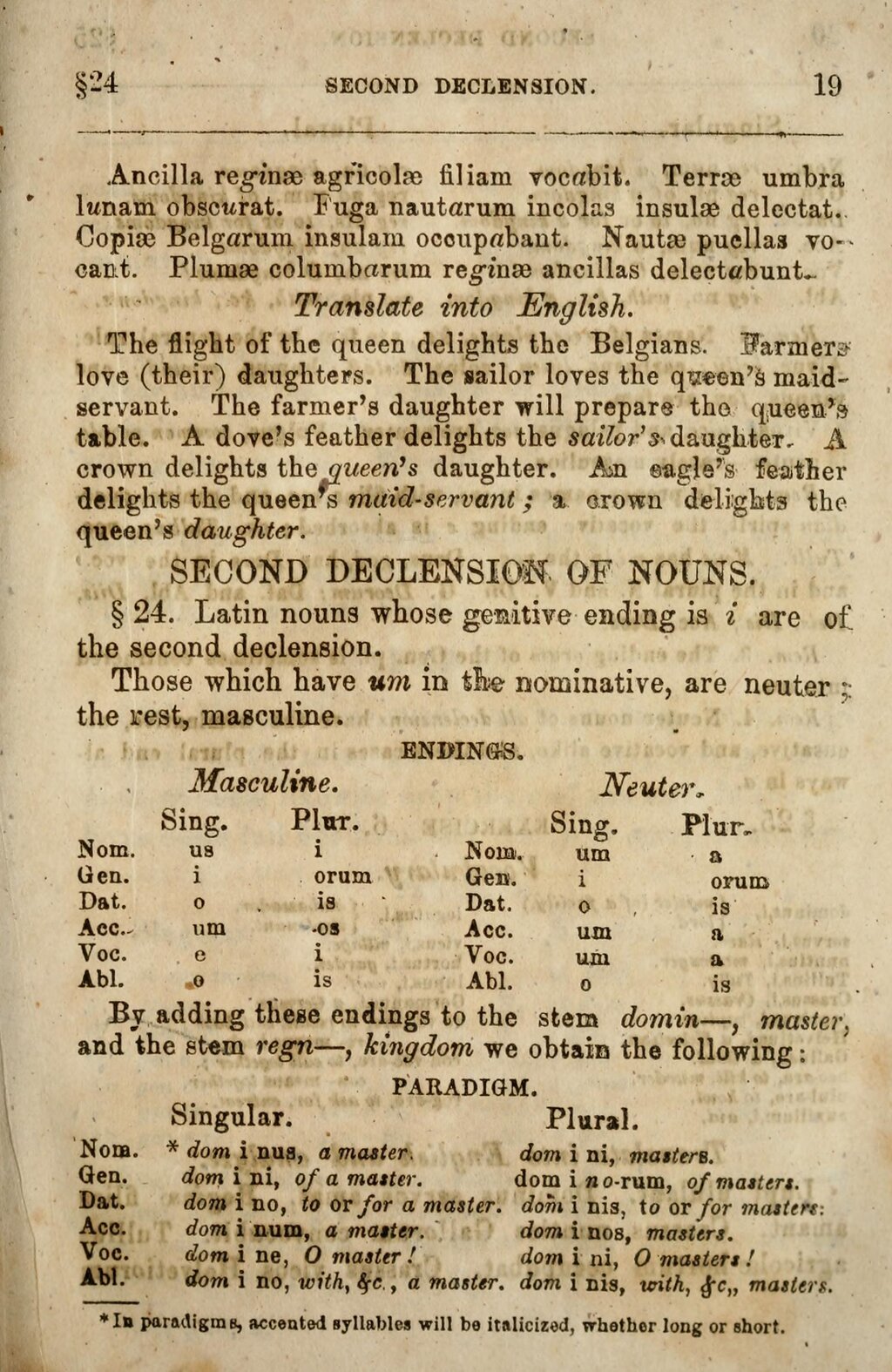
Latin groups its nouns into five families called declensions. A declension is simply a pattern of endings. If you know a noun's declension, you know which set of endings to use to show its gender, number, and its function in a sentence (which is known as its case).
Declension
noun
A group of nouns that follow a specific pattern of endings to indicate case, number, and gender.
So how do you know which of the five declensions a noun belongs to? You look at its genitive singular form. This is the second form you'll see in a Latin dictionary entry, and its ending is the key to unlocking a noun's declension.
| Declension | Genitive Singular Ending | Example Noun (Nom., Gen.) |
|---|---|---|
| 1st | -ae | puella, puellae (girl) |
| 2nd | -ī | servus, servī (slave) |
| 3rd | -is | rēx, rēgis (king) |
| 4th | -ūs | impetus, impetūs (attack) |
| 5th | -eī | rēs, reī (thing) |
When you look up a noun, it will typically be listed like this: puella, puellae, f. Let's decode that.
- puella is the nominative singular form. This is the basic, subject form of the noun.
- puellae is the genitive singular form. That -ae ending is our signal. Looking at the table, we know puella is a 1st declension noun.
- f. tells us the gender, which is feminine.
Here’s another example: servus, servī, m. The genitive singular ending is -ī, which means it's a 2nd declension noun. The m. tells us it's masculine.
The third declension is a large group with more variation, but the rule is the same. For rēx, rēgis, m., the genitive singular ends in -is, marking it as a 3rd declension noun. Its gender is masculine.
For now, focus on being able to identify a noun's declension and gender from its dictionary entry. This is the first and most important step to using nouns correctly.
What three properties are indicated by a Latin noun's ending?
What part of a noun's dictionary entry is the key to identifying its declension?
Understanding these core concepts—gender, number, and declension—provides the foundation for everything else in Latin.