Foundations of Human Psychology
Cognitive Psychology
The Inner World of the Mind
Cognitive psychology is the study of your mind at work. It explores the hidden mental processes that happen every second of every day: how you think, see, remember, and speak. It's not about what you think, but how you think.
Think of it as looking under the hood of your own consciousness. When you recognize a song, solve a puzzle, or simply decide what to eat for lunch, a complex series of cognitive processes are running in the background. This field aims to map out those processes.
Cognitive psychology is the scientific study of the mind as an information processor.
Seeing and Focusing
Every moment, your senses are flooded with information. The hum of a computer, the sight of words on a screen, the feeling of the chair you're sitting in. You can't possibly pay attention to all of it.
Perception is the first step. It’s how your brain organizes and interprets all that sensory input to create a meaningful picture of the world. It’s the process that turns random light patterns into a recognizable face and jumbled sound waves into a friend's voice.
This filtering process is called attention. Attention is the cognitive tool that allows you to select certain information for further processing while ignoring the rest. It’s how you can read this article despite potential distractions around you.
A classic example is the "cocktail party effect." You can be in a loud, crowded room, yet you can tune out all the surrounding chatter to focus on a single conversation. But if someone across the room says your name, your attention instantly shifts. This shows how our attentional system is always monitoring the background for important information.
The Mind's Filing Cabinet
Memory is more than just a single storage unit. It's a dynamic system for encoding, storing, and retrieving information. Cognitive psychologists often break it down into a few key stages.
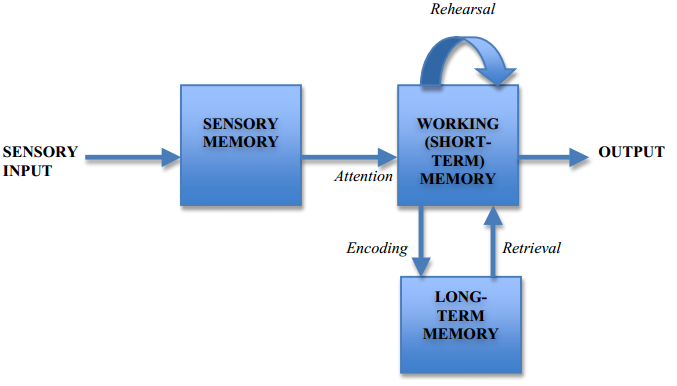
This model shows three main types of memory:
-
Sensory Memory: This is the briefest form, holding sensory information for only a few seconds. It’s like an echo of a sound or the fleeting afterimage of a bright light. It gives your brain just enough time to decide if the information is worth paying attention to.
-
Short-Term (or Working) Memory: This is your mental workbench. It holds the limited amount of information you are currently thinking about. When you're solving a math problem in your head or remembering a phone number just long enough to dial it, you're using your working memory. It has a small capacity, typically holding about 7 items at a time.
-
Long-Term Memory: This is the vast, seemingly limitless storehouse for your knowledge and experiences. Information moves from short-term to long-term memory through a process called encoding. When you need to remember something, you pull it out of long-term storage through retrieval.
Thinking and Deciding
Beyond perceiving and remembering, your mind is constantly working to solve problems and make decisions. These are some of the most complex cognitive functions we have.
Problem-solving is the process of finding a way to reach a goal when the path isn't obvious. This can be anything from figuring out a riddle to designing a bridge. Psychologists study the strategies we use, like trial-and-error or breaking a large problem into smaller, more manageable pieces.
Decision-making is a related process, but it involves choosing between different options or alternatives. Often, we don't have all the information we need, so we rely on mental shortcuts to make quick judgments.
These mental shortcuts are called heuristics. They're usually fast and effective, but they can sometimes lead to errors in judgment. For example, the availability heuristic is our tendency to judge the likelihood of an event by how easily examples come to mind. We might worry more about a shark attack than a vending machine accident, simply because shark attacks are more vivid and memorable in media, even though vending machines are statistically more dangerous.
Language is another core component of thought. It's not just a tool for communication; it's a system for structuring our thoughts and ideas. The process of learning a language as a child is one of the most remarkable cognitive feats, and it happens naturally for most people.
Now, let's test what you've learned about the mind's inner workings.
Cognitive psychology is primarily concerned with:
The 'cocktail party effect,' where you can focus on one conversation in a noisy room but still hear your name mentioned elsewhere, is a classic example of:
Understanding these cognitive processes gives us powerful insights into how we learn, reason, and interact with the world.