Foundations of Gene Cloning
DNA Structure
The Blueprint of Life
Every living organism, from a single-celled bacterium to a blue whale, has a manual that contains all the instructions needed for it to grow, function, and reproduce. This manual is deoxyribonucleic acid, or DNA. It's the molecular blueprint of life.
DNA is breathtakingly simple in structure and yet capable of directing the way we grow, reproduce and survive; hence it is often referred to as the genetic blueprint — the plan — of human life.
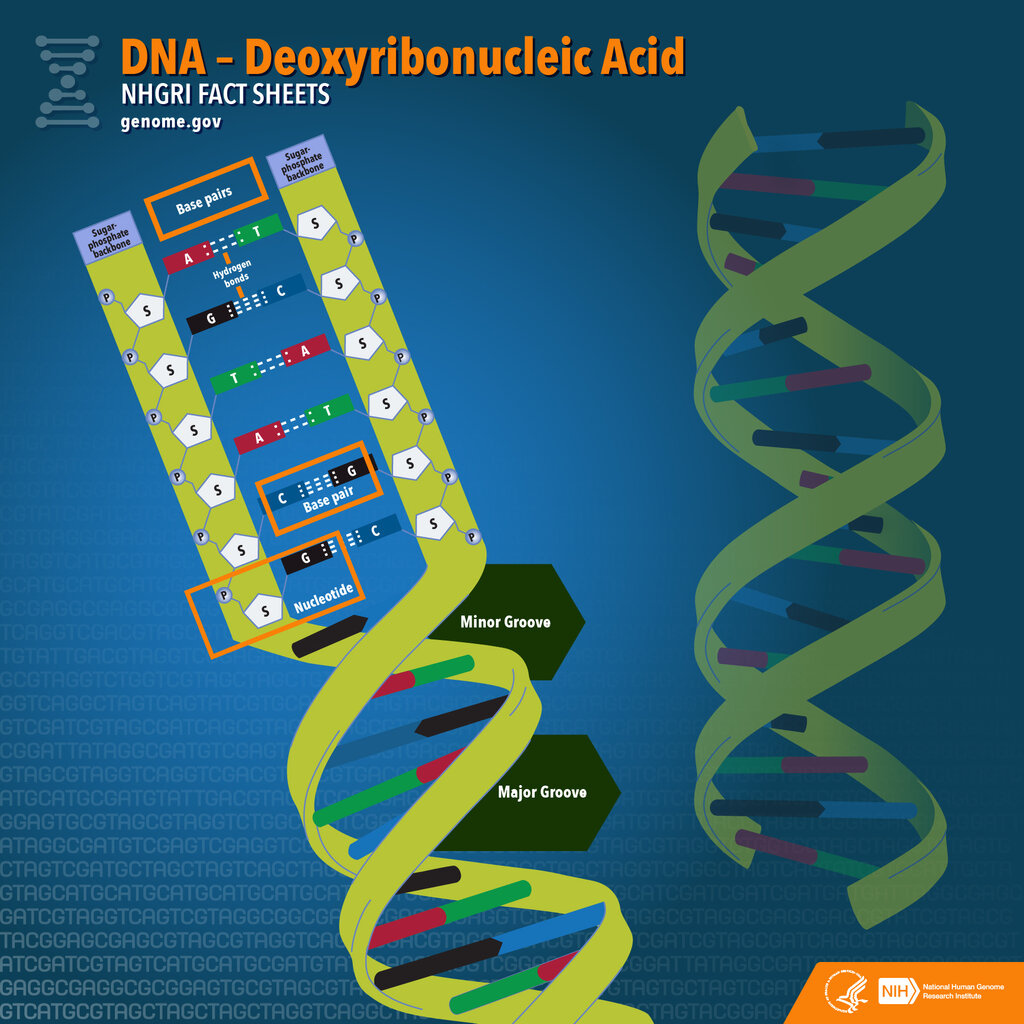
Visually, DNA has a famous and elegant shape: the double helix. Imagine a ladder that has been twisted into a spiral. The two long backbones of the ladder are made of sugar and phosphate molecules, while the rungs connecting them are what hold the actual genetic information.
The Building Blocks
To understand the double helix, we need to look at its fundamental units, called nucleotides. Each nucleotide is composed of three parts: a phosphate group, a five-carbon sugar called deoxyribose, and a nitrogen-containing base.
Nucleotide
noun
The basic structural unit of nucleic acids such as DNA, consisting of a sugar molecule (deoxyribose in DNA) attached to a phosphate group and a nitrogen-containing base.
The sugar and phosphate groups link together to form a chain, creating the long backbones of the DNA ladder. The critical part of the nucleotide for storing information is the base. There are four different bases in DNA:
- Adenine (A)
- Guanine (G)
- Cytosine (C)
- Thymine (T)
The sequence of these four bases along the backbone is what constitutes the genetic code.
The Rules of the Rungs
The two strands of the double helix don't pair up randomly. They follow a strict and simple rule known as complementary base pairing. The bases form the rungs of our twisted ladder, with one base from each strand meeting in the middle.
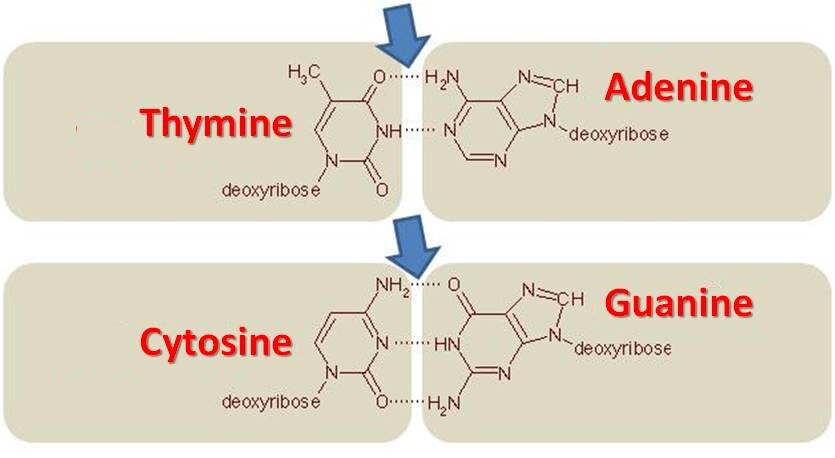
Adenine (A) always pairs with Thymine (T). Guanine (G) always pairs with Cytosine (C).
This pairing rule is due to the chemical structure of the bases. A and G are larger molecules called purines, while C and T are smaller molecules called pyrimidines. A purine always pairs with a pyrimidine, keeping the distance between the two backbones uniform along the entire length of the molecule.
The pairs are held together by hydrogen bonds. The A-T pair is connected by two hydrogen bonds, while the G-C pair is held by three, making the G-C connection slightly stronger.
Making a Copy
For life to continue, cells must divide, and before they do, they need to make a perfect copy of their DNA. This process is called DNA replication.
The double helix structure makes replication a straightforward process. An enzyme called helicase 'unzips' the two strands of the DNA molecule, breaking the hydrogen bonds between the base pairs. Each of the separated strands then serves as a template for creating a new, complementary strand.
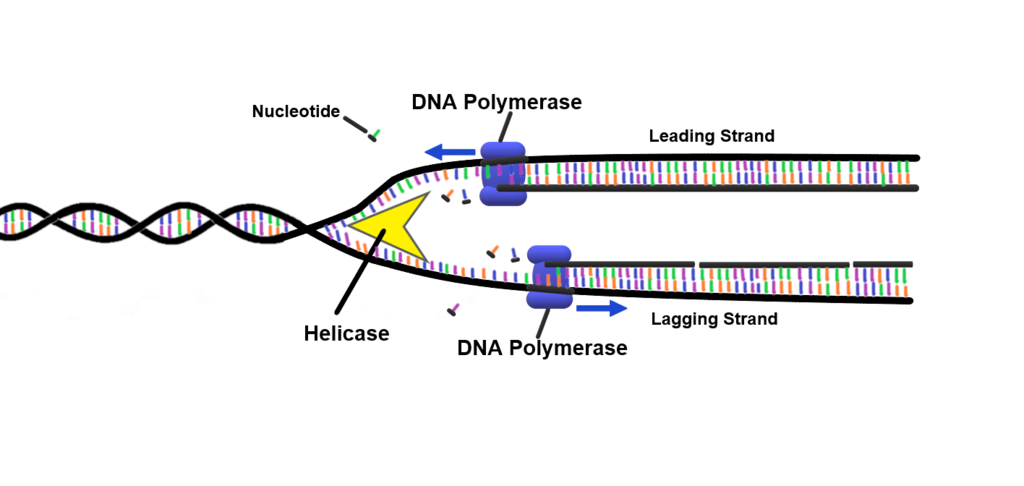
An enzyme called DNA polymerase moves along each template strand, adding the correct matching nucleotides. If it finds an 'A' on the template, it adds a 'T' to the new strand. If it finds a 'G', it adds a 'C', and so on. This continues until two identical DNA molecules are formed, each one a hybrid of one old strand and one new strand. This is known as semi-conservative replication.
This elegant system ensures that genetic information is passed on accurately from one generation of cells to the next.
What are the two molecules that form the long, repeating backbones of the DNA double helix?
If one strand of a DNA molecule has the base sequence 5'-A-T-T-G-C-A-3', what is the sequence of the complementary strand?