Foundations of Electrical Engineering
Electrical Fundamentals
The Language of Circuits
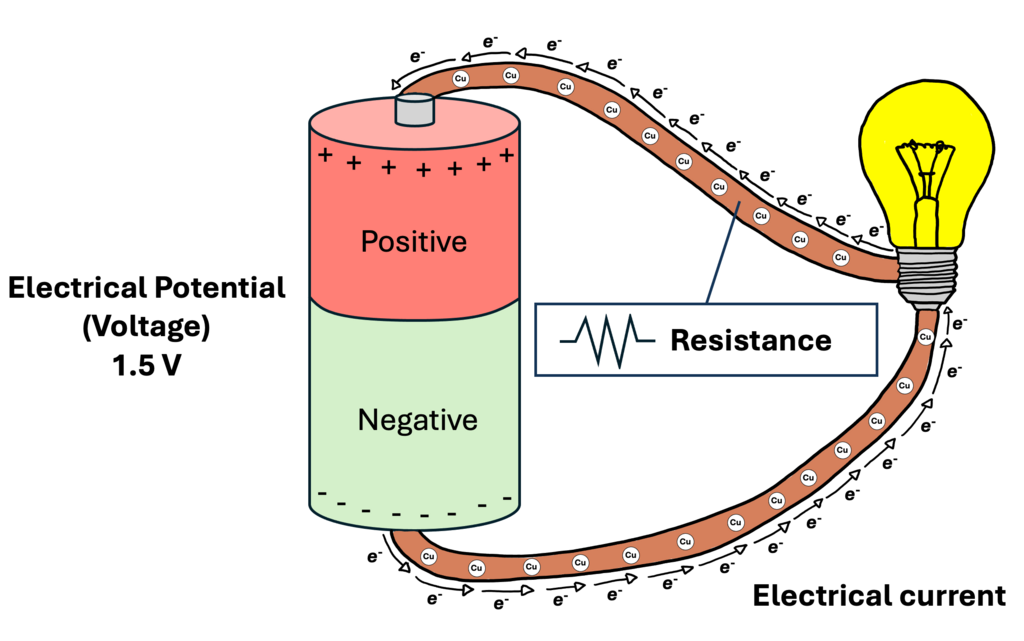
At its core, electricity is about the movement of tiny charged particles called electrons. To understand and control this movement, we need to speak the language of circuits. This language has three key words: voltage, current, and resistance.
Think of an electrical circuit like a plumbing system. The water flowing through the pipes is like the electric charge. In this analogy:
- Voltage () is the water pressure. It's the force pushing the water along. Without pressure, the water wouldn't move.
- Current () is the flow rate of the water. It's the amount of water passing a point per second.
- Resistance () is like a narrow section of pipe that restricts the flow. It's a measure of how much a material opposes the flow of electric charge.
Voltage is measured in volts (V), current in amperes or amps (A), and resistance in ohms (Ω). To make a current flow, you need a voltage source like a battery and a complete path, or circuit, for the electrons to travel through.
Ohm's Law
In the 1820s, German physicist Georg Ohm discovered a simple but powerful relationship between voltage, current, and resistance. His finding, now known as Ohm's Law, is a cornerstone of electrical engineering.
Ohm's Law states that the voltage across a component is equal to the current flowing through it multiplied by its resistance.
This formula can be rearranged to solve for any of the three variables. For example, if you know the voltage and resistance, you can find the current: . This makes perfect sense with our water analogy: to increase the flow rate (current), you can either increase the pressure (voltage) or decrease the restriction (resistance).
Kirchhoff's Laws
When circuits become more complex than a single loop, we need a couple of extra rules to figure out what’s happening. These rules were developed by Gustav Kirchhoff in the 1840s.
Kirchhoff's Current Law (KCL) deals with how current behaves when paths split. It says that the total current flowing into any junction (or node) in a circuit must equal the total current flowing out of it. It's like a river splitting into two smaller streams. The amount of water flowing into the split must equal the total amount flowing out through the two new paths. No charge is lost.
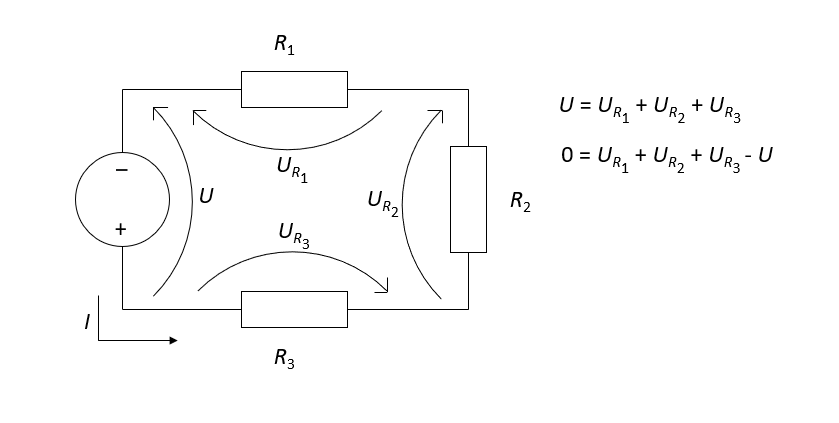
Kirchhoff's Voltage Law (KVL) is about voltage in a closed loop. It states that if you trace any closed path in a circuit, the sum of all the voltage drops across components (like resistors) must equal the total voltage supplied by the sources (like batteries). In other words, all the electrical pressure supplied by the source gets used up by the components in the loop. The total change in voltage around any closed loop is zero.
Power and Energy
Voltage and current tell us about the pressure and flow, but what about the actual work being done? That's where power and energy come in.
Power () is the rate at which electrical energy is converted into another form, like heat or light. It's the product of voltage and current, measured in watts (W).
A light bulb with a higher wattage is brighter because it converts electrical energy into light and heat at a faster rate. Using Ohm's Law (), we can also write the power formula in other ways, like or .
Energy is power used over a period of time. If power is the rate of energy use, then energy is the total amount consumed. Your electricity bill charges you for energy, not power. The common unit for electrical energy is the kilowatt-hour (kWh), which is the energy used by a 1,000-watt device running for one hour.
In the common analogy of an electrical circuit as a plumbing system, what does the water pressure represent?
A simple circuit has a 12-volt battery connected to a resistor. If 3 amps of current are flowing, what is the resistance of the resistor?
These fundamental concepts are the building blocks for understanding every electrical system, from the smartphone in your pocket to the power grid that spans the country.