Foundations of Electrical Engineering
Circuit Foundations
The Language of Circuits
Electric circuits are everywhere, from your phone to the power grid. To understand them, we need a shared language and a simplified model. We can't track every single electron zipping around. It's just not practical. Instead, electrical engineers use a powerful simplification called the Lumped Element Model..
This model assumes that all the complex physics of electricity and magnetism—the fields and waves—are contained inside the components. The wires connecting them are just ideal, perfect conductors. This lets us ignore the messy reality of electromagnetic fields propagating through space and focus only on what happens at the components themselves. It's an incredibly effective abstraction that makes circuit analysis possible.
Charge, Current, and Voltage
At the heart of every circuit are three fundamental quantities: charge, current, and voltage.
Charge (Q) is the fundamental property of matter that experiences a force in an electric field. You can think of it as the basic stuff of electricity. We measure charge in coulombs (C).
Current
noun
The rate at which electric charge flows past a point in a circuit.
Current (I) is the movement of charge. Specifically, it's the rate of flow. If you stand at one point in a wire and count how much charge passes by per second, you've measured the current. We measure current in amperes (A), or amps. One ampere is equal to one coulomb of charge flowing past a point in one second.
Voltage (V), on the other hand, is about energy. It represents the energy difference per unit of charge between two points. It's the "push" or "pressure" that makes the charges move. You can't have a voltage at a single point; it's always measured between two points. We call this a potential difference. We measure voltage in volts (V). One volt is equal to one joule of energy per coulomb of charge.
Power and Sign Convention
Power (P) is the rate at which energy is being used or generated. In electrical terms, it’s the product of voltage and current. We measure power in watts (W). One watt is one joule per second.
But is a component absorbing power or supplying it? To answer this, engineers use the .. It's a simple rule to keep our calculations consistent.
Imagine a generic circuit component. If the conventional current enters the component through its positive voltage terminal, the component is absorbing power. A resistor heating up is a classic example. If the current leaves through the positive terminal, the component is supplying power, like a battery.
A positive power value means the component is absorbing energy, while a negative power value means it is supplying energy to the circuit.
Sources of Power
Circuit components that supply power are called sources. They come in two main flavors: independent and dependent.
An independent source provides a constant voltage or current regardless of what's happening in the rest of the circuit. A battery is a good real-world approximation of an independent voltage source. A lab power supply can be set to act as an independent current source.
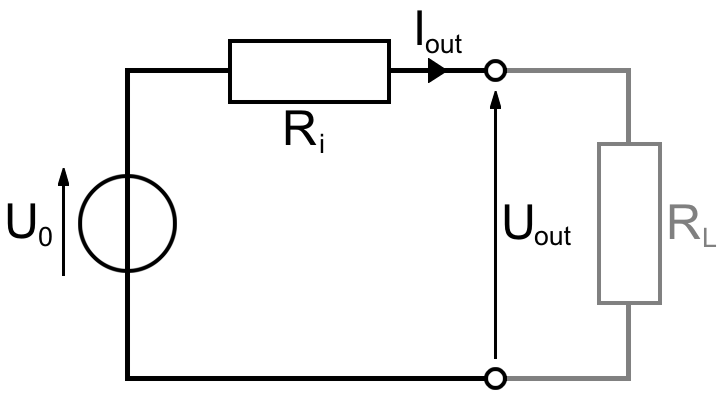
A dependent source, on the other hand, is a bit more interesting. Its output voltage or current depends on some other voltage or current elsewhere in the circuit. These are essential for modeling electronic components like transistors and operational amplifiers, which are the building blocks of modern electronics.
Understanding these basic elements—and the rules that govern their interaction—is the first step toward analyzing and designing any electrical circuit.
Ready to check your understanding?
What is the primary simplification made by the Lumped Element Model used in circuit analysis?
Which statement best describes the fundamental difference between electric current and voltage?
With these definitions in place, we can now start exploring the fundamental laws that govern how these quantities behave in a circuit.