Foundations of Electrical Engineering
Electricity Basics
The Invisible Push
Electricity is the flow of energy. At its core, it's all about tiny particles and their properties. The most fundamental of these properties is electric charge.
Electric Charge
noun
A fundamental property of matter that causes it to experience a force when placed in an electromagnetic field.
Think of charges like tiny magnets. Some are positive (like protons) and some are negative (like electrons). Just like with magnets, opposites attract, and similar charges push each other away. A positive charge and a negative charge will pull toward each other, but two positive charges will repel.
This simple rule of attraction and repulsion is what makes electricity work. But for these charges to do anything useful, they need to move. That requires a little push.
Pressure and Flow
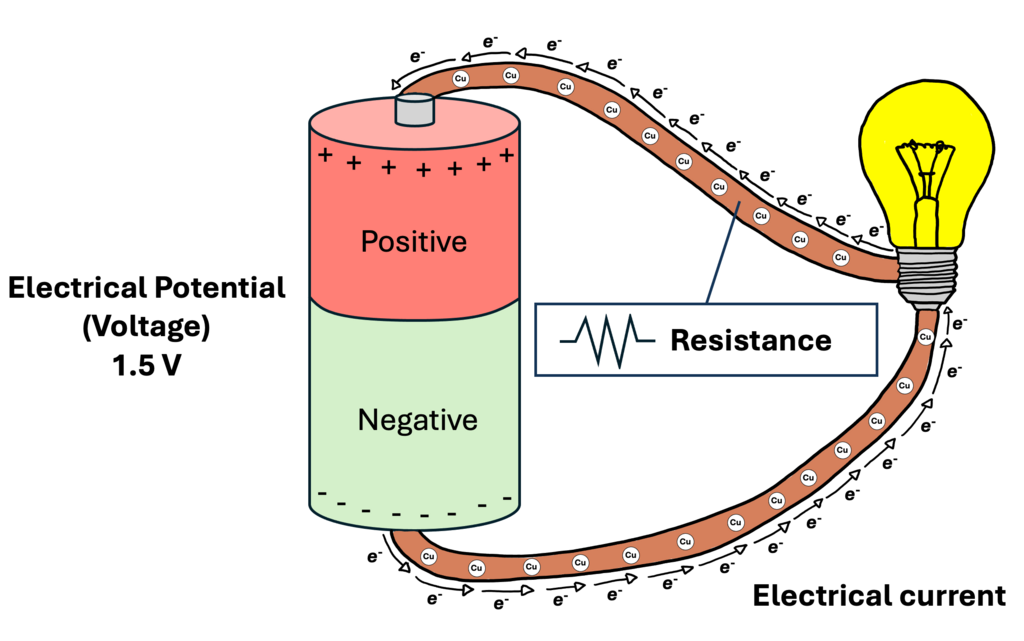
To understand how we get charges moving, imagine water in a hose. If the hose is lying flat, the water inside doesn't go anywhere. But if you increase the pressure at one end, the water flows out the other. Electricity works in a similar way, using voltage as its pressure.
Voltage
noun
The pressure from an electrical power source that pushes charged electrons (current) through a conducting loop.
Voltage, measured in volts (V), is the potential for energy to move. The higher the voltage, the stronger the push on the electric charges.
When voltage pushes charges along, it creates a current.
Current
noun
The rate at which electric charge flows past a point in a circuit.
Current is the flow itself, measured in amperes (A), often called amps. It's the amount of charge moving through a wire over a certain period. A high current means a lot of charge is flowing.
Putting Up a Fight
The path for electricity is never perfectly smooth. As charges flow through a material, they bump into atoms and other obstacles that slow them down. This opposition to the flow is called resistance.
Think of it as pinching the water hose. The tighter you pinch, the harder it is for water to get through. In an electrical circuit, materials with high resistance, like rubber or glass, are called insulators. They're like a kinked hose that stops the flow almost completely. Materials with low resistance, like copper or silver, are conductors. They let current pass through easily.
Resistance
noun
A measure of the opposition to current flow in an electrical circuit.
Resistance is measured in ohms (Ω). Every component in a circuit, even the wire itself, has some resistance. This property is not always a bad thing; it's what allows a light bulb filament to heat up and glow or a toaster to toast bread.
Ohm's Law
These three concepts, voltage, current, and resistance, are not independent. They're linked by a simple but powerful relationship known as Ohm's Law. It states that the current flowing through a circuit is directly proportional to the voltage applied and inversely proportional to the resistance.
This means if you increase the voltage (the push), the current (the flow) will also increase, assuming the resistance stays the same. If you increase the resistance (the opposition), the current will decrease, provided the voltage doesn't change.
This fundamental law is the key to analyzing and designing electrical circuits. By understanding how these three quantities relate, you can predict how a circuit will behave.
How do two particles with positive electric charges interact with each other?
In the analogy of water flowing through a hose, what does voltage represent?