Foundations of Economics
Introduction to Economics
The Heart of the Matter
At its core, economics is the study of choice. It's a way of thinking about how people, businesses, and governments deal with a fundamental problem: we have unlimited wants, but we live in a world of limited resources. This conflict between our desires and the reality of what's available is called scarcity.
Scarcity is the basic economic problem. There isn't enough of everything to go around for free.
Because of scarcity, we are forced to make choices. You can't spend the same hour studying and sleeping. A company can't use the same $100 to invest in new equipment and to give its employees a bonus. A government can't spend the same tax revenue on healthcare and defense. Every choice involves giving something up.
The Cost of a Choice
Economists have a specific term for what you give up when you make a decision: opportunity cost. It’s not just about the money you spend. It’s the value of the next-best alternative you didn't choose.
Opportunity Cost
noun
The value of the most desirable alternative given up as the result of a decision.
This leads directly to the idea of trade-offs. Life is a series of trade-offs. When you choose one thing, you are trading it for something else. A classic example is the “guns versus butter” trade-off. A country can spend its resources on military defense (guns) or on domestic goods and services for its citizens (butter). Producing more of one means producing less of the other.
Thinking Like an Economist
Economists use a few key principles to analyze choices. One of the most important is marginal analysis. This means thinking about the effects of adding or subtracting one more unit of something. Most decisions aren't all-or-nothing. You don't decide between studying for 10 hours and studying for zero. You decide whether to study for one more hour.
When you make this choice, you're weighing the marginal benefit (the extra knowledge you'll gain) against the marginal cost (the extra hour of sleep you'll lose). A rational decision-maker will only do something if the marginal benefit is greater than or equal to the marginal cost.
Rational choices are made at the margin. We compare the additional benefits of an action to its additional costs.
Another core principle is that people respond to incentives. An incentive is something that motivates a person to act, like a reward or a penalty. If the price of gasoline goes up, people have an incentive to drive less. If a company offers a bonus for meeting a sales target, employees have an incentive to work harder. Understanding incentives is key to understanding why people make the choices they do.
Two Views of the Economy
Economics is generally divided into two main branches: microeconomics and macroeconomics. They are two different lenses for looking at the same world.
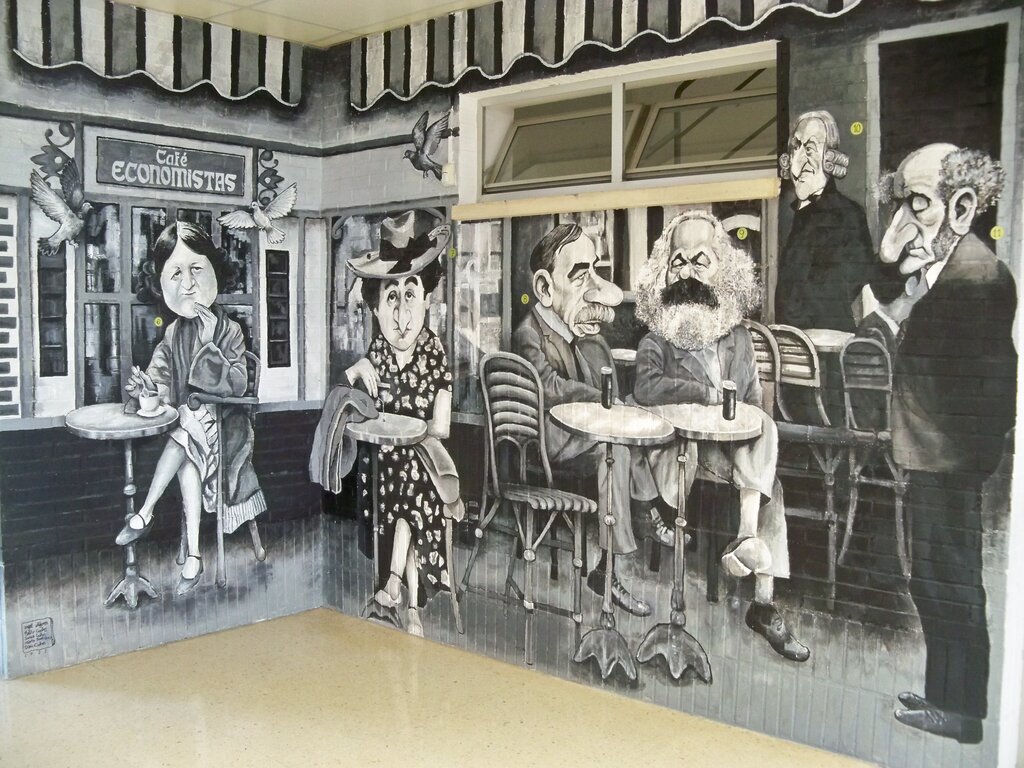
Microeconomics is the study of individuals, households, and firms. It focuses on the small parts of the economy. Think of it like looking at a single tree in a forest. It asks questions about individual markets and decision-makers.
Macroeconomics looks at the economy as a whole. It’s the big picture—the entire forest. It deals with economy-wide phenomena like inflation, unemployment, and economic growth.
| Microeconomics | Macroeconomics | |
|---|---|---|
| Focus | Individual markets and agents | The entire economy |
| Analogy | A single tree | The whole forest |
| Sample Questions | Why are housing prices rising in a specific city? How does a tax on soda affect consumer behavior? | What causes inflation? Why does the unemployment rate change? How can a country increase its economic growth? |
These two branches are deeply connected. The overall health of the forest (macro) depends on the health of the individual trees (micro). By understanding both, we get a complete picture of how the economy works.