Foundations of Economic Thought
Introduction to Economics
The Heart of the Matter
At its core, economics is the study of choices. Every day, you make dozens of them. Should you buy a coffee or save the money? Should you study for an extra hour or watch a movie? These individual decisions might seem small, but when you zoom out, you see that societies, businesses, and governments are making similar choices on a much grander scale. They decide what to build, what to produce, and how to distribute it.
All of these choices, big and small, are driven by one fundamental problem: we can't have everything we want. Our desires are practically limitless, but the resources to fulfill them—time, money, materials—are not. This conflict is the central puzzle economics tries to solve.
scarcity
noun
The basic economic problem that arises because people have unlimited wants but resources are limited. Because of scarcity, various economic decisions must be made to allocate resources efficiently.
The Cost of a Choice
Because scarcity forces us to choose, every decision comes with a hidden cost. It's not just about the money you spend. When you choose to do one thing, you are simultaneously choosing not to do something else. That trade-off is the true cost of your decision.
Imagine you have a free evening. You can either work for two hours and earn 💲40, or you can go to a concert that costs 💲20. If you choose the concert, the total cost isn't just the 💲20 ticket price. It's also the 💲40 you gave up by not working. The real economic cost of the concert is 💲60.
This idea is called opportunity cost. It’s the value of the next-best alternative that you had to forgo. Understanding this concept is crucial because it reveals the full picture of any choice we make. It forces us to ask, "What am I giving up?"
Mapping Our Limits
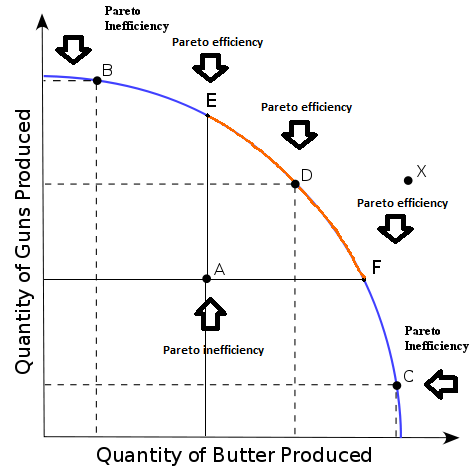
How can we visualize scarcity and opportunity cost for an entire economy? Economists use a simple but powerful tool called the Production Possibility Frontier, or PPF. The PPF is a graph that shows all the different combinations of two goods that a country can produce, assuming it uses all of its resources efficiently.
This graph tells a story about a society's production choices. Every point on the curve (like Point B) represents an efficient outcome. The economy is firing on all cylinders, using all its labor, technology, and resources to the fullest.
A point inside the curve (Point A) is inefficient. It means the economy is underperforming—perhaps due to high unemployment or idle factories. It could produce more of both goods with the resources it already has.
A point outside the curve (Point C) is unattainable with current resources and technology. It represents a production level we might want, but simply cannot reach. This is scarcity in graphical form.
The curve's downward slope shows opportunity cost. To produce more pizza, the economy must shift resources away from making robots, and vice-versa. The bowed-out shape shows that this opportunity cost isn't constant; it increases as you specialize more in one good, because some resources are better suited for one task than another.
These foundational ideas—scarcity, choice, and opportunity cost—are the building blocks for all of economics. They help explain the decisions of individuals, the strategies of businesses, and the policies of nations.
What is the fundamental economic problem that all societies face?
You have a free ticket to a concert. However, to attend, you must miss a 3-hour shift at work where you earn $20 per hour. What is the opportunity cost of going to the concert?