Foundations of Digital Marketing
Digital Marketing Basics
What Is Digital Marketing?
Digital marketing is any marketing that uses electronic devices and the internet. Businesses leverage digital channels like search engines, social media, and email to connect with current and prospective customers.
Think of it like this: traditional marketing is like putting up a billboard on a highway. You hope the right people drive by and see it. Digital marketing is like having a conversation with someone you know is interested in what you have to offer. It's more direct, personal, and measurable.
It’s not a single tactic, but a collection of strategies that help you reach customers on the digital platforms they already use.
The importance of being online is simple: that's where the people are. Whether they're looking for a new pair of shoes, researching a software tool, or trying to find a local restaurant, their journey almost always starts online. Digital marketing allows businesses to meet them there.
The Main Channels
Digital marketing isn't just one thing. It's a combination of different channels, each with its own strengths. While there are many, most fall into a few key categories.
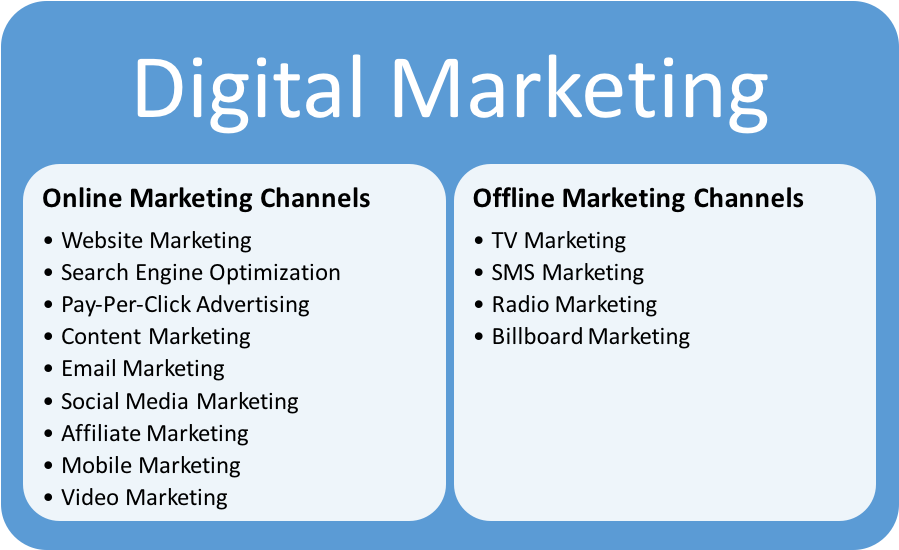
Here are some of the most common online channels:
- Search Engine Optimization (SEO): This is the practice of increasing the quantity and quality of traffic to your website through organic (non-paid) search engine results. It's about making your site more visible to people who are looking for your products or services via search engines like Google.
- Pay-Per-Click (PPC) Advertising: This is when you pay for your website to appear as a sponsored link at the top of search engine results. You pay a fee each time someone clicks on your ad. Google Ads is the most common platform.
- Content Marketing: This involves creating and sharing valuable free content—like blog posts, videos, and ebooks—to attract and convert prospects into customers. The goal is to provide value, not just sell.
- Social Media Marketing: This is the use of social media platforms like Facebook, Instagram, and LinkedIn to promote a product or service. It's about building a community and engaging with your audience.
- Email Marketing: This channel involves sending commercial messages to a group of people using email. It's an effective way to nurture leads, keep customers informed, and build relationships.
The Buyer's Journey
To market effectively, you need to understand how people make decisions. The buyer's journey is a framework that acknowledges a buyer's progression through a research and decision process. It helps you create content that addresses their needs at each stage.
The journey has three main stages:
-
Awareness Stage: The buyer realizes they have a problem or an opportunity. They're experiencing symptoms but haven't defined the root cause. For example, a photographer's camera is slow and taking blurry pictures. They know they have a problem, but they don't know why or what to do about it.
-
Consideration Stage: The buyer has now clearly defined their problem and is researching all available approaches or methods to solve it. Our photographer now knows their camera is outdated. They start researching different types of cameras: DSLRs, mirrorless, point-and-shoots.
-
Decision Stage: The buyer has decided on their solution strategy. They are now compiling a list of available vendors and products within their chosen approach. The photographer has decided they want a mirrorless camera and is now comparing specific models from different brands, reading reviews, and looking for the best price.
Your marketing should map to these stages. You wouldn't try to sell a specific camera model to someone who is just realizing their current one is broken.
Connecting Marketing to Business Goals
Digital marketing doesn't exist in a vacuum. Every activity, from a single social media post to a year-long email campaign, should tie back to a specific business goal. Without this connection, you're just creating noise.
Are you trying to increase sales by 15% this quarter? Attract more qualified job applicants? Launch a new product successfully? Each of these goals requires a different digital marketing strategy.
| Business Goal | Corresponding Digital Marketing Activity |
|---|---|
| Increase Online Sales | Run targeted PPC ads for specific products. |
| Generate More Leads | Create a downloadable ebook and promote it. |
| Build Brand Awareness | Run an engaging social media campaign. |
| Improve Customer Loyalty | Send exclusive offers to an email newsletter list. |
By aligning your marketing efforts with your business objectives, you ensure that your work has a tangible impact. It provides direction, helps you prioritize tasks, and makes it possible to measure what's working and what isn't.
Ready to test your knowledge? Let's see what you've learned.
Which statement best captures the primary advantage of digital marketing compared to traditional marketing, like a billboard?
A company pays Google a fee every time a user clicks on its link, which appears at the top of the search results page. Which digital marketing channel is this an example of?
Understanding these core concepts is the first step. From here, you can start to explore each channel and strategy in more detail.