Foundations of Design Theory
Design Elements and Principles
The Building Blocks of Design
Every design, from a simple logo to a complex website, is built from the same basic ingredients. These are the elements of design. Think of them as the raw materials you have to work with. They're what you see: the lines, shapes, and colors that make up the visual world.
Line
noun
A mark with greater length than width. Lines can be horizontal, vertical, or diagonal; straight or curved; thick or thin.
Lines do more than just outline objects. A horizontal line can suggest stability and calm, like a horizon. A vertical line can feel strong and aspiring, like a skyscraper. Jagged, diagonal lines create a sense of tension or excitement.
Shape
noun
The form of an object or its external boundary, outline, or external surface. Shapes are two-dimensional and can be geometric (like circles and squares) or organic (free-form and natural).
Shapes define objects and areas. Geometric shapes often feel orderly and modern, while organic shapes feel more natural and spontaneous. The space around a shape is just as important as the shape itself. This is known as negative space.
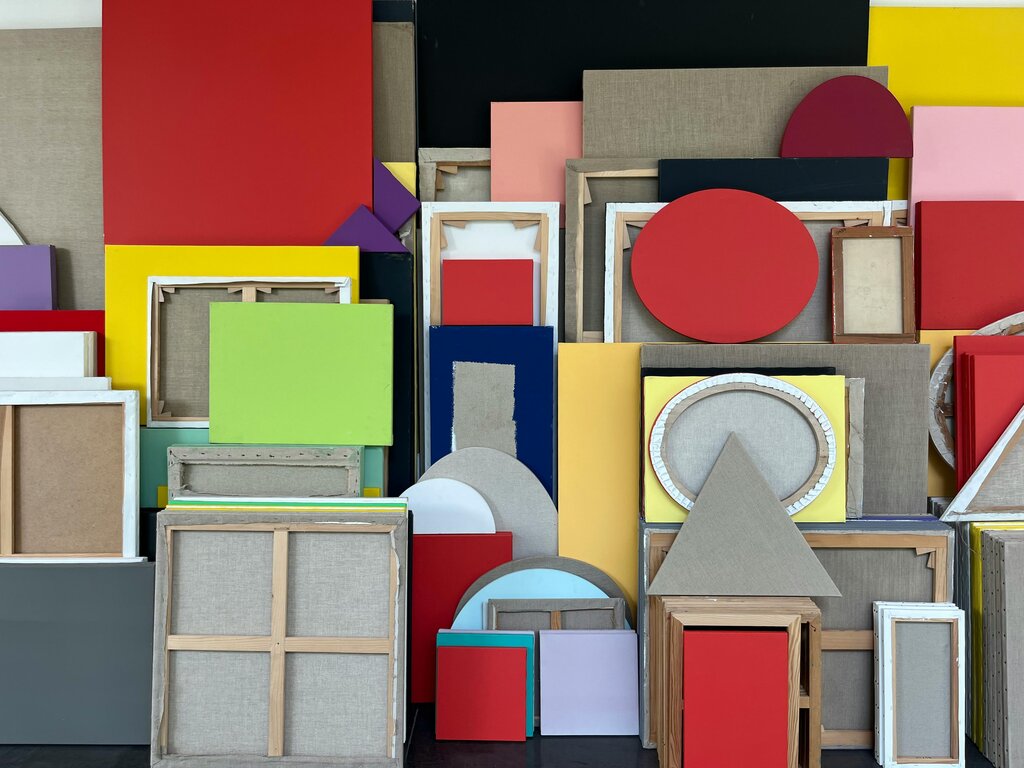
Color is a powerful tool for evoking emotion and drawing attention. Texture refers to the surface quality that can be seen or felt, adding depth and tactility. Space, both positive (the main subjects) and negative (the empty areas), helps define relationships between objects and creates focus.
The Rules of Arrangement
If elements are the ingredients, the principles of design are the recipe. They guide how you combine the elements to create an effective and appealing composition. They are less about what you see and more about what you feel when you look at a design.
The principles of design suggest how a designer can best arrange the various components of a page layout to connect to the overall design and to one another.
Balance is about the visual weight of the elements in a composition. It gives a design stability and structure. There are three main types:
Contrast is the arrangement of opposite elements—light vs. dark, rough vs. smooth, large vs. small. It creates visual interest and helps organize information by making key elements stand out. Emphasis is a strategy that uses contrast to draw the viewer's attention to a specific focal point.
Without contrast, a design is flat and uninteresting. Without emphasis, the viewer doesn't know where to look first.
Movement guides the viewer's eye through the design. This can be achieved with lines, shapes, and colors that create a path for the eye to follow. Rhythm is created by repeating elements in a predictable way, which produces a sense of organized movement. Think of the steady beat in a song.
Pattern is the simple repetition of an element, like tiles on a floor. While similar to rhythm, a pattern is typically more static and uniform.
Finally, Unity is the feeling that all the parts of a design belong together and form a coherent whole. When a design has unity, it feels complete and harmonious. This is the ultimate goal: to use all the elements and principles to create a single, unified message.
Putting It All Together
The elements and principles don't work in isolation. A strong design is a conversation between them. You might use the element of line to create a sense of movement. You could use the element of color to create contrast and therefore emphasis.
Consider this simple table to see how they often interact:
| Principle | How it uses Elements |
|---|---|
| Balance | Arranging the visual weight of shapes, colors, and space. |
| Contrast | Juxtaposing different lines (thick vs. thin), colors (light vs. dark), or textures (rough vs. smooth). |
| Movement | Using lines and shapes to guide the eye across the space. |
| Unity | Repeating colors, shapes, or textures to create a cohesive feeling. |
Understanding these relationships is the key to moving from just knowing the definitions to actually applying them. By consciously choosing your elements and arranging them with the principles in mind, you can create designs that are not just visually pleasing, but also clear, effective, and communicative.
Time to review what you've learned.
Let's check your understanding.
Which of the following best describes the relationship between the elements and principles of design?
A designer wants to create a sense of excitement and tension in their artwork. Which type of line would be most effective?
Mastering these fundamentals provides the foundation for all visual communication.