Foundations of Data Structures
Introduction to Data Structures
Organizing Information
Think about how you organize contacts on your phone. You don't just have a single, massive, jumbled list of names and numbers. They're alphabetized. You can search for a name, add a new person, or delete an old contact. This system makes the information useful. Without it, you'd be scrolling for minutes just to find one number.
In programming, we need similar systems for organizing information. That's what data structures are all about.
Data Structure
noun
A specific way of organizing, storing, and managing data in a computer so that it can be accessed and modified efficiently.
Simply put, a data structure is a container for data that follows specific rules. These rules determine how data is added, removed, and arranged. The choice of data structure directly impacts how well a program performs. A good choice makes a program fast and easy to manage; a poor choice can make it slow and clunky.
Data structures are the foundation upon which complex and efficient algorithms are built.
Two Main Categories
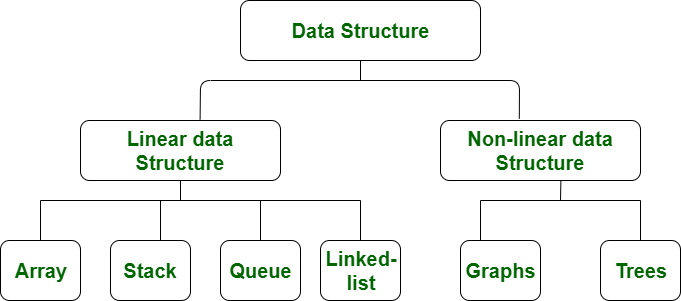
Data structures generally fall into two broad categories: linear and non-linear. The difference is all about how the data elements are connected to one another.
Linear data structures arrange items in a sequential order. Each element is attached to its previous and next element. Think of it like a train, where each car is connected to the one before it and the one after it. Simple examples include arrays and linked lists.
Non-linear data structures arrange items in a hierarchical or networked way. An element can be connected to several other elements. A family tree is a good analogy. A parent can have multiple children, and those children can have their own children, forming a branching structure. Trees and graphs are common non-linear structures.
| Feature | Linear Structures | Non-Linear Structures |
|---|---|---|
| Arrangement | Sequential | Hierarchical or connected |
| Traversal | Single level, straightforward | Multi-level, complex |
| Example | A to-do list | A company's organizational chart |
| Common Types | Arrays, Stacks, Queues | Trees, Graphs |
Basic Operations
No matter which data structure you're using, you'll usually perform a few common actions on it. Understanding these operations is key to understanding how data structures work.
Some structures are great at certain operations and not so great at others. For example, finding an item in an alphabetized list is very fast. But if you have to add a new item right in the middle, you have to shift everything after it, which can be slow. The trade-offs between these operations are what make choosing the right data structure so important.
Different programming languages provide their own tools for working with these structures. Python has built-in lists, dictionaries, and sets, which are powerful and flexible data structures. Java has the Collections Framework, offering implementations of lists, maps, and more. While the names and specific features might change from one language to another, the core concepts of how they store and manage data remain the same.
Let's check your understanding of these fundamental concepts.
What is the primary purpose of a data structure?
Which of the following real-world examples best represents a non-linear data structure?
Understanding these basic ideas sets the stage for exploring specific data structures and seeing how they solve real-world programming problems.