Foundations of Data Structures
Introduction to Data Structures
Organizing Information
Think about your music library. You could have every song dumped into one giant, unsorted folder. Finding a specific track would be a nightmare. Or, you could organize it: by artist, then by album, then by track number. Suddenly, finding what you want is fast and easy.
In programming, we face the same challenge with data. A data structure is simply a way of organizing and storing data in a computer so that it can be accessed and used efficiently. It's not just about storing things; it's about storing them in a smart way that makes our programs faster and more powerful.
The choice of data structure can be the difference between a program that runs in seconds and one that takes hours.
Different problems call for different organizational systems. Planning a road trip requires a map, which connects cities in a complex network. Stacking plates in a cabinet requires a simple pile. Data structures provide these specialized systems for digital information.
Two Main Flavors
Data structures generally fall into two categories: linear and non-linear.
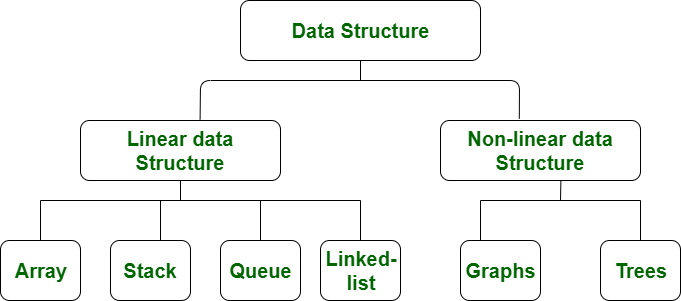
Linear structures organize data in a sequence, like beads on a string. Each element is connected to its previous and next element. A to-do list is a perfect real-world example. You have a first item, a second, a third, and so on. Common examples in programming include arrays, stacks, and linked lists.
Non-linear structures are for data that doesn't fit neatly in a line. The elements can be connected in many ways. Think of a family tree. A person can have multiple children, who in turn have their own children. The relationships are hierarchical and branch out. Social networks are another example, where one person can be connected to hundreds of others. Trees and graphs are the most common non-linear structures.
A Quick Tour
Let's meet a few of the most fundamental data structures. You don't need to know how to build them yet, just what they are.
Array
noun
A collection of items stored at contiguous memory locations. Think of it as a numbered row of boxes, where you can instantly access any box if you know its number.
Linked Lists are also sequential, but the elements aren't stored next to each other in memory. Instead, each item contains a pointer to the next one in the chain, like a scavenger hunt where each clue tells you where to find the next.
| Structure | How it Stores Data | Best For... |
|---|---|---|
| Array | In a continuous block | Quick access to elements |
| Linked List | As separate, linked items | Adding or removing elements easily |
Trees are hierarchical structures with a root element and branching child elements. They are great for representing things like file systems on your computer or an organization's management structure.
Graphs are collections of nodes (or vertices) connected by edges. They are perfect for modeling networks, like city maps, social connections, or the internet itself.
This is just a small sample. There are many specialized data structures, each with its own strengths and weaknesses. As you continue your journey in computer science, you'll learn how to pick the right tool for the job.
Ready to check your understanding?
What is the primary purpose of a data structure?
Which of the following real-world examples would be best represented by a non-linear data structure?
Understanding these basic categories is the first step toward writing efficient, well-organized code.