Foundations of Data Structures
Introduction to Data Structures
What Are Data Structures?
Think about a library. If books were just thrown into a giant pile, finding the one you want would be a nightmare. Instead, libraries organize books by genre, then alphabetically by author. This system makes finding a specific book fast and efficient.
In computer science, a data structure is like that library's organizational system, but for information inside a program. It’s a specific way of arranging and storing data so that we can access and work with it effectively. Without them, even simple programs would slow to a crawl.
At their core, data structures are about one thing: organizing information to solve problems efficiently.
Computers work with basic pieces of information called primitive data types. These are the fundamental building blocks, like integers (whole numbers), floating-point numbers (decimals), booleans (true or false), and characters (letters and symbols).
A data structure takes these simple types and combines them into something more useful. It gives them shape and rules, allowing us to perform complex operations like searching for a specific item, sorting a list of numbers, or adding new data seamlessly. The right structure can make a task incredibly fast, while the wrong one can make it impossibly slow.
Common Ways to Organize Data
There are many different data structures, each with its own strengths and weaknesses. They generally fall into two main categories: linear and non-linear.
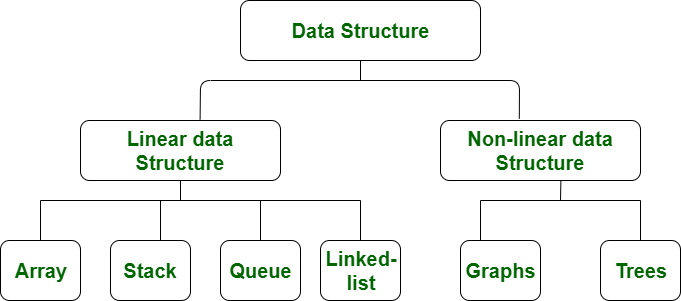
Linear data structures arrange items in a sequence, one after another. Think of a checklist.
- Arrays: An array is a list of items stored in a numbered sequence of slots, like a row of mailboxes. It's simple and fast for accessing an item if you know its position, but can be rigid if you need to add or remove items from the middle.
- Linked Lists: A linked list is a chain of items where each item contains a pointer to the next one. It’s like a scavenger hunt where each clue tells you where to find the next. This makes it very flexible for adding or removing items.
- Stacks: This structure follows a "Last-In, First-Out" (LIFO) principle. Imagine a stack of plates; you add a new plate to the top and also take one from the top. The last plate you put on is the first one you take off.
- Queues: A queue works on a "First-In, First-Out" (FIFO) basis, just like a line at the grocery store. The first person to get in line is the first person to be served.
Non-linear data structures connect items in a more complex way, without a simple sequence.
- Trees: A tree organizes data hierarchically. A family tree is a perfect example, with ancestors branching out to descendants. In programming, trees are used for things like file systems on your computer.
- Graphs: A graph is a network of nodes connected by edges. It's great for modeling relationships, like a social network where people are nodes and friendships are edges, or a map where cities are nodes and roads are edges.
Why It Matters
Choosing the right data structure is a fundamental skill in software development. Using a queue to manage print jobs, a tree to organize a database index, or a graph to power a recommendation engine all lead to more efficient, scalable, and powerful applications.
You'll find data structures at work in nearly every piece of software you use, from the operating system on your phone to the websites you visit. They are the silent, organized foundation that makes modern computing possible.
What is the primary purpose of a data structure?
You are managing a system that processes tasks in the order they are received. The first task that comes in must be the first one completed. Which data structure best models this "First-In, First-Out" (FIFO) behavior?