Foundations of Computer Programming
Computer Logic
Not Magic, Just Instructions
Computers seem incredibly smart. They can calculate complex problems, connect us with people across the globe, and even create art. But here's the secret: a computer isn't smart at all. It's more like an extremely fast and obedient puppy that can only follow very specific commands.
Think about following a cooking recipe. The instructions tell you exactly what to do, step-by-step. "Add 1 cup of flour," "Preheat oven to 350 degrees," "Mix for 3 minutes." If you follow the steps precisely and in the correct order, you get a cake. If you skip a step or do them out of order, you might get a mess. A computer program is just like that recipe. It's a set of instructions, written by a human, that tells the computer exactly what to do.
Input, Process, Output
Every task a computer performs follows a simple, three-part pattern: Input, Process, and Output. This is often called the IPO model and it's the fundamental way all computers work.
| Step | What it is | Example (Calculator App) |
|---|---|---|
| Input | You give the computer some data. | You press the keys: 5, +, 3, = |
| Process | The computer follows its instructions to work on the data. | The calculator's program performs the addition operation on the numbers 5 and 3. |
| Output | The computer gives you back the result. | The screen displays the number 8. |
This simple cycle applies to everything. Writing a document? Your keystrokes are the input, the word processor formats the text (the process), and the words appearing on the screen are the output. Every action, no matter how complex, can be broken down into this basic flow.
Speaking the Computer's Language
If programming is like writing a recipe, you have to write it in a language the chef understands. You can't write instructions for a computer in plain English. We need special, structured languages called programming languages. The code written in these languages is called source code because it's the original source of the instructions.
// This is a simple piece of source code.
// It tells the computer to print "Hello, World!"

function sayHello() {
  print("Hello, World!");
}
But there's a catch. A computer's processor doesn't understand languages like Python or JavaScript directly. It has its own native language, called machine code. It's a series of raw electronic signals that are incredibly fast for a machine to read, but completely unreadable for a human.
So how do we bridge the gap? We use a special program that acts as a translator. This translator is called a compiler or an interpreter. Its only job is to take the human-readable source code and convert it into the machine code the computer's processor can execute.
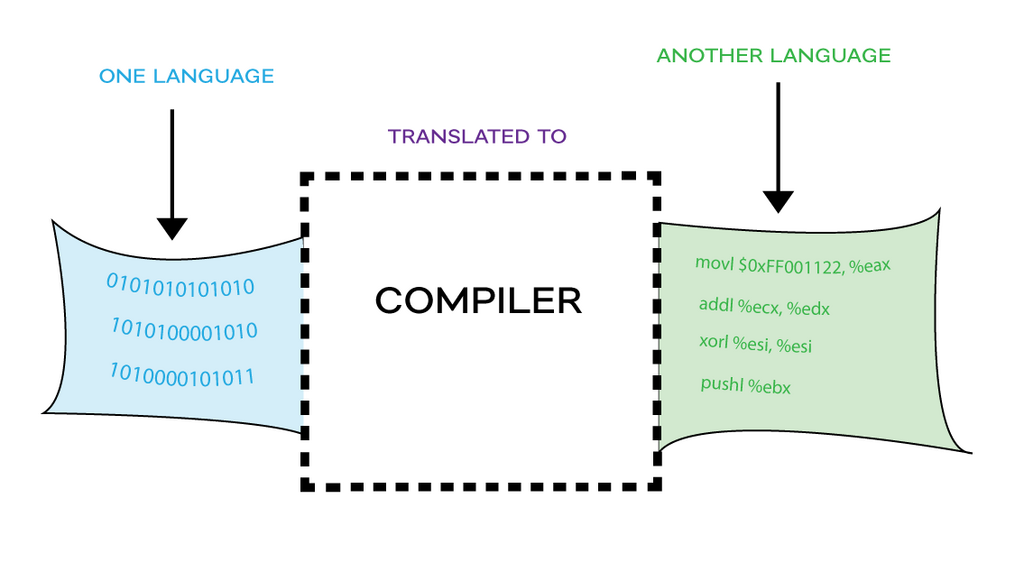
Think of it like a diplomat giving a speech at the United Nations. The diplomat writes their speech in French (source code). An interpreter listens and translates the speech into Japanese (machine code) for another diplomat to understand. Without the translator, there's no communication.
Which statement best describes how a computer operates?
The fundamental three-part cycle that all computer tasks follow is called the ______ model.