Foundations of Computer Networking
Networking Basics
What is a Network?
At its core, a computer network is simply a group of two or more computers connected to share resources and communicate. Think of it like a city's road system. Your house is a computer, your neighbor's house is another, and the roads are the connections that let you visit each other, send mail, and share things.
The main purpose of a network is to make our lives easier. Instead of copying a file to a flash drive and walking it over to another computer, you can send it instantly over the network. A whole office can share a single printer. Most importantly, networks allow for communication, from sending a quick email to having a video call with someone across the globe.
The Building Blocks
Just like a road system needs streets, intersections, and destinations, a computer network needs specific hardware to function. There are three main types of components you'll find in almost any network.
End Device
noun
Any device that connects to a network and is used directly by a person. These are the sources and destinations of network communication.
Next, we have the hardware that directs the flow of traffic within a single, local network.
Switch
noun
A device that connects multiple end devices together on a single computer network. It intelligently forwards data only to the specific device it's intended for.
Finally, we need a way to connect different networks together, like connecting your home network to the internet.
Router
noun
A device that connects two or more separate networks. It acts as a dispatcher, choosing the best path for data to travel between networks.
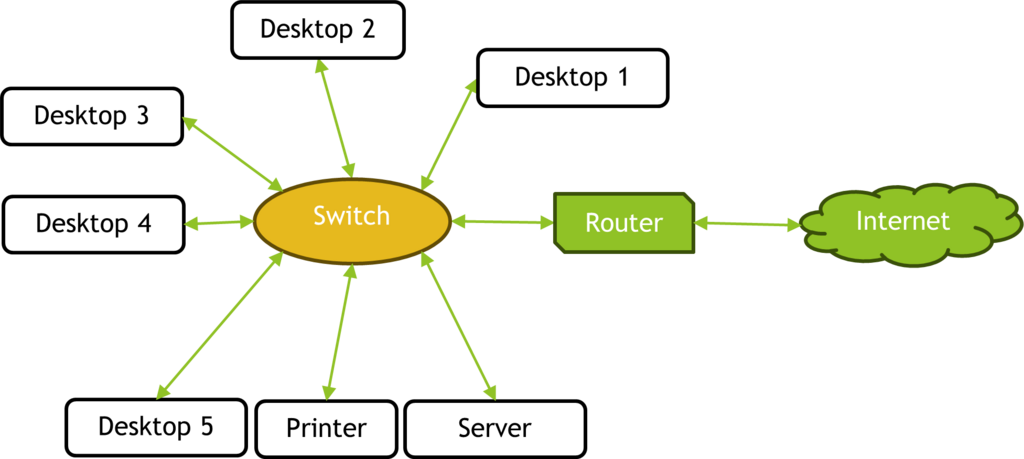
Putting it all together, a typical small network looks something like this:
Networks Big and Small
Networks come in different sizes, depending on the area they cover. The three main types are LAN, MAN, and WAN.
Think of it this way: a LAN is your neighborhood, a MAN is the entire city, and a WAN is the national highway system connecting all the cities.
A Local Area Network (LAN) is the most common type you'll encounter. It covers a small geographical area, like a single home, office building, or school campus. Because they're small, LANs are usually fast and managed by a single person or organization.
A Wide Area Network (WAN) connects networks over a very large area, such as a state, country, or even the entire world. The internet is the ultimate example of a WAN. It's a massive collection of interconnected LANs and other networks. WANs are more complex and are often managed by multiple service providers.
A Metropolitan Area Network (MAN) fits in between. It's a network that spans a physical area larger than a LAN but smaller than a WAN, such as a city. A MAN might connect all the government buildings or school campuses within a city.
| Network Type | Geographic Scope | Common Example |
|---|---|---|
| LAN | Small (Room, Building) | Home Wi-Fi Network |
| MAN | Medium (City, Campus) | A city-wide public internet service |
| WAN | Large (Country, Global) | The Internet |
What is the primary purpose of creating a computer network?
A university connects the networks of all its campuses located across a single city. This is an example of what type of network?
Understanding these basic components and types of networks is the first step in seeing how our digital world is connected.