Foundations of Computer Networking
Network Basics
What Is a Network?
Think of a conversation. For it to happen, you need at least two people, a shared language, and a way for the message to travel between them, like sound waves through the air. A computer network is surprisingly similar. It’s just a group of two or more devices connected together so they can share information and resources.
The core job of any network is simple: move data from point A to point B. Whether you're sending an email or streaming a movie, a network is what makes it happen.
These devices can be computers, phones, printers, servers, or even smart lightbulbs. The connections can be physical, like an Ethernet cable, or wireless, like Wi-Fi. The resources they share could be an internet connection, a file, or access to a printer.
Networks at Different Scales
Networks come in all sizes, depending on the distance they need to cover. We can think of this as a spectrum, from the personal devices around you to the global internet.
Personal Area Network (PAN)
noun
A network for connecting devices within a person's immediate workspace. It's the smallest type of network.
A PAN is all about you and your gadgets. When you connect your Bluetooth headphones to your phone or sync your fitness tracker, you’ve created a PAN. It’s small, simple, and usually wireless, covering just a few feet.
Local Area Network (LAN)
noun
A network that connects devices in a limited area like a home, school, or office building.
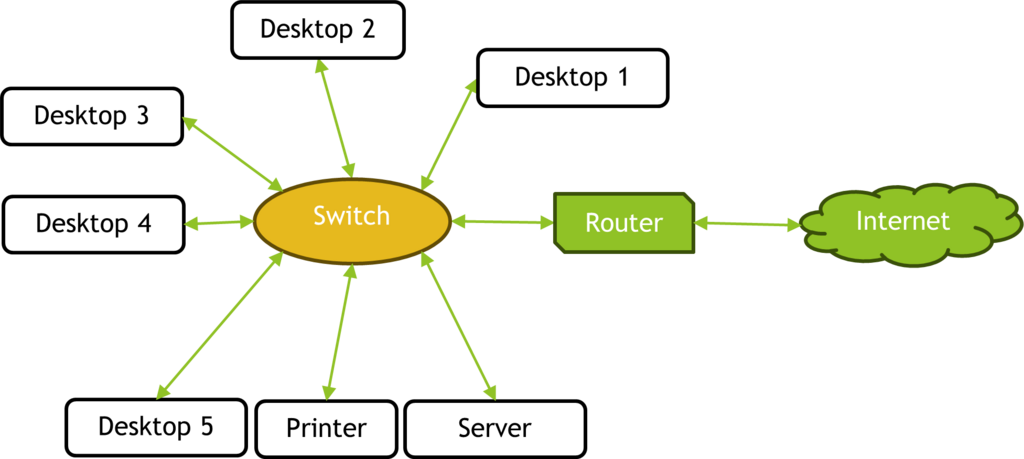
A LAN connects devices in a single location. Your home Wi-Fi is a perfect example. It links your laptop, phone, TV, and maybe a printer, all under one roof. They can easily talk to each other and share a single internet connection. In an office, a LAN connects all the company computers and printers.
Wide Area Network (WAN)
noun
A network that spans a large geographical area, such as a city, country, or even the entire world. It's a network of networks.
A WAN connects multiple LANs over long distances. A large company might have a WAN to connect its office in New York with its office in London. The ultimate WAN is the internet itself, which is a massive, global network connecting millions of LANs from all over the planet.
How Devices Talk to Each Other
On a network, devices don't just chat randomly. They usually follow one of two main communication patterns: the client-server model or the peer-to-peer model.
In the client-server model, one device (the client) requests information or a service, and another more powerful device (the ) provides it. Think of ordering at a restaurant. You (the client) ask the waiter for a burger, and the kitchen (the server) prepares and delivers it. When you visit a website, your web browser is the client requesting a page from the website's server.
In the (P2P) model, devices communicate directly with each other without a central server. Each device, or peer, has equal capabilities. It’s like a phone call between two friends. There's no middleman; the conversation happens directly between them. Some file-sharing services and video chat applications use a P2P model, allowing users to connect directly.
Network Shapes
Just as buildings have different floor plans, networks have different layouts. This arrangement is called . The topology determines how devices are connected and how they communicate with each other. While there are many complex designs, most are built from a few simple shapes.
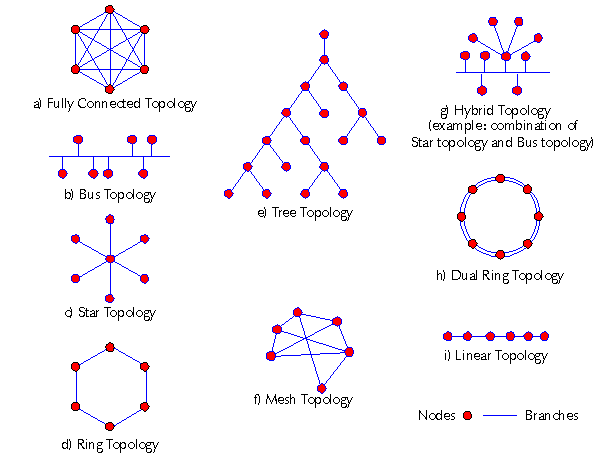
Two of the most common topologies are:
-
Star Topology: All devices are connected to a central hub or switch. It’s like the spokes of a wheel. If one computer's cable fails, the rest of the network is unaffected. This is very common in home and office LANs.
-
Bus Topology: All devices share a single communication line. It's simple and cheap to set up, but if the main cable fails, the entire network goes down. It's an older design that you're less likely to see today.
What is the fundamental definition of a computer network?
Which of the following is the best example of a Wide Area Network (WAN)?
Understanding these basic building blocks—what a network is, its different scales, and its common structures—is the first step into the world of computer networking. Every email, video, and website relies on these fundamental ideas.