Foundations of Communication Systems
Introduction to Communication Systems
Getting the Message Across
At its heart, a communication system has one job: to move information from a source to a destination. Think of a simple conversation. You have a thought you want to share (the information), you speak the words (transmission), the sound waves travel through the air (the channel), and your friend hears and understands you (reception). That entire process is a communication system.
Whether it's a phone call, a text message, or a TV broadcast, the goal is always the same. These systems are the invisible infrastructure that connects our modern world, allowing us to share ideas, data, and experiences over vast distances instantly.
Every communication system, no matter how complex, is built on three fundamental components.
- Transmitter: Takes the original message and converts it into a signal suitable for travel.
- Channel: The medium the signal travels through.
- Receiver: Captures the signal and converts it back into a usable message.
The transmitter's job is to encode the information. For a radio station, the transmitter takes the DJ's voice and music and turns them into radio waves. For your phone, the transmitter converts your voice into an electrical or digital signal.
The channel is the path the signal takes. This could be the air for radio waves, a copper wire for a landline telephone, or a fiber-optic cable for high-speed internet. Every channel faces challenges, like noise and interference, which can distort the signal.
Finally, the receiver's role is to reverse the transmitter's work. It picks up the signal from the channel and decodes it, turning radio waves back into music or digital signals back into the voice of the person you're talking to.
The Language of Signals
Information travels through these systems in the form of signals. A signal is just a physical quantity, like voltage or a radio wave, that varies over time to carry information. There are two main families of signals: analog and digital.
An analog signal is continuous, meaning it can have any value within a range. Think of a dimmer switch on a light; you can set the brightness to any level between off and full. Vinyl records and old broadcast television use analog signals. While they can capture rich detail, they are very sensitive to noise. Any interference in the channel gets mixed in with the signal, degrading the quality.
A digital signal is discrete, meaning it only uses a specific set of values, typically just two: on or off, represented by 1s and 0s. Think of a standard light switch; it's either fully on or fully off. This simplicity makes digital signals incredibly robust. Even if noise interferes with the signal, the receiver can usually still tell a 1 from a 0, resulting in a perfect, error-free copy of the original message. This is why CDs don't get scratchy like records and why your HD stream is so clear.
Putting It All Together
Let's trace a digital message. Your computer (the source) has a file made of 1s and 0s. The transmitter, perhaps a Wi-Fi router, encodes this binary data into radio waves. These waves travel through the air (the channel), where they might get weakened by distance or mixed with signals from other devices (noise).
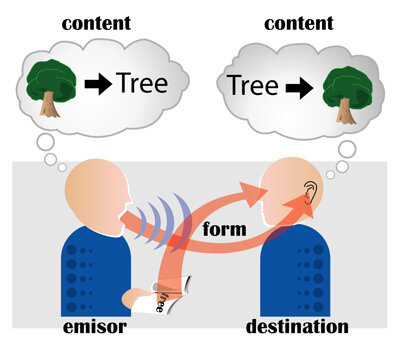
Your laptop (the destination) has a receiver that picks up these radio waves. Its main task is to distinguish the intended 1s and 0s from the background noise. It then reconstructs the original file perfectly. The properties of the signal, like its strength and frequency, and the characteristics of the channel, determine how successfully this process works.
What is the primary function of any communication system?
In a TV broadcast, the air through which the radio waves travel is an example of which component?
Understanding these basic building blocks is the first step to seeing how all modern communication technology works, from a simple walkie-talkie to the global internet.