Foundations of College Chemistry
Atomic Structure
The Building Blocks of Matter
Everything around you, from the air you breathe to the screen you're reading this on, is made of atoms. For a long time, people thought atoms were the smallest possible things, tiny, indivisible spheres. The word atom even comes from the Greek word atomos, which means "uncuttable."
But as we discovered, atoms are made of even smaller pieces called subatomic particles. There are three main types: protons, neutrons, and electrons. Protons and neutrons are packed together in the center of the atom, in a dense region called the nucleus. Electrons, which are much smaller and lighter, zip around the nucleus in a cloud.
Protons have a positive electrical charge, electrons have a negative charge, and neutrons have no charge at all. The number of protons in an atom's nucleus determines what element it is. For example, any atom with exactly one proton is a hydrogen atom. An atom with six protons is always carbon. This crucial number is called the atomic number.
Proton
noun
A subatomic particle with a positive electric charge, found in the nucleus of an atom.
In a neutral atom, the number of electrons is equal to the number of protons, so their positive and negative charges cancel each other out.
Electron
noun
A subatomic particle with a negative electric charge that moves around the nucleus of an atom.
Neutrons don't affect the atom's charge, but they do add mass and play a key role in holding the nucleus together. Protons, being all positively charged, would fly apart if it weren't for a powerful force that involves the neutrons.
Neutron
noun
A subatomic particle with no electric charge, found in the nucleus of an atom.
A Picture in Motion
Our picture of the atom wasn't built in a day. It evolved over centuries as scientists made new discoveries.
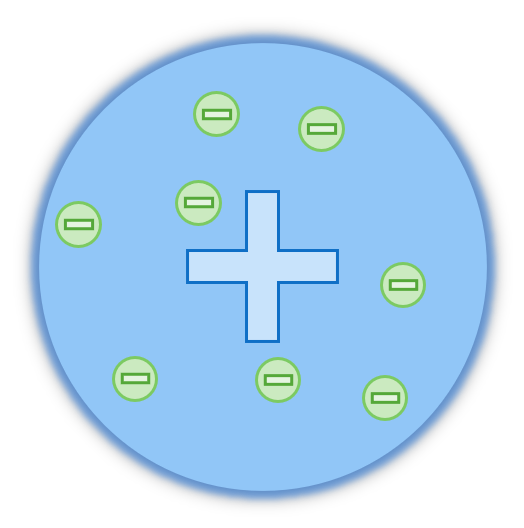
In the early 1800s, John Dalton imagined atoms as simple, solid balls. But in 1897, J.J. Thomson discovered the electron. He proposed a "plum pudding" model, where negative electrons were scattered inside a sphere of positive charge, like raisins in a pudding.
Then came Ernest Rutherford. In his famous gold foil experiment, he shot tiny particles at a very thin sheet of gold. Most particles went straight through, but a few bounced back. This surprising result meant the positive charge wasn't spread out; it was concentrated in a tiny, dense center, which he called the nucleus. The atom was mostly empty space.
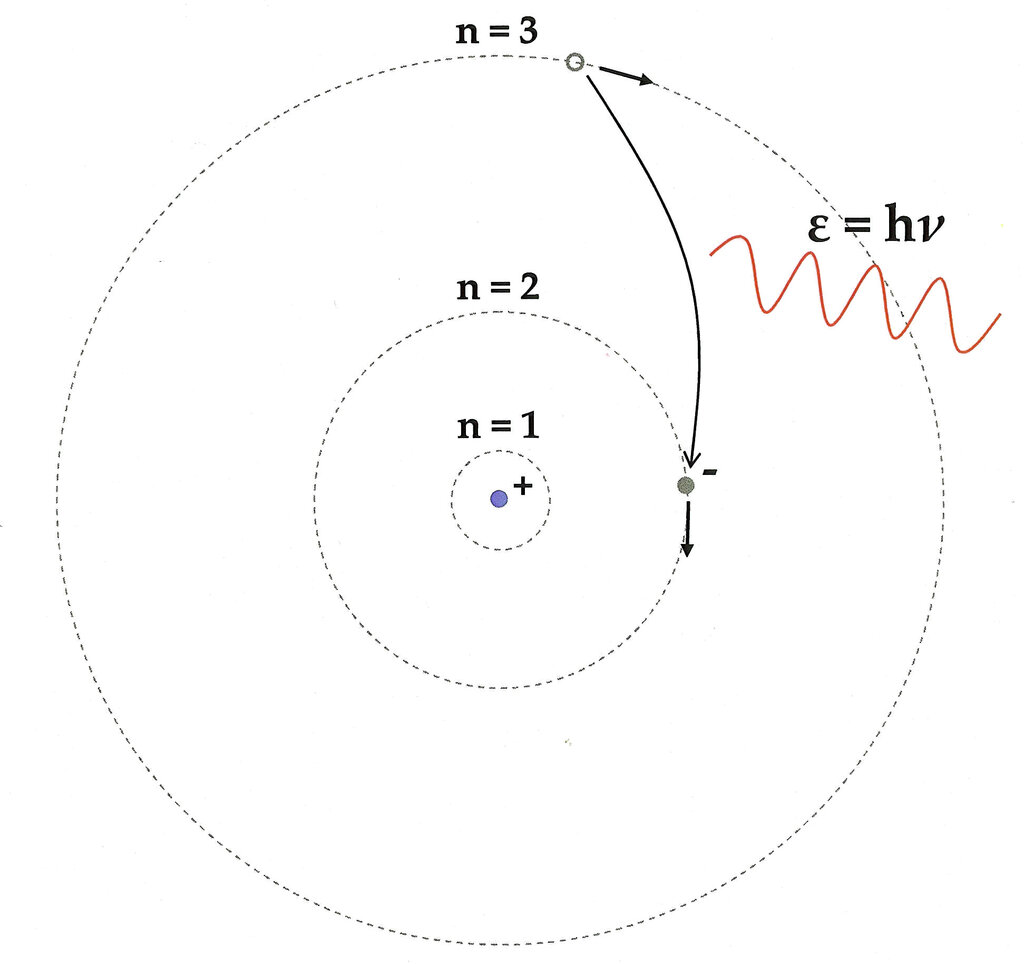
In 1913, Niels Bohr refined this model. He suggested that electrons don't just fly around randomly but travel in specific circular paths, or shells, around the nucleus, like planets orbiting the sun. An electron could jump from a lower-energy shell to a higher one by absorbing energy, or fall to a lower shell by emitting energy as light.
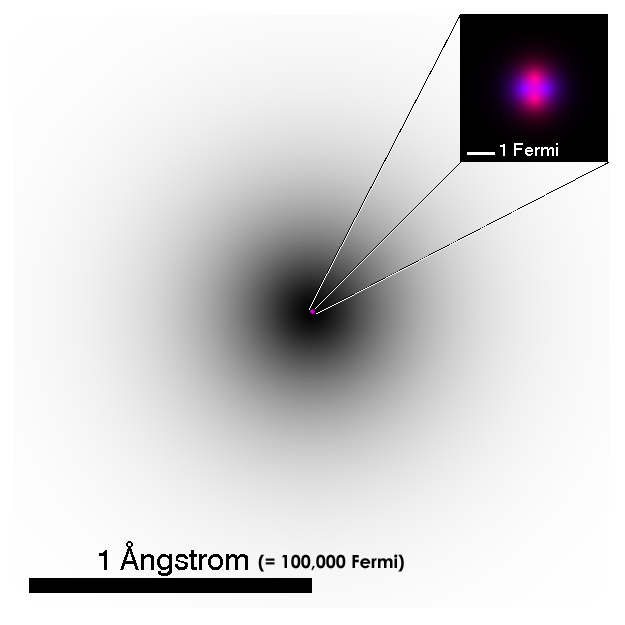
Today, we use the quantum mechanical model. It tells us that we can't know the exact path of an electron. Instead, we can only describe regions where an electron is most likely to be found. These regions are called orbitals, and they create a fuzzy "electron cloud" around the nucleus.
Family Variations
While the number of protons defines an element, the number of neutrons can vary. Atoms of the same element that have different numbers of neutrons are called isotopes.
Because they have the same number of protons and electrons, isotopes of an element behave the same way chemically. But since they have different numbers of neutrons, they have different masses.
For example, all carbon atoms have 6 protons. Most have 6 neutrons (Carbon-12), but some have 7 (Carbon-13) or even 8 (Carbon-14).
Hydrogen is a great example. It has three common isotopes.
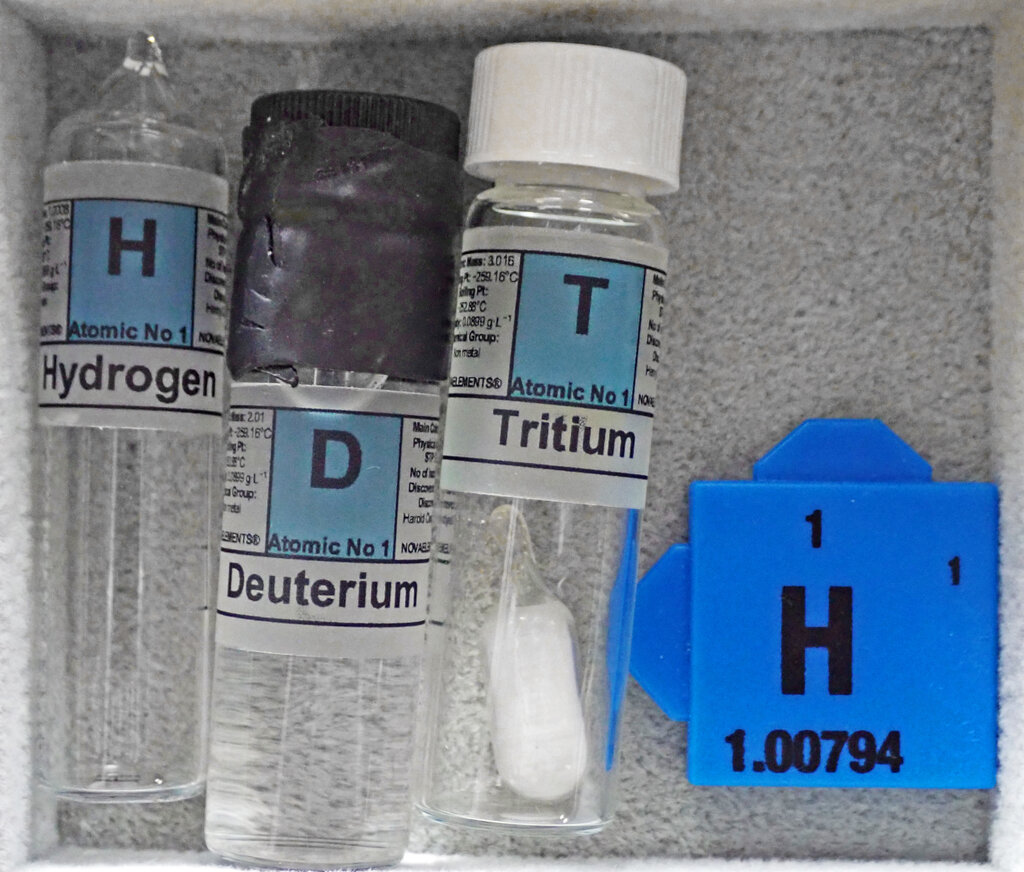
| Isotope Name | Protons | Neutrons | Electrons |
|---|---|---|---|
| Protium (Hydrogen-1) | 1 | 0 | 1 |
| Deuterium (Hydrogen-2) | 1 | 1 | 1 |
| Tritium (Hydrogen-3) | 1 | 2 | 1 |
The atomic mass you see on the periodic table is a weighted average of the masses of an element's naturally occurring isotopes. This is why most atomic masses aren't whole numbers. For example, chlorine's atomic mass is about 35.5, because it exists as a mix of Chlorine-35 (about 75%) and Chlorine-37 (about 25%).
Electron Addresses
Just like people live in cities, states, and countries, electrons live in shells, subshells, and orbitals. This system, called electron configuration, describes how electrons are arranged in an atom and is key to understanding an element's properties.
The main energy levels are called shells, numbered 1, 2, 3, and so on, starting from the one closest to the nucleus. Shell 1 has the lowest energy, and it can hold a maximum of 2 electrons. Shell 2 can hold up to 8 electrons, and shell 3 can hold up to 18.
Each shell is divided into one or more subshells, which are given letters: s, p, d, and f. These subshells contain the orbitals, which are the regions where electrons are most likely to be found. An s subshell has one spherical orbital. A p subshell has three dumbbell-shaped orbitals. The d and f subshells are even more complex.
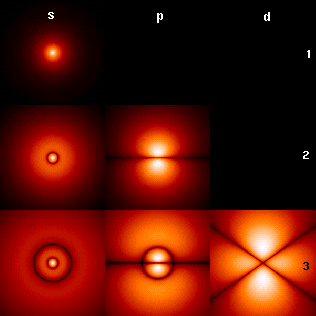
Each orbital can hold a maximum of two electrons. Electrons fill the lowest energy orbitals first, starting with the 1s orbital in the first shell, then the 2s and 2p orbitals in the second shell, and so on.
Let's look at a nitrogen atom. It has 7 protons and, in its neutral state, 7 electrons. Here's how they're arranged:
- The first two electrons go into the 1s orbital.
- The next two go into the 2s orbital.
- The remaining three electrons go into the three 2p orbitals.
We write this electron configuration as $1s^22s^22p^3$. The superscripts show the number of electrons in each subshell.
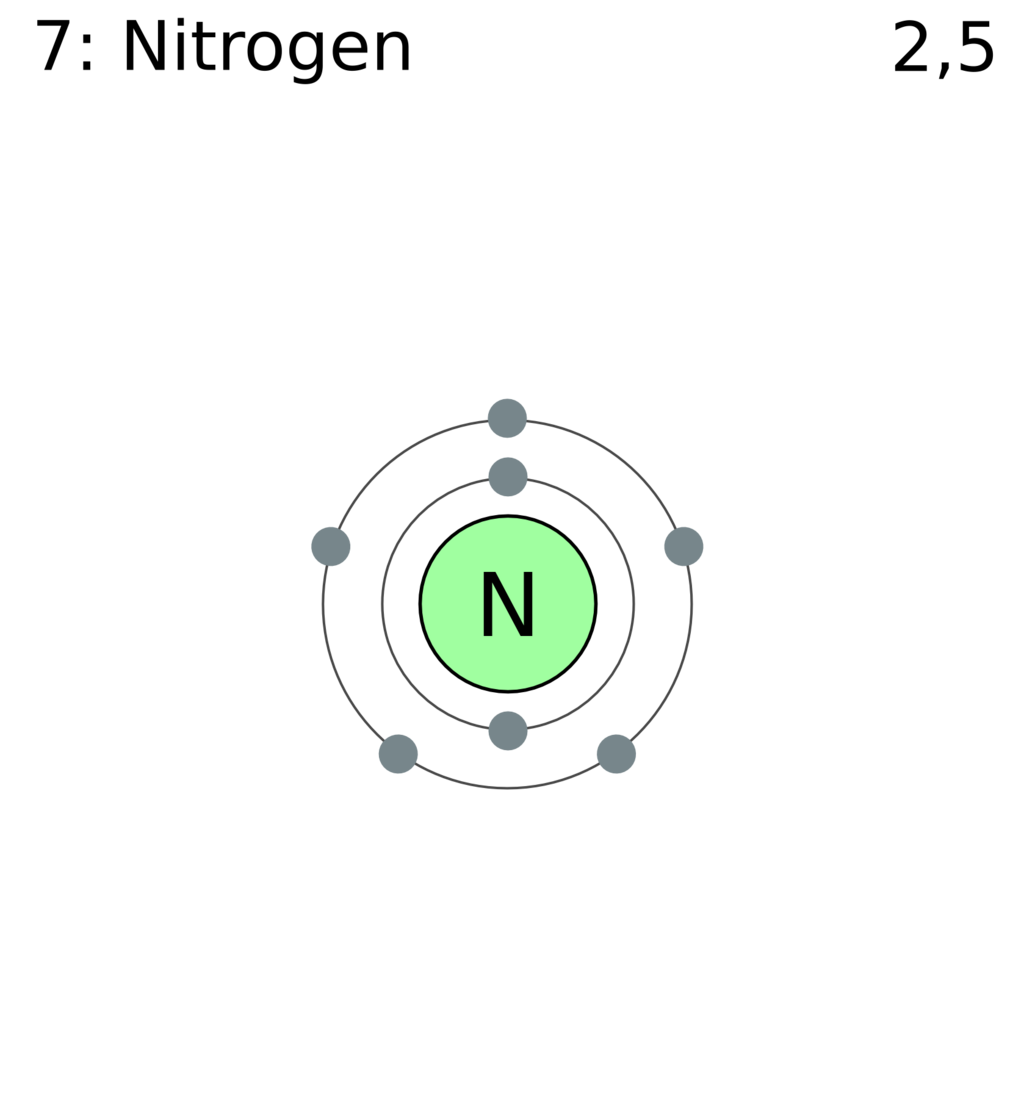
This orderly arrangement of electrons is what governs how atoms interact with one another, forming the basis for all of chemistry.
Ready to check your understanding?
What are the electrical charges of a proton, a neutron, and an electron, respectively?
Ernest Rutherford's gold foil experiment, where some particles bounced back from the foil, led to what major discovery?
Understanding the atom's structure is the first step toward understanding the behavior of all matter.